

Theory
Keeping it casual: conversations, not meetings
When your calendar fills up with hour-long “interviews” that make people perform: how to switch to informal customer interviews, spot formality, match the length to the goal, say little about the idea and learn in five-minute chats.
~11 min read · 12 exercises · 250 points
Before you start
A full calendar
CatChow's subscription needs more evidence, so Sofia has filled her calendar: twelve hour-long interviews over two weeks, each with an invite and a short intro deck. Only five people have accepted so far, and each slot costs her about three hours.
In this lesson you'll see what turning every conversation into a formal meeting does to people's answers, how to match the length of a chat to what you need, and how much you can learn in five informal minutes.
The meetings anti-pattern
Sofia booked twelve customer interviews for two weeks: an hour each, a calendar invite, a short intro deck. Only five accepted. Then she counted what one really costs: about an hour of emails and rescheduling, half an hour of prep, the hour-long call and half an hour of notes. Three hours each, so 12 × 3 = 36 hours, almost a working week. The questions she actually needs answered take about five minutes each.
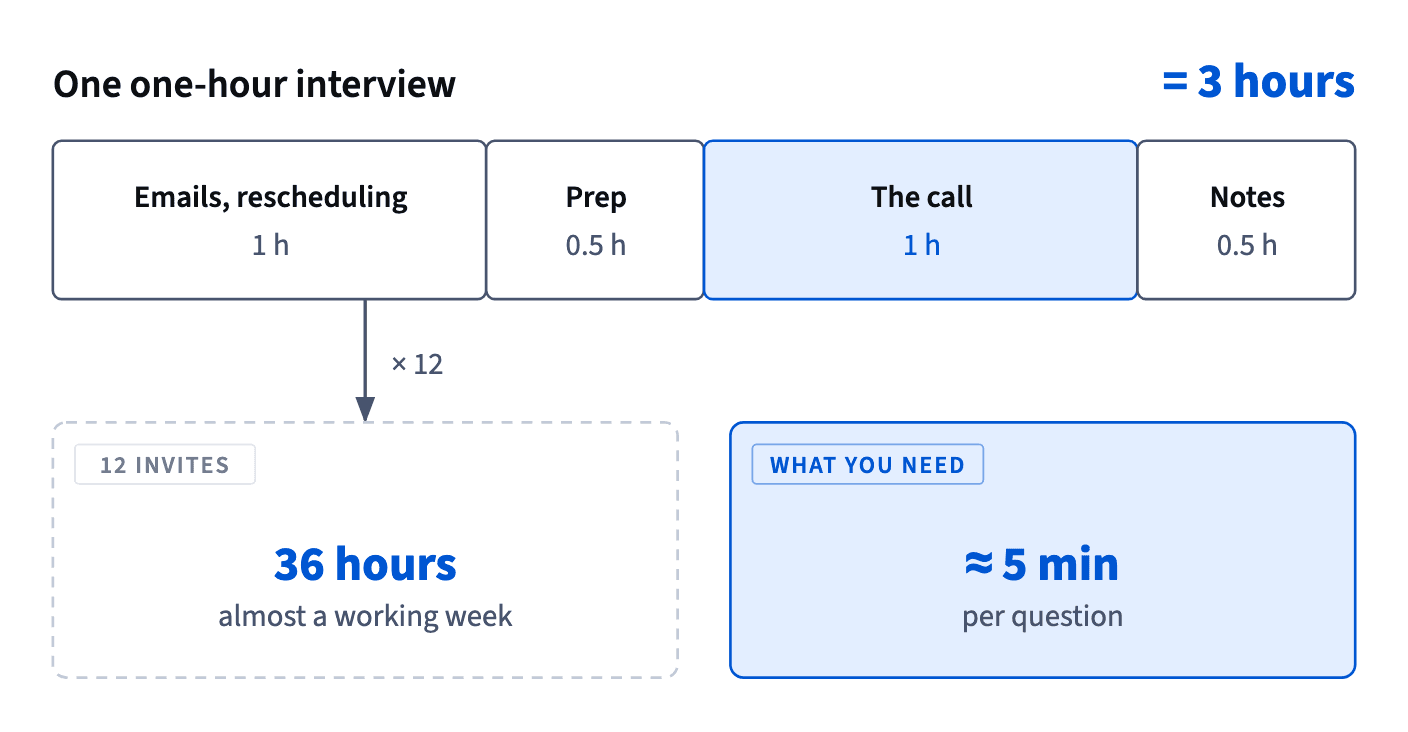
Turning every chance to talk into a calendar slot is the meetings anti-pattern. Beyond the hours, it does two more kinds of damage. A formal meeting makes people expect a product demo and give careful, polished answers. And while you're busy booking slots, you skip the conversations that happen on their own.
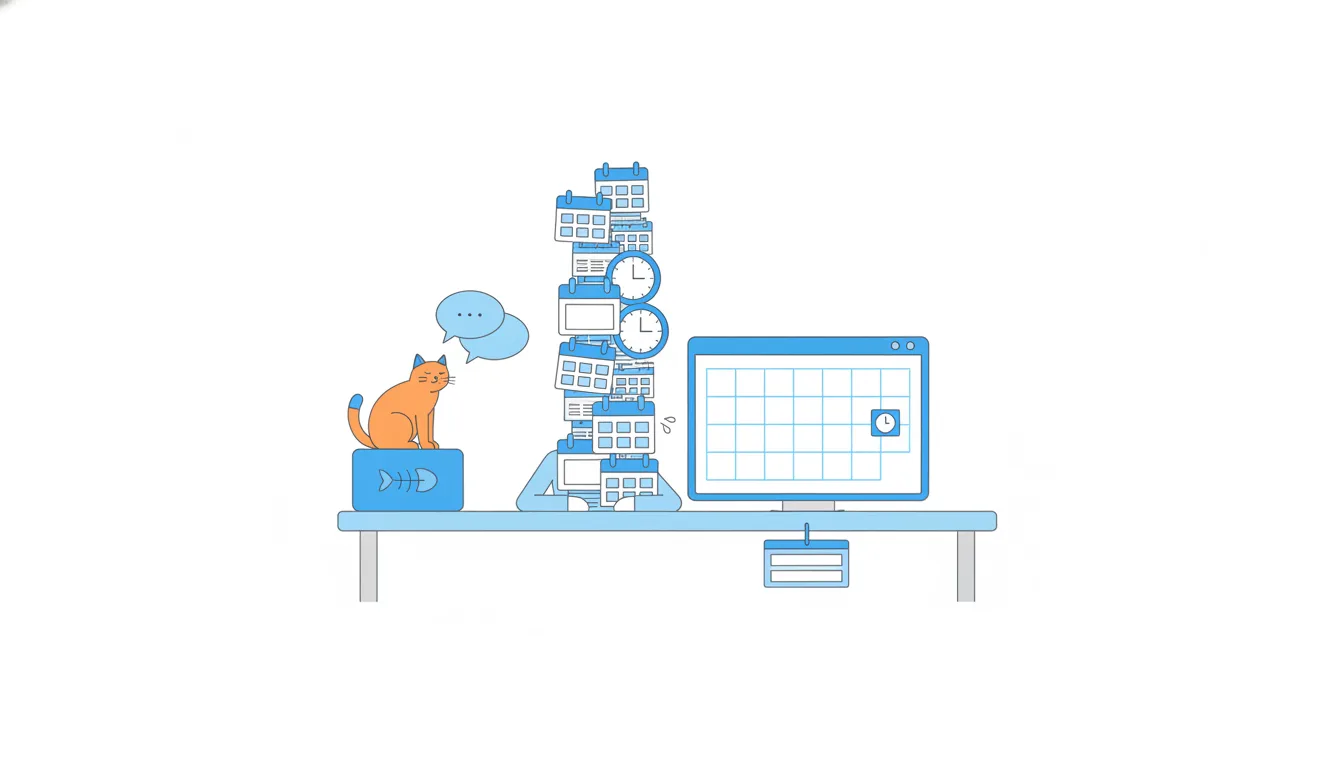
Before sending an invite, ask whether a short chat would teach you the same. Keep the one or two meetings where a longer talk really makes sense, and replace the rest with chats where your customers already are.
- Don'tTwelve one-hour invites with a deck: about 36 hours of work.
Each scheduled hour carries about two more around it.
- DoA dozen five-minute chats at the pet expo, one or two big questions each.
The same questions answered in a fraction of the time.
What casual looks like
Keeping it casual means learning through ordinary conversations instead of formal interviews: no invite, no “interview”, no deck. On Saturday Sofia bumped into Olivia at a pet-shop checkout. Olivia was buying two bags of food, so Sofia said hi and asked about it. The answer: last month the shop had none of Whiskers's food for a whole week, he refused everything else, so now she always buys a spare.

Four minutes by the till gave Sofia more than their hour-long scheduled call: a real recent event, what it cost, and a new habit built around it.
A chat like that fully counts as a customer conversation. It's built on past specifics, which is exactly what you're after. And because Olivia wasn't performing for an interview, she was simply telling a friend about her month, the informal setting made the answers more honest, not less. Unplanned doesn't mean unimportant; it often means unpolished, which is what you want.
- Do“Two bags today? Is that new?”
A curious question about something happening right now.
- Don't“Could we book an hour next week for a proper interview?”
Turns a natural moment into a meeting with a performance.
Symptoms of formality
You can hear when a conversation has become too formal. Sofia opened her scheduled call with: “Thank you for agreeing to this interview. It'll take about an hour. First, on a scale of 1 to 5, how satisfied are you with CatChow?” Olivia answered: “Oh, a proper interview! Um… a four, I suppose? I hope my answers will be useful to you.”

That last line is the giveaway. Olivia is performing: she feels she's doing Sofia a favour. If it feels like a favour, it's too formal.
The causes are usually on your side:
- thanking them for the “interview”;
- promising to take “just a few minutes of your time”;
- rating scales from 1 to 5, questionnaires and forms;
- slide decks and a clipboard.
Each one signals a test, so people try to give good answers instead of true ones. A curious, casual question about something real does the opposite, and a customer who starts with “Ha, don't get me started…” is about to give you the real story.
- Don't“Thank you for agreeing to this interview. On a scale of 1 to 5…”
Two symptoms in one line: the word “interview” and a rating scale.
- Don'tCustomer: “I hope my answers are useful to you.”
She feels she's doing you a favour, so she's performing.
- DoCustomer: “Ha, don't get me started on that shop…”
Relaxed and about to tell a real story.
Match the length to the goal
Casual doesn't mean every conversation should be short. There's no single right length; it depends on what you need to learn.
- Whether a problem exists and matters: about five minutes, casually. One or two questions by a till or at a stand will do.
- How they handle it now and what they've tried: ten to fifteen minutes, still informal.
- How a whole industry works, say how pet food gets from factory to shelf: an hour or more with an expert. Here a longer, planned conversation makes sense.
- Showing something concrete, like a prototype or pre-order terms: a scheduled meeting of about thirty minutes that ends with agreed next steps.
The rule behind the list: a formal slot is worth it only once you have something to show or to ask for. Before that, the calendar invite costs more than it gives, both in hours and in how carefully people start choosing their words.
- DoFive minutes at the checkout to check whether running out of food matters to her.
A small question, a small conversation.
- Don'tAn hour-long scheduled call just to learn whether the problem exists.
Far more time and formality than the goal needs.
Say little about the idea
In a casual chat people sometimes ask why you're so curious. Tell the truth, briefly: “I work at CatChow, we're trying to understand how people buy cat food.” Then turn straight back to them. No subscription, no deck. That isn't hiding anything: it's true, it's just not a pitch.
Give away as little about the idea as you can while still steering somewhere useful. The idea can come at the end, if it comes at all. The moment you describe it, people stop telling you about their life and start reacting to your plan.
So when a chat turns up something real, your next line settles whether you keep learning or start selling. Olivia has just said the shop had no food for Whiskers for a week. Follow her story: what did she do in the meantime, and what did it cost her? A pitch, a request to book a “proper” interview or a rating scale all pull the chat away from her real experience.
- Do“A whole week? What did you do in the meantime?”
Follows her story into what happened and what it cost.
- Don't“Funny you mention it: we're launching a subscription that fixes exactly that!”
From here on she reacts to your idea instead of telling her story.
- Do“I work at CatChow, we're trying to understand how people buy food.”
Honest about who you are, quiet about the idea.
Asking for time without the ceremony
Some people you can't just bump into. Victor runs pet-food buying for a chain of twenty shops, so Sofia has to ask for his time. Her first draft: “Dear Mr Miller, CatChow invites you to take part in a 60-minute research interview about our new subscription service. Please choose a slot below.”
Every phrase in it pushes the wrong way:
- 60 minutes is a big ask of someone that busy, and it promises a long, formal session;
- “research interview” and “take part” turn the chat into a test he must perform in;
- the subscription in the first line means every answer he gives will be about your idea, not about how his shops buy food.
What's fine stays: greeting him by name is ordinary politeness, and saying the message comes from CatChow is honest and expected. The problem isn't naming the company, it's leading with the product. Strip the ceremony, keep the honesty, and ask the way you'd ask a colleague, not the way a research institute would.
- Don't“…invites you to take part in a 60-minute research interview about our new subscription service.”
Long, formal, and it leads with the idea.
- DoKeep: “Hi Victor, I'm Sofia from CatChow.”
Naming yourself and the company is honest, not formal.
A small, honest ask
Once the ceremony is gone, a good request for time is short and built from four parts:
- Who you are, honestly: your name and that you work at CatChow.
- Why them: something you've noticed about their world that they'd care about, such as how shops have struggled to keep certain foods in stock.
- A small ask: about fifteen minutes, on one topic, at a time that suits them.
- No product: nothing about the subscription. You're asking about their experience, not for feedback on your idea.
Written that way, the message reads like a note from a curious colleague. It's easy to say yes to, because it costs little and is about a subject the person knows better than anyone. And it sets up a conversation rather than a test, so the answers you get are about what really happens in their shops. If the idea comes up at all, it can wait until the end of the call.
- Do“Hi Victor, I'm Sofia from CatChow. We've noticed shops struggling to keep some foods in stock. Could I ask you about it for 15 minutes this week?”
Honest, specific and small.
- Don't“Please choose a slot for a one-hour session about our new subscription.”
Big, formal and about the idea, not about him.
Casual inside the company
The sales managers in the team of Megan, CatChow's head of sales, groan when the product team asks for a “stakeholder interview”: last time it meant an hour of slides and a survey. That's typical. Colleagues and existing customers are the easiest people to talk to casually, yet they're the ones we formalise most.
There are lighter ways in:
- join the sales team's Monday stand-up for five minutes and ask one question;
- sit with support agents for an hour, listen to real customer calls and ask a follow-up in between;
- ask one of your three big questions when a customer phones about a late delivery anyway.
Each of these puts you next to customers' own words, unfiltered, without taking anyone's afternoon. A 20-question survey to all agents takes everyone's time and leaves no room for follow-ups. A report written by the head of support gives you someone else's summary instead of real examples. And as Megan put it, five minutes at the stand-up is something the team will actually welcome.
- DoSit with support for an hour and ask one question between calls.
Customers' own words, no slides, no survey.
- Don'tA 60-minute “stakeholder interview” with slides for the head of support.
The formal ritual that makes colleagues groan and perform.
Notes from chance meetings
Events like a pet expo are perfect for casual chats: hundreds of the right people in one hall. Leave forms, tablets and clipboards behind, because they turn a chat into a survey. Keep your three big questions on your phone and aim for one or two per chat.
To start a chat with a stranger, ride on something already happening: what they're holding, what they've just asked the seller. A woman picking up a big bag of prescription diet food is an easy opening, and a gentle follow-up through her story leads straight to your big question about special-diet owners.
Write your notes right after each chat, not during it and not at the end of the day. Minutes later you still remember the exact words, and exact words are what you'll need when the team asks what people really said. By evening, a dozen chats blur into one. A dozen five-minute chats noted this way can teach more than a week of formal interviews.
- Do“That's a big bag of the vet food. Is it hard to find?” Then notes right after the chat.
Rides on what's happening and keeps the exact words.
- Don'tA feedback form on a tablet at the stand.
Collects opinions and leaves no room for stories.
Ready to practise?
Answer the lesson's exercises and earn 250 points the first time you finish it.
Start the exercises