

Theory
Why you and not a notebook? A positioning statement
What customers really compare you with, what only you do, what it's worth in their money, and how to say it in one line in their words: a positioning statement. Ends with the module case.
~10 min read · 10 exercises · 250 points
Before you start
“My notebook is free”
Oscar is back from a GarageDesk sales trip with an objection he couldn't answer. At a parts counter in another city, a shop owner laughed: why pay every month, when his notebook is free?
This case closes the module. You'll find out what shops really compare GarageDesk with, what only it does, what that is worth in the shop's money, and how to say it in one line, in customers' own words.
Your real competitors are the alternatives
A competitive alternative is whatever customers would use if your product didn't exist. For a small product it is rarely another app that looks like yours.
Ask in calls what people do today, and write down every answer. For an independent repair shop that wants regulars back, GarageDesk's list is:
- a paper notebook plus Viber messages typed by hand;
- a relative paid to call regulars, as Dennis, a shop owner, once paid his niece to do;
- a general CRM;
- the expensive systems dealerships use;
- doing nothing: hoping regulars remember on their own.
Doing nothing is often the biggest alternative of all. Owners who choose it never see the regulars who quietly went to the shop across the street, so they don't feel a problem to solve.
Starting from this list changes everything that follows. If you compare yourself only with similar software, you prepare answers to questions few customers ask, while the owner at the parts counter is weighing you against a free notebook. Positioning begins with what customers actually do, not with a list of apps.
- Do“What do you do today so regulars come back for their next service?”
- Don't“Our competitors are the three other reminder apps on the market.”
Misses the notebook, the relative and doing nothing, which most shops actually choose.
Free to buy, expensive to use
Every alternative has a price, and it is rarely the one on the label. Price each one honestly, in money and in time, mistakes and lost customers.
- Notebook and Viber by hand: costs nothing to buy. But someone spends about five hours a month typing messages, and half the regulars still get forgotten until they go elsewhere.
- A relative paid to call regulars: Dennis, a shop owner who now uses GarageDesk, paid his niece 4,000 UAH a month for the same job, and she has days off.
- A general CRM: cheap, but built for businesses that sell goods. No reminders by mileage, and someone has to set it all up.
- A dealership system: several times the price, weeks to set up, built for a showroom rather than a four-bay garage.
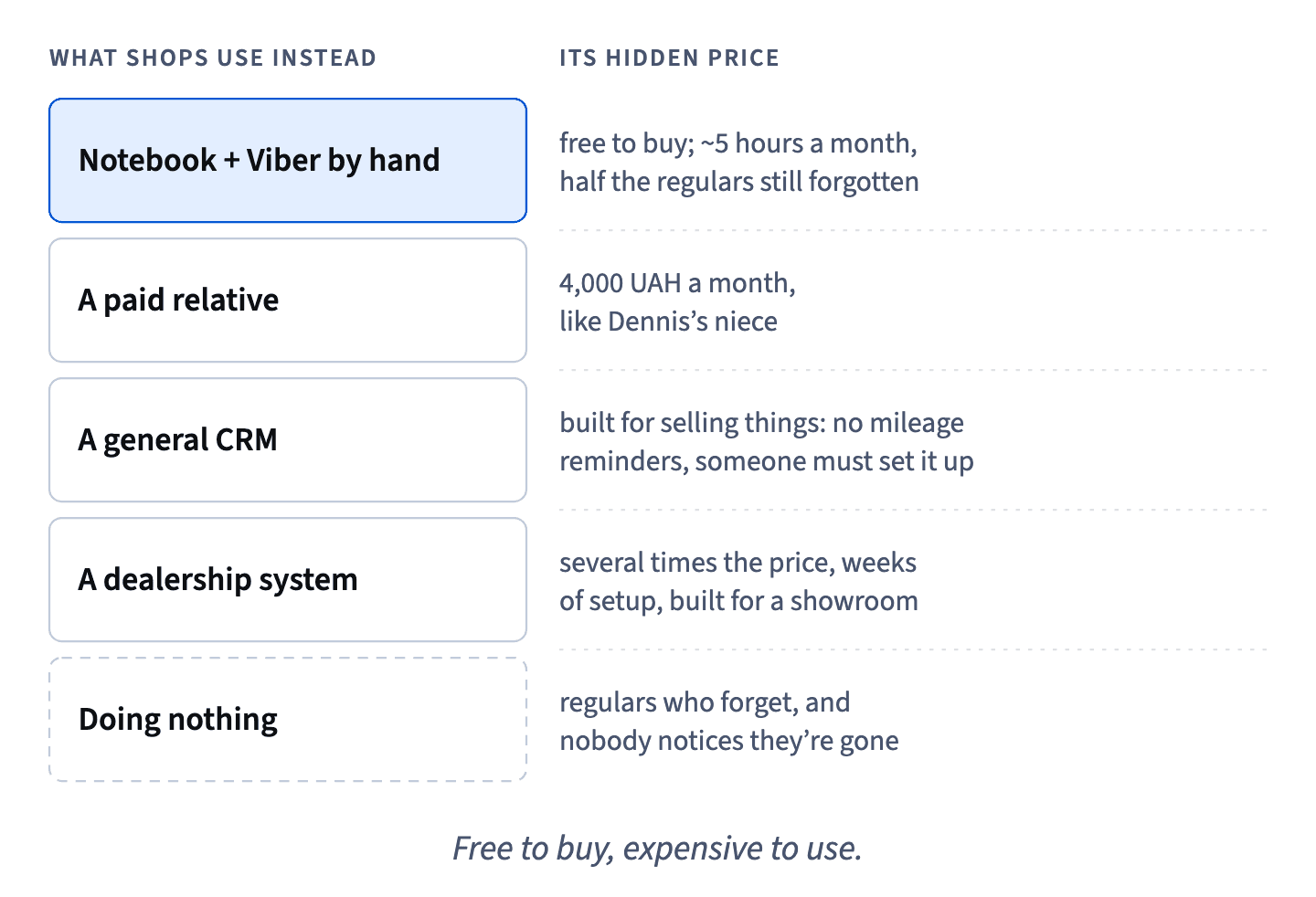
The useful sentence is: free to buy, expensive to use. The biggest hidden cost of the notebook isn't paper or time; it is the regulars who were never reminded and quietly went to the shop across the street.
Once you see each alternative's real price, you know what to compare against, and your own price stops looking like the only cost in the room.
- Do“The notebook costs nothing, but forgotten regulars cost you their next service.”
- Don't“The notebook costs a few hundred hryvnias a year in paper and pens.”
Prices the label, not the regulars who never came back.
Each alternative loses on its own point
One generic claim, “we're better”, answers none of the alternatives. Each loses to you on a different point, so each needs its own short comparison.
- Against the notebook and Viber by hand: reminders go out on their own, on time, and nobody gets forgotten.
- Against a paid relative: a fraction of the cost, and it never takes a day off.
- Against a general CRM: reminders by date and mileage, built for repeat car service.
- Against a dealership system: sized and priced for a 2–8 bay shop, running in two days.
Notice the pattern: each line names what only you do compared with that one alternative, in a way the customer can check. “Reminders by mileage” is checkable; “smarter” is not.
These lines are what sales calls are made of. When an owner says “I already use a CRM”, Oscar doesn't need a speech, just the one difference that matters against that choice. Write the lines down and keep them next to the phone.
- Do“A general CRM doesn't remind by mileage. GarageDesk does, and it's built for repeat car service.”
- Don't“GarageDesk is simply better than all of them.”
Answers no alternative and can't be checked.
Positioning in the customer's words
Positioning is how customers place a product in their heads: next to which alternatives, for whom, and why it is better for them. It lives in their words, so take your words from your calls, not from other software sites.
GarageDesk's old headline was “A CRM with automated multichannel customer notifications”. No owner has ever said that sentence. Owners say “regulars”, “he forgot his oil change”, “went to the shop across the street”.
A good top line:
- names the result the customer wants, in their words: regulars come back for their next service;
- says briefly how it happens: reminders by date and mileage, under the shop's own name;
- makes clear who it's for.
Lead with what the customer gets first. Repair history per car and other features help keep regulars later; they belong lower on the page.
Avoid two traps: jargon (“multichannel notifications”) and empty superlatives (“the most innovative software”). And don't compare yourself with an alternative most of your customers never considered, such as a dealership system for a small garage.
- Do“Your regulars come back for their next service on their own: reminders by date and mileage, under your shop's name.”
- Don't“A CRM with automated multichannel customer notifications.”
Jargon no owner uses.
Name a category customers already know
A positioning statement needs a category: the shelf in the customer's head where your product goes. The category tells people in two words what kind of thing this is, so they know what to compare it with and roughly what to expect.
Pick a category customers already understand: “service reminders for repair shops”, “online booking”, “client reminders for accountants”. Then the rest of the line can spend its words on the difference.
The tempting mistake is inventing a new category to sound unique: “the first Regular Return Engine”. Nobody searches for it, nobody knows what it does, and every visitor first has to decode the name before they can care. A small team with no ad budget can't afford to educate a market about a new word.
Being different belongs in the second half of the line, not in the category name: a familiar shelf, plus the one thing only you do on it. “Service reminders for repair shops, by date and mileage, under your shop's name” is instantly clear and still says what the notebook and the general CRM can't do.
- Do“Service reminders for repair shops, by date and mileage.”
- Don't“GarageDesk, the first Regular Return Engine.”
A new word every visitor has to decode first.
Four steps to a one-line positioning statement
Positioning can be done as a short, repeatable method. Each step depends on the one before it.
- List the alternatives: what customers would use if your product didn't exist, doing nothing included.
- Find what only you do compared with each alternative. You can't say what's unique before you know what you're compared with.
- Translate it into value in the customer's money or time. “Reminders by mileage” becomes “regulars come back”, and a returned oil change leaves the shop about 700 UAH.
- Name a familiar category and say it in one line in the customer's words. That line is your positioning statement.
Then a fifth habit: revisit it when the market or the product changes.
The common mistake is starting at step 4: brainstorming slogans before anyone has listed the alternatives. The result sounds good in the office and means nothing at the parts counter. The one line comes last because it is a summary of the first three steps, not a replacement for them.
- DoAlternatives → what only we do → value in their money → one line.
- Don'tAn hour of slogan brainstorming before anyone has asked customers what they use now.
Starts at the last step.
Positioning goes stale
A positioning statement is true for a market at a moment. The product may stay the same while everything around it moves:
- a new competitor appears, for example a cheap reminder add-on inside a popular CRM;
- a new law changes what shops may send to car owners or how they must store phone numbers;
- a new kind of customer arrives: shops in another city, a franchise, a different type of business;
- the alternatives shift: if most owners move from notebooks to a general CRM, the line written against the notebook stops answering their real objection.
So repeat the four steps whenever something like this changes, and at least on a regular rhythm, for example once a quarter. Ask new customers what they used before, check whether the same alternatives still come up in sales calls, and read the objections Oscar hears at the parts counter.
The opposite habit is common: a product changes every month, while the website headline written at launch stays untouched for years. When objections in sales start sounding new, treat that as the signal to rewrite the line.
- DoEvery quarter: “What did you use before GarageDesk?” asked of new shops, and the headline checked against the answers.
- Don't“We wrote the headline at launch; the product hasn't changed, so it's still right.”
The market moves even when the product doesn't.
Answering “it's free” in the customer's money
Against a free alternative you never win on price. You win by showing its hidden cost and your value in the customer's own money.
Start by agreeing: the notebook really is free. Arguing makes the owner defend his choice. Then switch to his numbers. A regular who comes back for an oil change leaves the shop about 700 UAH of margin. GarageDesk costs 750 UAH a month. How many returned cars cover it?
cars needed = monthly price / margin per returned car, rounded up
750 / 700 = 1.07 → 2 cars a month.
One car isn't quite enough (700 < 750); two leave 1,400 UAH, well above the price. A shop with a few dozen regulars due for service each month needs only two of them to come back because of a reminder.
Say it in the owner's words: “Two regulars back for an oil change a month, and GarageDesk has paid for itself.” Then add what the notebook can't do: reminders go out on time, under the shop's own name, without anyone sitting down to write them.
- Do750 / 700 = 1.07 → 2 returned cars a month cover GarageDesk.
- Don't750 / 700 ≈ 1, so one returned car pays for it.
700 is 50 UAH short of 750: round up.
- Don't“Our software is far more advanced than a notebook.”
Argues with the owner instead of counting in his money.
Ready to practise?
Answer the lesson's exercises and earn 250 points the first time you finish it.
Start the exercises