

Theory
How to sell a business: the deal
How to sell a business, step by step: the letter of intent, checking the buyer, six weeks of due diligence and an earn-out, on GarageDesk's sale. Ends with the final case of the course.
~10 min read · 10 exercises · 250 points
Before you start
The deal
One more advising session at GarageDesk, maybe the most important one. Axle Group, the Kyiv software company that wants to buy GarageDesk, has sent a two-page letter of intent with the price, payments and dates, and Nina wants to sign it tonight.
This final case closes the course. You'll go through the sale step by step: what the letter really commits the founders to, how to check the buyer, what weeks of scrutiny from the buyer's side look like, and how to judge payments that depend on future results.
The letter of intent is when the lawyer comes in
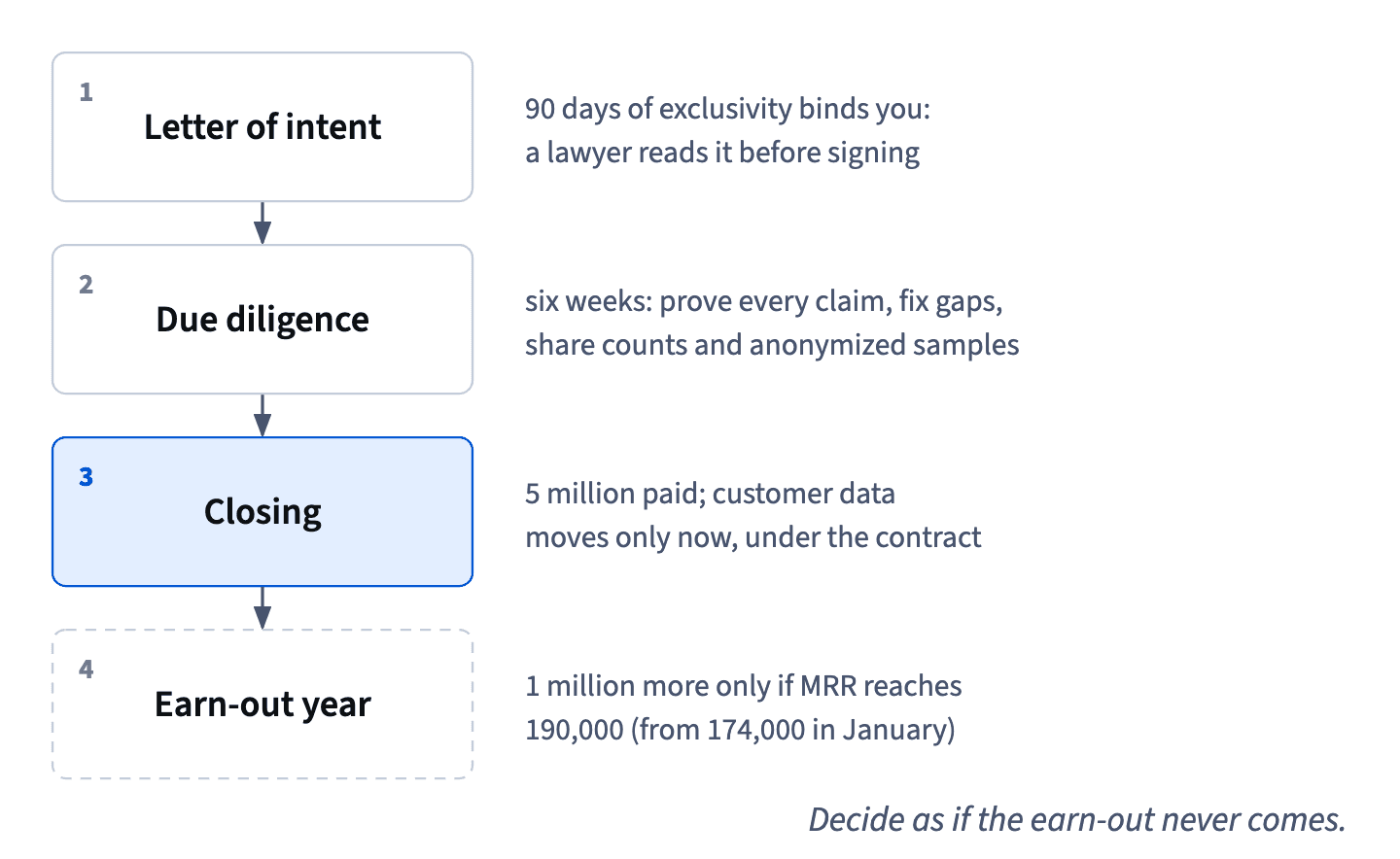
A letter of intent (LOI) is a short, mostly non-binding document in which a buyer sets out the main terms of a planned acquisition before the full checks: price, payment structure, timeline. Axle's is two pages: price, payments, dates.
“Mostly non-binding” makes it tempting to sign quickly. Don't. The LOI fixes the frame for everything that follows. Once it is signed, renegotiating the price or the structure is much harder, and the founders are now inside a sale process with a timetable set by the buyer.
That makes the LOI the right moment to bring in a lawyer:
- not earlier: paying a lawyer for every curious call from an interested buyer would be expensive and pointless;
- not later: after closing it is too late to change anything, and a small deal is still the founders' life's work;
- at the LOI: the buyer has lawyers; the founders need one who has read deals like this before.
GarageDesk's choice is Laura, who drafted contracts for the distributor where Nina used to work. She reads the LOI before anyone signs.
- Do“Laura reads the LOI this week; we sign after her comments.”
- Don't“It's mostly non-binding, so let's sign tonight and get a lawyer later.”
The LOI sets the frame; later is too late.
The clauses in an LOI that do bind
Even a “non-binding” letter of intent usually contains a few clauses that do bind the seller. Read those before anything else.
- Exclusivity (a no-shop clause): for a set period the seller may not talk to other buyers while this one runs due diligence and prepares the final contract. Axle's letter asks for ninety days.
- Confidentiality: neither side may disclose the talks or the information exchanged.

Exclusivity costs the seller a lot. For three months the founders can't test their price against anyone else, and if the buyer drags things out or lowers the price at the end, the alternatives have gone cold. A business that keeps running well during those months is the founders' main leverage.
So negotiate it like a price term: a shorter period that matches the real work (six weeks of checks need less than ninety days), a clear end date, and the right to walk away if the buyer changes the main terms.
The general rule: never treat a document as harmless because its title says “intent”. Read each clause for what it stops you from doing.
- Do“We accept exclusivity for 45 days, ending on a fixed date, and it lapses if the price changes.”
- Don't“Ninety days of exclusivity is just a formality.”
It binds: no other buyer for three months.
Check the buyer, and get promises in writing
Due diligence runs in both directions. The buyer will check the founders for six weeks; the founders should check the buyer too, especially a strategic one that will change the product.
Two practical checks:
- Look at what the buyer did before. Oscar called the founders of two companies Axle had bought. One product still runs with its team; the other was folded into Axle's own software within a year. Both outcomes are possible here.
- Ask directly about the plans for the product, the customers and the founders' roles.
Axle answered: GarageDesk stays a separate product for at least two years, with a link to Axle's parts catalog, and shop prices don't change in the first year.
Then the key step: put those answers in the contract. A promise made in a friendly meeting is easy to forget once the money has changed hands and the people who made it have moved on. Asking for it in writing isn't distrust; it is how both sides make sure they mean the same thing. It also protects the shops that trusted the founders.
- DoContract clause: “GarageDesk remains a separate product for at least two years; shop prices unchanged for the first year.”
- Don't“They promised at the meeting; asking for it in writing would look distrustful.”
Spoken promises are easy to forget after closing.
Get ready for due diligence before it starts
Most deals that fail in due diligence fail on gaps the founders could have fixed in a week. Prepare before the checks start.
- Clean books: monthly profit and loss statements, all business costs paid from a separate business account. A cost paid from a founder's personal card has to be found, documented and moved.
- Code ownership: a signed assignment of rights from everyone who wrote code. Laura, the founders' lawyer, found that the contract of Ethan, GarageDesk's contract developer, didn't say the code he writes belongs to GarageDesk. Common and fixable this week; found late, a gap like that can stop a deal.
- Metrics a buyer can verify: subscription and churn numbers ready for read-only access.
- Sensitive data plan: decide in advance what is shared as counts or samples and what moves only at closing.
And one thing people forget: keep running the business. Six weeks of checks are six weeks of the buyer watching your numbers. If sales and support slip while the founders answer questions, a dip in MRR can cost them at the negotiating table or in the earn-out.
- DoThis week: Ethan signs an assignment of code rights; all tool bills move to the business account.
- Don'tPausing new sales for six weeks to focus on the buyer's questions.
A dip in MRR during the checks costs the sellers.
Prove every claim without exposing customers
Due diligence is the detailed check a buyer runs before closing to confirm that everything the seller claimed is true: finances, metrics, contracts, code, legal risks. The seller's job is to make each claim easy to verify while releasing sensitive data step by step.
Match what is checked with what to provide:
- revenue and costs: monthly profit and loss statements from a separate business account;
- customers and churn: read-only access to subscription numbers, anonymized;
- car owners' phone numbers: counts and anonymized or masked samples until closing;
- who owns the code: signed assignments of rights from everyone who wrote it.
The phone numbers deserve special care. They are the shops' customers, not GarageDesk's to hand over before the sale. Counts per shop, masked delivery logs and a live check, where the buyer picks shops and sees their records on a call, prove the base is real without exposing anyone. Full data moves only at closing, under the contract.

A buyer who insists on raw personal data before closing is itself a warning sign.
- Do“Here are counts per shop and masked delivery logs; pick any ten shops and we'll show their records on a call.”
- Don'tSending the full spreadsheet of car owners' names and phones “to speed things up”.
Personal data of the shops' customers, before the sale is final.
How far away is the earn-out target?
An earn-out is part of the sale price paid only if the business reaches agreed goals after the sale, usually while the founder still works in it. By then the buyer runs the company: the founders don't control the budget, the prices or the team.
So before accepting a target, measure how far it is from where the business will really start:
growth needed = (target − starting MRR) / starting MRR
Use the right starting point. GarageDesk's MRR is 165,000 in October, but the January price step (about 60 shops from 600 to 750 UAH) takes it to 174,000 before any new shop joins.
- Original target 200,000: (200,000 − 174,000) / 174,000 ≈ 14.9%, or 21.2% from October's 165,000.
- Negotiated target 190,000: (190,000 − 174,000) / 174,000 = 16,000 / 174,000 ≈ 9.2% in twelve months.
Laura's advice was the standard one: ask for more at closing and a target you can actually reach. Axle agreed to 5,000,000 at closing and 1,000,000 if MRR reaches 190,000 within twelve months.
- Do(190,000 − 174,000) / 174,000 = 16,000 / 174,000 ≈ 9.2%.
- Don't16,000 / 190,000 ≈ 8.4%.
Growth is measured from the starting MRR, not from the target.
Expected value: weigh the uncertain part
The final offer, 5,000,000 at closing plus a 1,000,000 earn-out, has the same six-million headline as the original 4,000,000 plus 2,000,000. So did the founders gain anything? To compare offers with different earn-outs, weigh the uncertain part by how likely you think it is:
expected value = paid at closing + p × earn-out

where p is your own estimate of the chance the target is reached.
The founders gave the old target (200,000) about a 50% chance and the new one (190,000, +9.2%) about 80%. Those are their estimates, not facts.
- Old offer: 4,000,000 + 0.5 × 2,000,000 = 5,000,000 UAH.
- New offer: 5,000,000 + 0.8 × 1,000,000 = 5,800,000 UAH.
The same headline, six million, is worth 800,000 more in expectation, and, more important, a larger share of it is certain.
Use expected value to compare, not to decide. The earn-out either pays in full or doesn't pay at all; nobody receives “0.8 of a million”. The safest habit is to treat the earn-out as a possible bonus and ask: would we accept this deal for the closing payment alone?
- Do5,000,000 + 0.8 × 1,000,000 = 5,800,000 UAH expected.
- Don't(5,000,000 + 1,000,000) × 0.8 = 4,800,000 UAH.
The closing payment is certain; only the earn-out is weighted.
Decide on the certain part
The most useful single question about a deal with an earn-out is: is the closing payment alone acceptable? Measure it two ways.
As a share of the headline price:
- old offer: 4,000,000 / 6,000,000 ≈ 67% certain;
- final offer: 5,000,000 / 6,000,000 ≈ 83% certain.
As a multiple of ARR (1,980,000 UAH in October):
- old offer: 4,000,000 / 1,980,000 ≈ 2.0× ARR, the bottom of the illustrative 2–4× range;
- final offer: 5,000,000 / 1,980,000 ≈ 2.5× ARR, comfortably inside it.
That is what the negotiation really won. The headline didn't move, but the money that arrives for sure rose by a million and now sits inside the fair range on its own. If the earn-out pays, it's a bonus; if it doesn't, the founders still sold at a price they can defend.
The GarageDesk deal closes in January: 5,000,000 at closing, 1,000,000 more at MRR ≥ 190,000 within twelve months. Nina stays twelve months, Oscar six.
- Do5,000,000 / 1,980,000 ≈ 2.5× ARR certain.
- Don't6,000,000 / 1,980,000 ≈ 3.0× ARR, so the certain part is fine.
Divides the headline, earn-out included, not the certain part.
Ready to practise?
Answer the lesson's exercises and earn 250 points the first time you finish it.
Start the exercises