

Theory
Sell, keep or raise: an exit strategy
Two offers in one week: a company wants to buy GarageDesk, an investor wants a stake. A business exit strategy with three possible answers, who is really buying, and the questions that decide between them.
~10 min read · 9 exercises · 250 points
Before you start
Two offers in one week
Big week at GarageDesk: Axle Group, a software company from Kyiv, wants to buy the whole business, and the same week Richard, the investor who made the first offer years ago, calls again, ready to buy a stake. The founders want you and Alex to help them weigh it all.
In this lesson you'll lay out the three answers on the table, sell, keep or raise, look at who is really buying and why, and find the questions that decide between them.
Start with why you'd sell, not with the price
An exit is the moment founders turn their ownership into money, usually by selling the company in full or in part. An offer gives founders three answers to choose from: sell, keep the business as it is, or raise money to grow faster. Before any numbers, ask why you would sell at all.
Lasting reasons look like this:
- personal risk: almost all of a family's wealth sits in one company. Oscar's does;
- the next stage needs work you don't want: Nina loves building the product but not running a company of about twenty people to reach a thousand shops;
- wanting to move on to something new.
Weak reasons pass quickly or come from outside: one bad week and tiredness, or a buyer calling, which can make an offer feel like an obligation. It isn't. An offer is a signal of interest, not a deadline, and a healthy business usually attracts more than one.
Write your reasons down before you look at the price. They become the test for every option: which one actually answers them?
- Do“Almost everything my family owns is in GarageDesk; I want some of it safe.”
- Don't“A buyer called, so we should probably say yes before he changes his mind.”
An offer is a signal of interest, not an obligation.
Read an offer as certain money plus a maybe
The headline number of an offer is rarely the money you will receive. Split it into two parts before comparing it with anything.
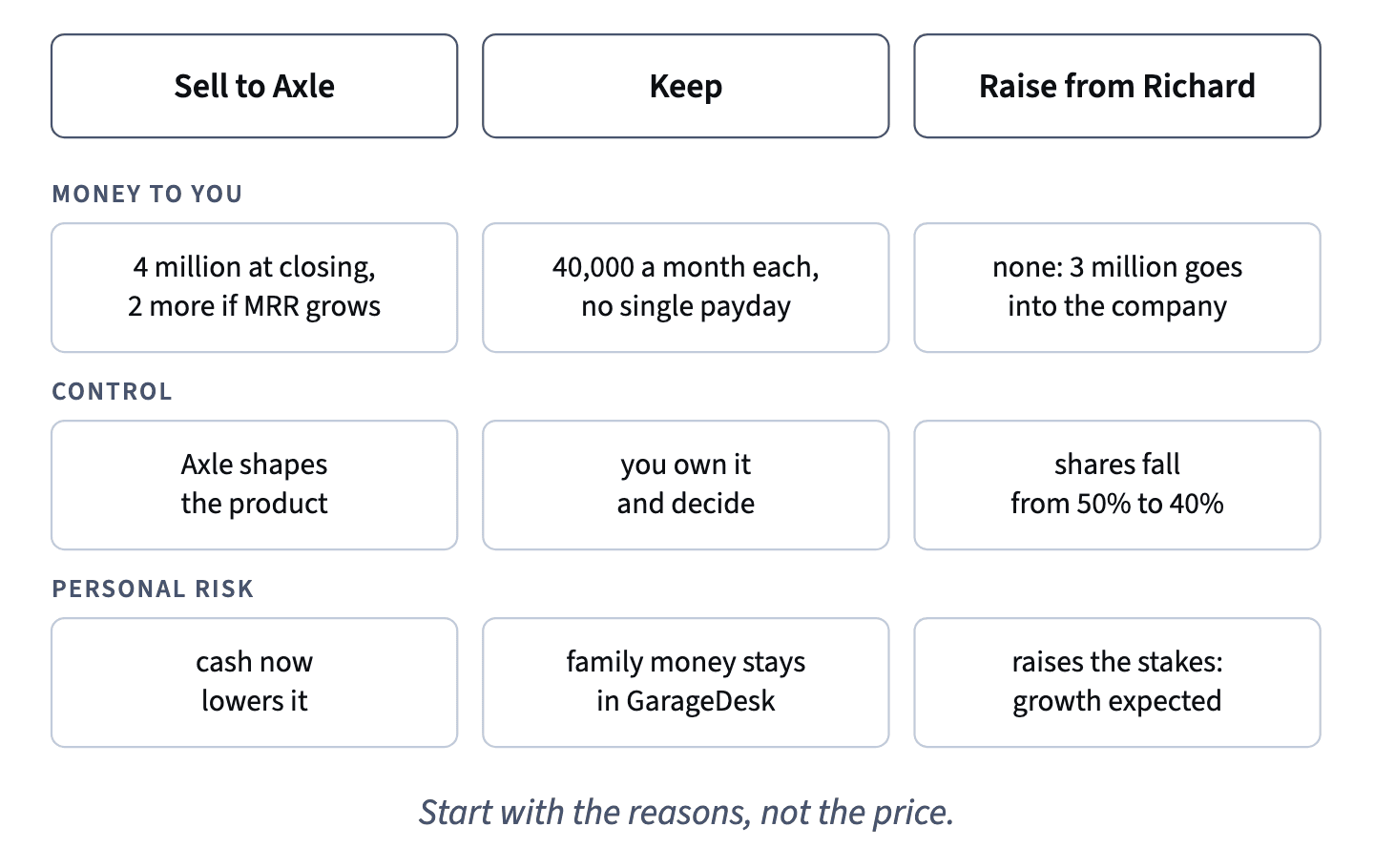
- Paid at closing: the money that arrives when the deal is signed. Axle offers 4,000,000 UAH at closing.
- Conditional: money that arrives only if something happens later. Axle's other 2,000,000 is an earn-out, paid only if MRR reaches 200,000 UAH twelve months after closing, while Nina stays twelve months and Oscar six.
So “six million” really means four million for sure plus two million that depends on growth the founders will no longer fully control. Treat the conditional part as a possible bonus, not as money you have.
Also read the other terms as part of the price: how long the founders must stay, in what roles, and what happens to the product and its customers. Twelve months of Nina's time is part of what Axle is buying.
Compare options on the certain part first, then ask how likely the rest is. The next lessons show how to judge both.
- Do“4,000,000 at closing for sure, plus up to 2,000,000 if MRR hits 200,000 in a year.”
- Don't“Axle is paying us six million.”
Treats a conditional earn-out as money in hand.
What a sale turns into cash today
Keeping a profitable business and selling it are two ways of receiving money: a steady income over years, or a large sum at once. To compare them, translate the sale into years of the income you would otherwise earn.
GarageDesk in October: 240 shops, MRR 165,000 UAH, costs without the founders' pay 67,000, and each founder pays himself or herself 40,000 a month. About 165,000 − 67,000 − 80,000 = 18,000 is left over each month.
Oscar's half of Axle's 4,000,000 at closing is 2,000,000 UAH.
- Pay per year: 40,000 × 12 = 480,000 UAH.
- Years of pay: 2,000,000 / 480,000 = 4.17 ≈ 4.2 years.
So the sale turns over four years of work into cash today, and removes his family's risk of having everything in one company.
The comparison is rough on purpose: it ignores tax, the chance that his pay grows, and the earn-out. What it shows is the trade: keeping means good income, ownership and no single payday; selling means the money arrives at once and someone else shapes the product's future.
- Do2,000,000 / (40,000 × 12) = 2,000,000 / 480,000 ≈ 4.2 years.
- Don't2,000,000 / 40,000 = 50 years.
40,000 is monthly pay: 50 is months, about 4.2 years.
Who is buying: financial, strategic or growth investor
The same price can mean very different futures depending on who pays it.
- A financial buyer acquires a company for its profit and growth and wants it to keep running much as before, often an investment firm with a portfolio of small software businesses.
- A strategic buyer, often a larger company in a related market, buys for something that fits its own business: customers, technology, a position. Expect the product to change and the founders to be asked to stay.
- A growth investor doesn't buy the company; it buys a share of a fast-growing one, expecting it to become much bigger.
Axle Group sells software to the distributors GarageDesk's shops buy parts from. Two hundred and forty repair shops using a product every day is exactly what it lacks, so Axle is strategic. Expect links to its parts catalog, maybe new prices, and a need for the founders to stay, which is why Nina is asked for twelve months.
Richard, who wants 20% to help GarageDesk grow faster, is a growth investor. The kind of buyer tells you what happens after the deal: how much the product changes, how long the founders stay and what the money is for.
- Do“Axle buys us for our 240 shops and links us to its catalog: a strategic buyer.”
- Don't“Six million is six million, whoever pays it.”
Ignores what the buyer will do with the product and the founders.
Questions to ask a strategic buyer
A strategic buyer is buying something that fits its own plans, so the most important questions are about those plans, not about the buyer's size or speed.
Before going further with Axle, the founders need answers to:
- What does GarageDesk look like in two years? Does it stay a separate product, or is it folded into Axle's software?
- What changes for the shops? Prices, the parts-catalog link, who owns the shops' client lists and how car owners' data is used.
- What are the founders' roles after the sale? Twelve months for Nina and six for Oscar doing what, reporting to whom, with what authority?
- How is the earn-out measured? If MRR decides two million, who controls prices and sales after closing?
Ask for the important answers in writing: a promise made in a friendly meeting is easy to forget once the money has changed hands. And check the answers against what the buyer has done before, for example by talking to founders of companies it bought earlier.
The shops trusted the founders with their regulars. Asking these questions is also how that trust is kept.
- Do“What will GarageDesk look like in two years, and will shop prices change? Please put it in writing.”
- Don'tAsking only how big Axle's office is and how fast the money arrives.
Misses what happens to the product and the shops.
Raising money isn't cashing out
Richard's offer, 3,000,000 UAH for 20%, sounds better than a sale: more money in the headline, and the founders keep 80%. The question is where the money goes.
When an investor buys new shares, the money goes into the company, not to the founders. GarageDesk would use it to hire salespeople and open new regions. Nina and Oscar personally receive nothing, and each of their stakes falls from 50% to 40%. This is dilution: the same founders own a smaller share of a company that now has more cash.
The money also comes with an expectation. Richard pays 3,000,000 for 20% because he expects GarageDesk to be worth far more later, so the company is now committed to growing much faster.
That changes the founders' situation in a direction they didn't ask for. Oscar wanted to reduce his family's risk; with Richard's money his wealth is still all in GarageDesk, and the stakes are higher. Nina didn't want to run a bigger company; the growth plan requires exactly that.
Raising money answers the question “how do we grow faster?”, not “how do we take money off the table?”.
- Do“Richard's 3,000,000 goes into the company; we each go from 50% to 40% and get nothing in hand.”
- Don't“We each pocket 1,500,000 and still keep 80%.”
New shares: the money goes into the company.
The value implied by a price for a share
When someone pays a price for a share of a company, you can work out the value of the whole company that price implies:
implied value = price paid / share bought
Richard offers 3,000,000 UAH for 20%:
3,000,000 / 0.20 = 15,000,000 UAH
Because his money buys new shares and stays in the company, this is the value after the money comes in. Before it, the company is valued at 15,000,000 − 3,000,000 = 12,000,000.
Why is it so much higher than Axle's 6,000,000 for the whole business? They price different things. Axle pays for GarageDesk as it is: 240 shops and today's profit. Richard pays for the bigger company he expects after salespeople and new regions, and his money comes with that growth plan attached. The higher number is a bet on a future the founders would have to build, not a price someone will pay for the business today.
So never compare the two headline numbers directly. Ask what each price buys and what each one requires of you.
- Do3,000,000 / 0.20 = 15,000,000 UAH after the money comes in.
- Don't3,000,000 × 0.20 = 600,000 UAH.
Multiplies instead of dividing: that's 20% of his price, not the company's value.
Paper value is not money
After Richard's investment, each founder would own 40% of a company valued at 15,000,000 UAH:
0.40 × 15,000,000 = 6,000,000 UAH each, on paper
That is as much per founder as Axle offers for the whole company. It is tempting to conclude that raising money makes them richer than selling. It doesn't, at least not yet.
A paper value is what a share would be worth if someone bought it at that price. Nobody has offered to. The 15,000,000 rests on Richard's expectation that GarageDesk grows much bigger, and it becomes cash only if the growth happens and a later buyer or investor pays at least that much. If growth stalls, the paper value can shrink, while Axle's 4,000,000 at closing would already be in the founders' accounts.
So compare cash with cash and risk with risk: the certain part of a sale against the uncertain future value of shares. For Oscar, whose goal is to make his family's money safe, 6,000,000 on paper in the same single company doesn't answer his reason at all.
- Do“On paper my 40% is 6,000,000; in my account it's still zero.”
- Don't“Richard makes each of us worth 6,000,000, more than Axle's whole offer, so raising is the better deal.”
Compares paper value with cash at closing.
Ready to practise?
Answer the lesson's exercises and earn 250 points the first time you finish it.
Start the exercises