

Theory
Value-based pricing: start from the cost of today
A value-based pricing example: anchor the first price to what the current workaround costs the customer and what the result is worth, not to your own costs or your fears.
~10 min read · 9 exercises · 250 points
Before you start
Where did 600 come from?
A new module at GarageDesk, and pricing is on the agenda. The planned price of 600 UAH a month was worked out from the founders' own costs and the number of shops they hoped to get. Now there are facts from the shops to check it against.
In this lesson you'll set a first price from what the customer's current workaround costs and what the result is worth to them, rather than from your own costs or your fears.
Price from the customer's side, not yours
There are three tempting ways to set a first price, and only one looks from the customer's side.
- Your costs. Tools plus what the founders need to live, divided by the shops you hope to get. That tells you how many customers you need, a useful number for the milestones, but nothing about what a shop will pay. Dennis has never seen your hosting bill.
- A competitor's price. A general CRM costs about the same, so why not copy it? Because Dennis doesn't compare you with a CRM he doesn't use. He compares you with his niece and her notebook.
- What the problem costs today and what solving it is worth. This is value-based pricing: the price is anchored to the customer's current workaround and to the gain the result brings.
The fourth option, "the lowest price that feels safe", isn't an anchor at all. It answers the founders' fear, not the customer's question.
A shop decides by comparing your price with what it already spends and loses. Start there, and use your own costs only to check that the business can work at that price.
- Do“Dennis pays his niece 4,000 UAH a month. 600 is 15% of that.”
- Don't“Tools and our living costs come to 50,000 a month; divided by 84 shops, that's about 600.”
The value anchor: what the result is worth
Value-based pricing has two anchors. The first is what the shop spends today on its workaround. The second is what the result is worth: the extra money the shop makes when the problem is solved.
For reminders, the result is regulars who come back. Its value per month is:
extra margin = returned visits per month × margin per visit
Use margin, what the shop keeps after parts and the mechanic's time, not the full bill, because that's what actually lands in the owner's pocket. Dennis expects at least 3 returned visits a month at about 700 UAH margin each: 3 × 700 = 2,100 UAH a month.
Then compare with the price: 2,100 ÷ 600 = 3.5. The result is worth three and a half times what GarageDesk costs. Check: 3.5 × 600 = 2,100.
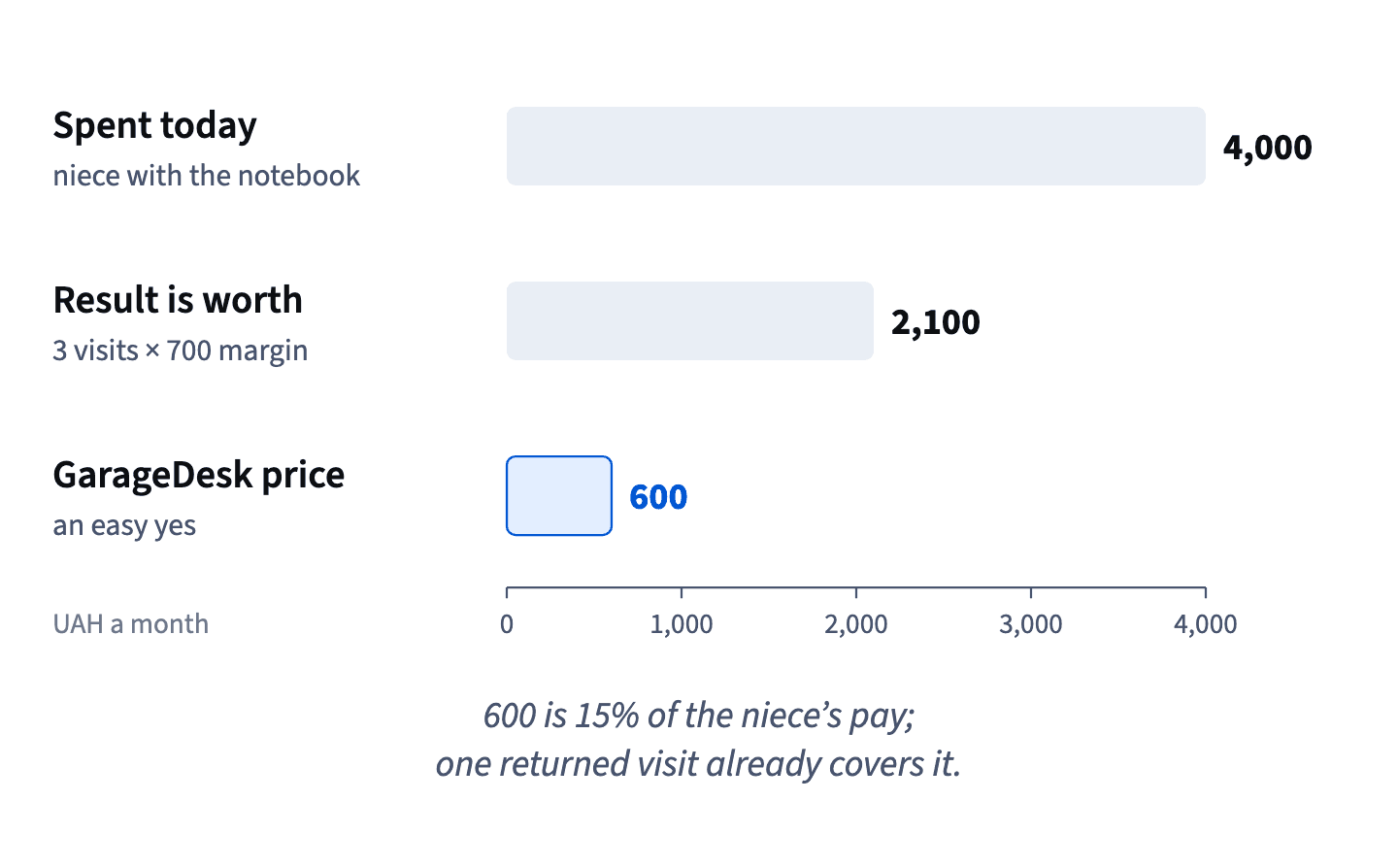
A ratio well above 1 is what makes a price easy to say yes to. Below 1, the shop would be paying more than it gets back, however good the product looks.
Ask the owner for his own figures; an estimate he made himself is far more convincing to him than yours.
- Do3 visits × 700 UAH = 2,100; 2,100 ÷ 600 = 3.5 times the price.
- Don't700 ÷ 600 = 1.17 times the price.
Uses one visit instead of the three Dennis expects each month.
The workaround anchor: price as a share of today's cost
The other anchor compares the price with what the shop already spends on the problem every month:
price as a share of the workaround = price ÷ monthly cost of the workaround × 100%
For Dennis: 600 ÷ 4,000 = 15%. Even if GarageDesk takes over only part of the niece's job, the numbers still work for him.
For a shop where the administrator gets a 1,500 UAH monthly bonus for calling customers back: 600 ÷ 1,500 = 40%. Still well under the current cost, but a smaller gap, so the conversation needs the value anchor too: the regulars who come back.
How to read the share:
- well below 100%: the price is an easy decision for a shop that already pays;
- close to or above 100%: the shop would pay as much as it does now, so the product must clearly do the job better;
- no workaround cost at all: there's nothing to compare with, and the shop is probably not a buyer yet.
Put the price on top and the shop's cost underneath. Flipping the fraction (4,000 ÷ 600) gives a ratio, not a share, and is easy to misread.
- Do600 ÷ 1,500 × 100% = 40% of the bonus the shop pays now.
- Don't1,500 ÷ 600 = 250%.
Flips the fraction: that's how many times the bonus covers the price, not the price's share.
A lower price doesn't win shops that spend nothing
"Let's start at 300 to be safe" sounds prudent. Ask: safe from what?
Look at who the lower price would affect:
- Shops like Dennis's, which already pay 4,000 UAH a month for a workaround, won't be stopped by 600. For them a cut to 300 changes nothing except how much GarageDesk earns: it gives away half the revenue from exactly the customers who'd have paid easily.
- Shops like Paul's, which spend nothing on the problem today, aren't held back by the price. Their barrier is that they don't feel the problem in money. At 300 they still spend nothing, because a cheaper solution to a problem you don't pay for is still a cost you don't need.
So the cut loses money on one group and wins almost nothing in the other. The shops that hesitate at 600 usually hesitate at any price.
The useful move is the opposite: find more shops that already spend on the problem, and show them the two anchors. Price objections from shops with a real workaround cost are rare when the numbers are on the table.
- Do“Paul isn't held back by 600; he spends nothing on the problem. Let's find more shops like Dennis's.”
- Don't“At 300, even Paul will sign up.”
Start at a price you can keep
Prices are not symmetrical. Lowering a price later is easy: customers welcome it and nobody needs persuading. Raising it later is hard: it means a conversation with every existing customer, some of whom will leave or feel misled.
That asymmetry has a clear consequence for a first price: start at a price you can keep, one justified by the two anchors, rather than a deliberately low one you hope to raise.
A price that's too low also sends a message. To a shop owner, 300 UAH a month for something that's supposed to bring back regulars can read as "a toy" or "a side project that won't last". A price in line with the value says the founders take the problem seriously.
This doesn't mean the price is fixed forever. As the product does more, there's room to charge more, especially for new customers. And if a well-chosen price turns out to block shops that clearly spend on the problem, lowering it is still available.
What to avoid is the plan "start cheap and raise it once they're hooked". It saves a little courage today and costs a lot of awkward conversations later.
- Do“600 is backed by both anchors, and we can keep it.”
- Don't“Let's start at 300 and double it once shops are hooked.”
Add up the shop's full cost of today
The cost of today is the shop's, not the founders'. Add up everything the shop spends or loses on the problem, not only the most visible part:
- money paid: Dennis's 4,000 UAH a month to his niece, an administrator's bonus, a tool the shop pays for;
- hours given: an owner's Saturday mornings typing reminders, Martha's five hours a month;
- margin lost: regulars who forget their next service and take their car to another shop.
The last line is often the biggest and the least visible. Nobody sends an invoice for a customer who didn't come back, so the owner has to be asked to count it.
What doesn't belong here: GarageDesk's own numbers. The 2,000 UAH a month for hosting and tools and what Nina needs to live on matter for the milestones, how many shops the founders need, but they're invisible to the shop and irrelevant to what it will pay.
Different parts of the total also convince different people. Hours saved speak to the administrator who does the work; money returned speaks to the owner who pays. With Greg, start with visits and money, and let Martha talk about her evenings.
- DoNiece 4,000 + owner's Saturday hours + margin from regulars who didn't return.
- Don't“The cost of today includes our 2,000 UAH of hosting.”
How many returned visits pay for the product
For any shop, one quick calculation shows whether the price makes sense:
returned visits needed = monthly price ÷ margin per returned visit, rounded up to a whole visit.
At 700 UAH margin: 600 ÷ 700 = 0.86, so 1 returned visit a month already covers the price. At 900 UAH margin: 600 ÷ 900 = 0.67, again 1 visit, with 900 − 600 = 300 UAH to spare.
The result turns into the simplest possible sentence for a hesitant owner: "If GarageDesk brings back one regular a month, it has paid for itself." The owner can check that against his own memory of how many regulars he loses.
Ask each shop two things: what the workaround costs a month, and roughly how many extra visits a month reminders might bring. Then compare both with 600.
Rounding up matters for the same reason as before: 0.67 of a visit doesn't exist. Rounding down to 0 would claim the product pays for itself with no visits at all, which is never true.
- Do600 ÷ 900 = 0.67 → 1 returned visit a month covers the price.
- Don't900 ÷ 600 = 1.5 → 2 visits are needed.
Flips the division: margin over price, not price over margin.
The sentence for a hesitant shop
When a shop owner hesitates over 600 UAH a month, the instinct is to explain: what the founders spend, how hard the product was to build, why the price is fair to GarageDesk. None of that answers the owner's real question, which is "is this worth it for me?"
The answer that works is in his own numbers, in one sentence:
- "One regular who comes back a month leaves you about 700 UAH. That already covers the 600."
- "You pay your niece 4,000 a month for this. GarageDesk is 600."
Both sentences do the same thing: they compare the price with something the owner already knows and counts. He can check them against his own memory and his own books, and he doesn't have to trust the founders' arithmetic.
Sentences built on the founders' side ("our hosting costs 2,000", "we need 600 from 80 shops to live") invite sympathy at best and bargaining at worst. They also tell the owner the price is about GarageDesk's needs, which makes it feel negotiable.
Keep the sentence short, use his numbers, and stop talking after it.
- Do“One regular back a month leaves you about 700 UAH. That covers the 600.”
- Don't“Our hosting and tools cost 2,000 a month, so we need 600 from each shop.”
Ready to practise?
Answer the lesson's exercises and earn 250 points the first time you finish it.
Start the exercises