

Theory
Your own money or investors?
The advantages and disadvantages of venture capital against bootstrapping: what an investor really buys, why venture money expects huge growth, what self-funding costs and three questions for choosing how to fund a startup.
~9 min read · 9 exercises · 250 points
Before you start
Where you work
GarageDesk is a subscription web app for independent car repair shops in Ukraine: online booking, service reminders and repair history in one place. Two co-founders run it: Nina, a developer, and Oscar, who handles sales and support. They have a working demo and their own savings, but not one paying shop yet.
You join Alex, their mentor, as an advisor. Over the course you'll help them make each decision, from the first paying customer to steady monthly profit and, perhaps, selling the company. This first lesson starts with the question in front of them today: should they take an investor's money at all?
What an investor actually buys
An equity investor doesn't pay for your product and doesn't lend you money. They buy a share of the company: a slice of its future value and, in practice, a voice in how it's run.
That voice is often written into the offer itself. Conditions such as "hire three developers", "grow tenfold in three years" or "raise a bigger round within 18 months" are the real price of the check. They set the pace and the direction of the company for years.
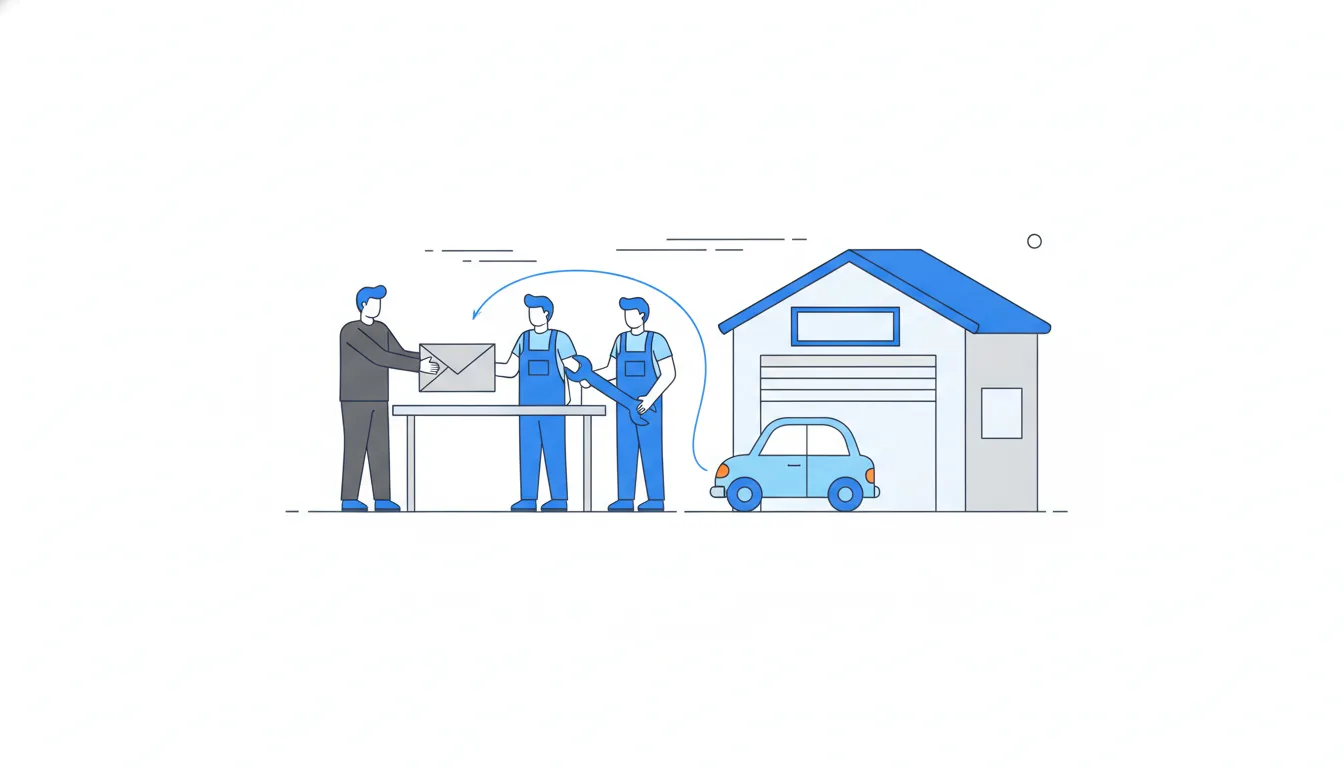
Three things the money is not:
- not a loan: nobody repays it if the company fails, which is why the investor wants a say;
- not a gift: the investor expects a return many times bigger than the check;
- not a license: the investor doesn't buy the right to use the product.
So before you look at the amount, read the strings attached. The question isn't "is 2,000,000 UAH a lot?" but "do we want the company those conditions describe?"
- Do“He gets 20% of GarageDesk and a say in how fast and where it grows.”
- Don't“It's like a loan: we'll pay it back once we earn.”
Dilution: why every slice shrinks
When a company sells a new share to an investor, the existing owners don't hand over their own shares one by one. The company issues new ones, so everyone's slice of the pie gets thinner at the same rate. That's dilution.
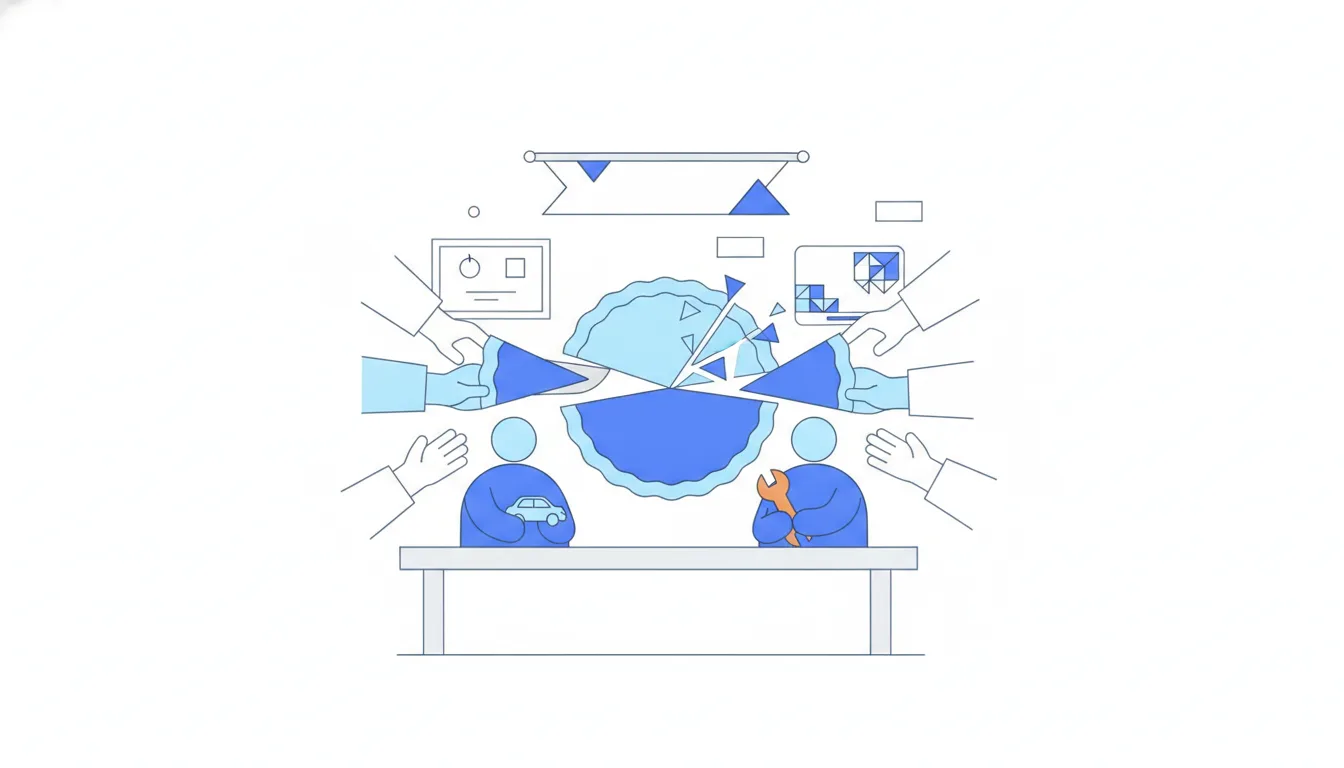
The arithmetic is multiplication, not subtraction. Selling 20% of the company means every existing owner keeps 80% of what they had:
- before: 50% each;
- after a 20% round: 50% × 0.8 = 40% each;
- after another 20% round: 40% × 0.8 = 32% each, 64% together.
Dilution isn't bad in itself. If the money helps the company grow a lot, 32% of a large company can be worth far more than 50% of a small one. That's the main argument for venture money.
The trap is to treat it as free. Each round also brings new owners with their own targets, so the founders' say in decisions shrinks along with their slice.
- Do50% × 0.8 = 40%, then 40% × 0.8 = 32% each.
- Don't50% − 20 = 30% each after two rounds.
Subtracts percentage points instead of shrinking each slice.
Ownership after several rounds
To find what a founder owns after a series of funding rounds, multiply by what each round leaves:
- For each round, compute 1 − the share sold. Selling 20% leaves 0.8; selling 25% leaves 0.75.
- Multiply the founder's starting share by every one of those factors, in any order.
- Check the sum: all owners together, old and new, must still add up to 100%.
For GarageDesk: 50% × 0.8 × 0.75 = 30% per founder. Together the founders hold 60%; Richard's 20% becomes 15% after the second round, and the new investor holds 25%. 60 + 15 + 25 = 100, so the numbers hold.
Notice that the earlier investor is diluted too. Every round shrinks every existing slice, including the slices of past investors, which is why investors often ask for rights to buy into later rounds.
A quick sanity check: if your answer ever comes out negative or the totals don't reach 100%, you subtracted where you should have multiplied.
- Do50% × 0.8 × 0.75 = 30% per founder; 60 + 15 + 25 = 100.
- Don't50% − 20 − 25 = 5% per founder.
Subtracting round sizes as points; the totals no longer add up to 100%.
Every source of money has a price
Bootstrapping means building a company with little or no outside money. It usually starts with self-funding, the founders' own savings, and moves to customers' payments as fast as possible. Between that and venture capital sits a shelf of other options, and none of them is free:
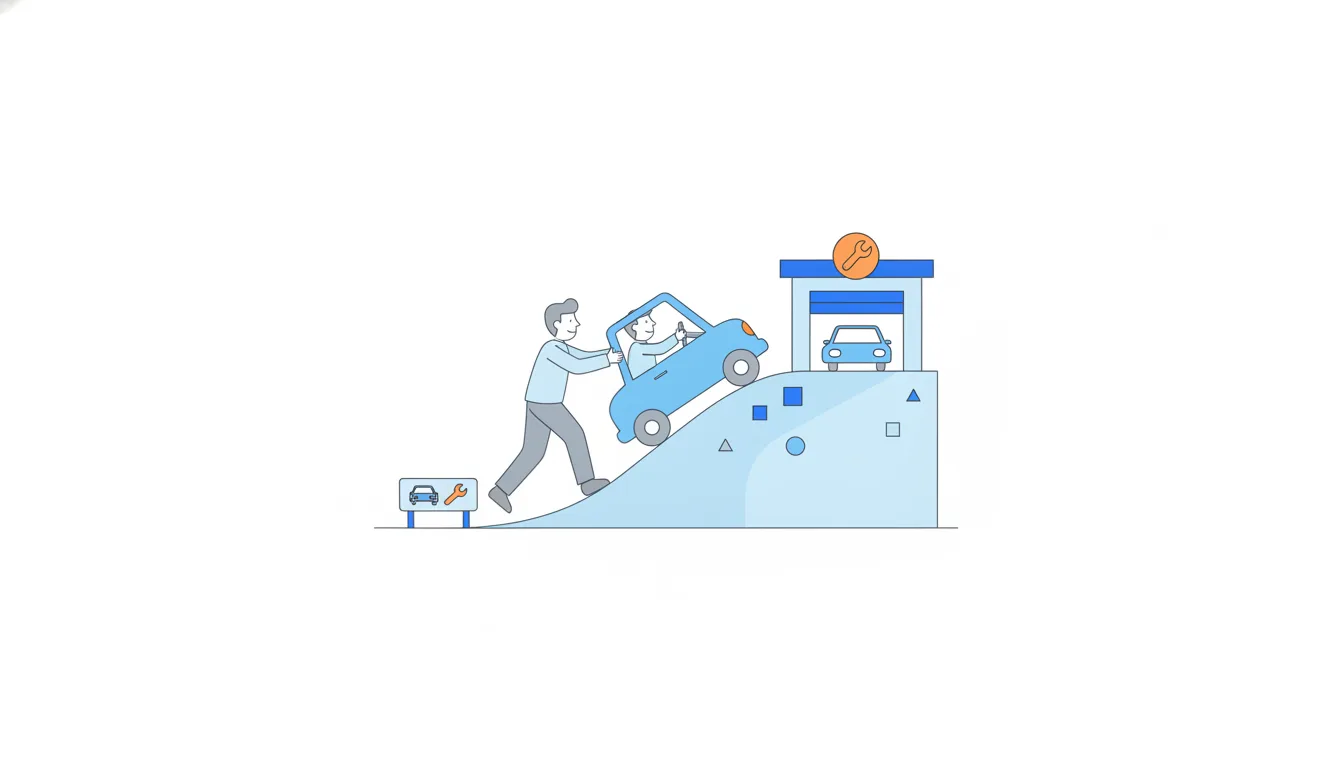
- own savings: your personal money is at risk and growth is slower, but the whole company stays yours;
- venture capital: you give up a share and accept pressure to grow very fast;
- bank loan: a fixed payment every month whether revenue comes or not, often against collateral;
- family loan: no shares, but a relationship is on the line if things go wrong;
- revenue-sharing investor: a percentage of monthly sales until an agreed sum is repaid, usually only for a business that already earns.
The useful question is not "which money is cheapest?" but "which price can we afford to pay?" A team with steady revenue can carry a loan; a team with no customers yet can't.
- Do“The family loan costs no shares, but we'd be risking Nina's relationship with her aunt.”
- Don't“A loan from family is free money.”
When outside money is the right tool
Venture capital works like a portfolio of bets. A fund backs many startups, knowing most will fail, so a few enormous winners must pay for all the losses. That's why a venture investor needs every company to have a real chance of becoming huge, and why "a solid, profitable business" can disappoint them.
Outside money fits when the business really needs it:
- big spending long before the first sale: hardware, medical devices or anything that needs years of development and certification;
- a race where the leader takes almost everything: a marketplace or network where customers flock to the biggest player.
It fits badly when costs are small, when customers choose and switch slowly, or when the founders want a calm, profitable company. A competitor raising money doesn't create a race on its own: if customers change tools once every few years, there's no prize for arriving first with someone else's cash.
So check the business, not the headlines.
- DoA medical device with 18 months of certification before the first sale needs money up front.
- Don't“Our competitor raised money, so we must raise too.”
Three questions before any offer
An offer on the table pulls the conversation toward its amount and terms. Step back and answer three questions about the business and the founders first:
- Size. Can this market ever produce a company big enough for a fund? Thousands of independent repair shops is a good market for two founders, not for a fund that needs a giant.
- Speed. Does winning require spending far ahead of revenue? If customers pick software slowly and rarely switch, there's no race to fund.
- Life. What should the founders' work look like in five years, and whom do they want to answer to?
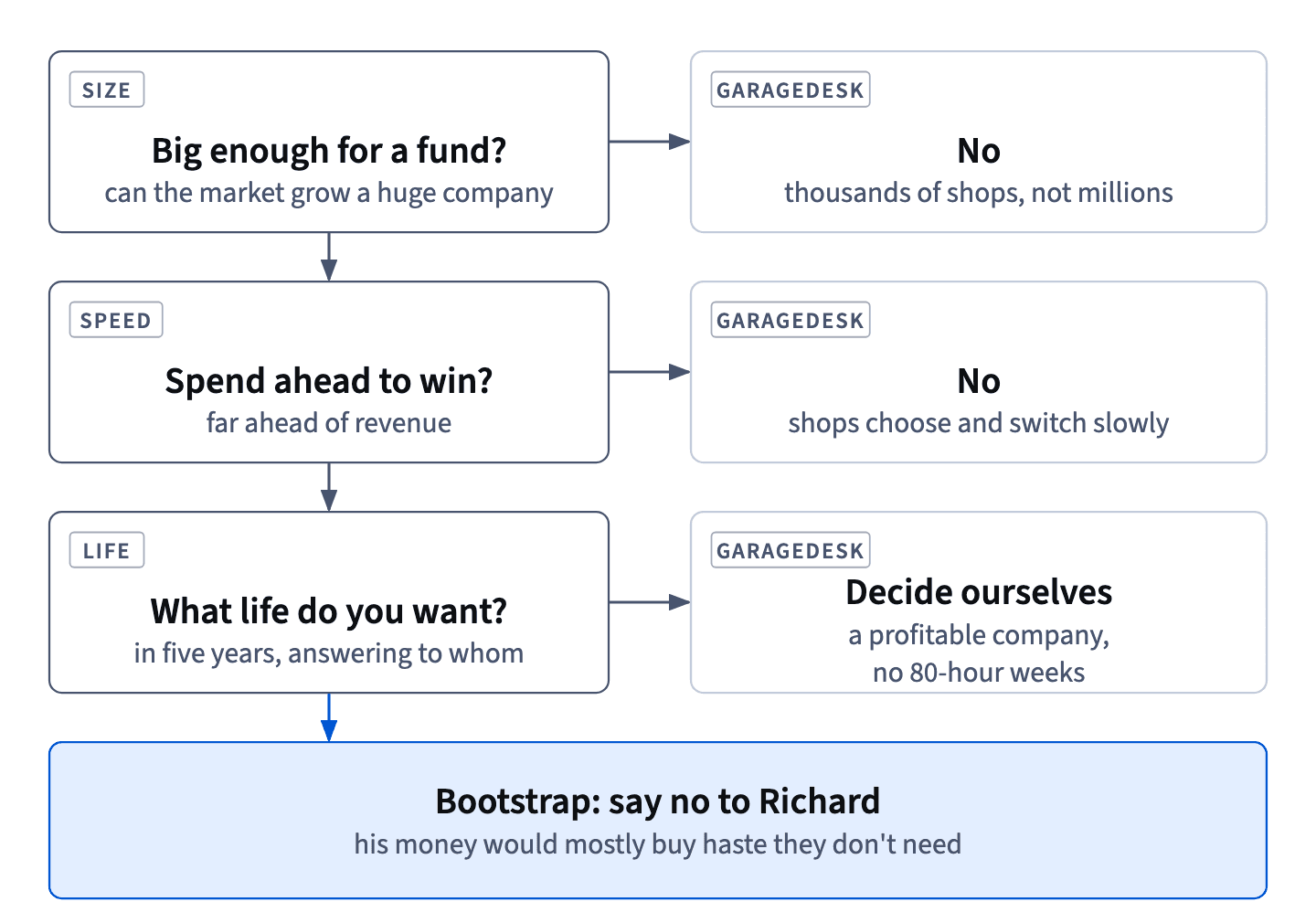
Only after these answers does it make sense to compare offers. If all three point away from venture money, a bigger check is the same mismatch in a larger size. If they point toward it, the next step is to find the investor whose targets match the plan.
The order matters: decide what company you're building, then pick the money that fits it.
- Do“Size: thousands of shops. Speed: they switch slowly. Life: we want to decide ourselves. So venture money doesn't fit.”
- Don't“Let's wait for a bigger offer and take that one.”
A choice for now, not a vow
Choosing to bootstrap is a decision about today's facts, not a lifelong vow. If the market turns out larger, a race appears or the founders' goals change, the answer to "should we take investment?" can change too.
Many founders deliberately start on their own money, prove that customers pay, and only then talk to investors. That order has two advantages:
- better terms: a company with paying customers and revenue is worth more, so the same share sold later raises more money and costs less control;
- a real choice: founders who don't need the money can say no to terms that don't fit.
Saying no to one investor also doesn't burn the bridge. A short, reasoned reply that thanks them and offers updates keeps a useful contact for later.
What doesn't hold up is pride: "real founders never take investors' money" is a slogan, not a reason. The reasons are the three answers about size, speed and life.
- Do“Not now: let's prove shops pay us first, then talk to investors from strength.”
- Don't“If we bootstrap, we can never take investment.”
A reason that holds up
When founders decline an offer, the reason matters as much as the decision. A strong reason can be checked against facts and would change if the facts changed. A weak one is a slogan that would give the same answer whatever the situation.
Test a reason with three filters:
- Is it about this business? "The market is modest and customers switch slowly" is; "investors are bad" isn't.
- Does it fit the founders' goals? Growth targets that would break the life they want are a real reason.
- Is it true? "Dilution always makes founders poorer" is a myth: a smaller slice of a much bigger company can be worth more.
Also watch for the bigger-check trap. "Two million is too little, let's wait for more" accepts the same strings attached, only with a larger number. If the deal doesn't fit, the size of the check doesn't fix it.
A reason that passes all three filters is also the one an investor will respect when you explain it.
- Do“The market is modest, we don't need to race, and tenfold growth doesn't fit the life we want.”
- Don't“Real founders never take investors' money.”
Ready to practise?
Answer the lesson's exercises and earn 250 points the first time you finish it.
Start the exercises