

Theory
Money milestones for a startup
Startup milestones measured in money, a ladder of sums you can check in the bank: which bill each milestone covers, what it changes in the founders’ week and which work can wait.
~8 min read · 9 exercises · 250 points
Before you start
A ladder you can check in the bank
Back with GarageDesk's founders. The plan is set: Nina has handed in her notice, and Oscar's evenings are in the calendar. Now they need a way to tell whether they're getting anywhere, by money rather than by how busy they feel.
This lesson closes the module with a ladder of money milestones: sums you can check in the bank, which bill each one covers, what it changes in the founders' week, and which work can wait until later.
Money milestones: progress you can check in the bank
A self-funded company can't measure progress by how busy the founders feel or how many people liked the demo. It needs money milestones: points where the product's income covers one more real bill. Each one is a sum you can check in the bank account, and each one changes what the founders' week should be about.

The first rung is always the same: the first payment. Not a demo that went well, not "sounds great, call me", not a sign-up for a free trial. One customer paying real money because the product fixes a real problem. For GarageDesk that's one shop paying 600 UAH.
Why be so strict? Because praise is free to give. People say nice things to be polite, to end a conversation or because they really mean them today and forget tomorrow. A payment is the first signal that costs the customer something, so it's the first one you can trust.
Until that rung is reached, everything else is preparation.
- Do“One shop paid 600 UAH this week: first rung reached.”
- Don't“Seven owners loved the demo, so we've hit our first milestone.”
The GarageDesk ladder
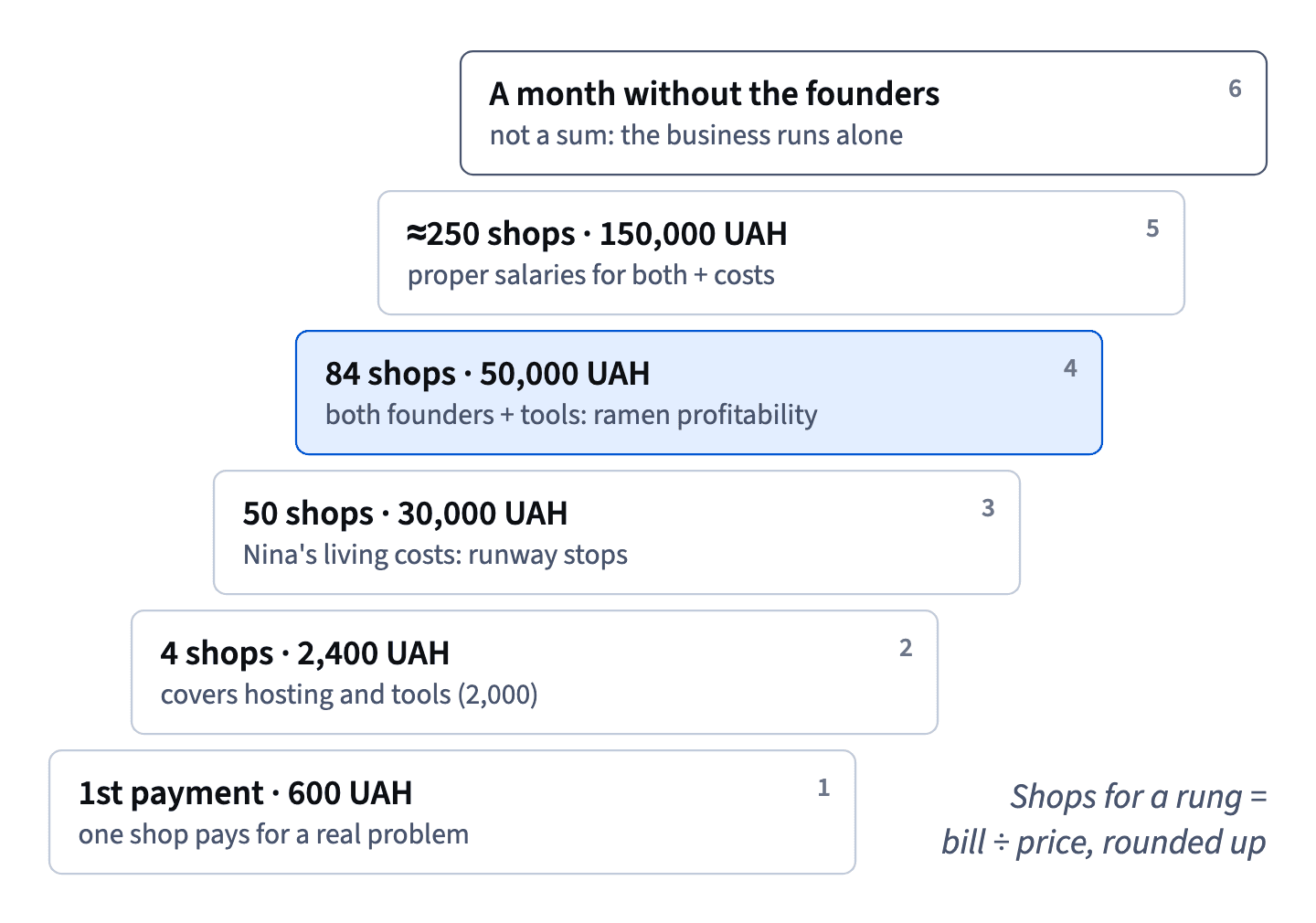
A ladder of money milestones lists the bills in the order the business will cover them. For each rung: shops needed = bill ÷ price, rounded up. At 600 UAH per shop per month, GarageDesk's ladder is:
- First payment: one shop, 600 UAH.
- Tools: hosting and tools cost 2,000 UAH; 2,000 ÷ 600 = 3.33, so 4 shops (2,400 UAH). The product stops costing the founders money.
- Nina: her living costs are 30,000 UAH; 30,000 ÷ 600 = 50 shops. Her runway stops counting down.
- Both founders plus tools: 30,000 + 18,000 + 2,000 = 50,000 UAH, so 84 shops. That's ramen profitability for two.
- Proper salaries: about 150,000 UAH a month, roughly 250 shops.
- The business runs for a month without either founder. The last rung isn't a sum but a test of independence.
Write your own ladder from your own bills. The rungs are only useful if each one names a real cost the business takes over.
- Do50 shops × 600 = 30,000 UAH: Nina's living costs are covered.
- Don't“50 shops means both founders are paid.”
Milestones and triggers are different things
Two kinds of numbers live side by side in a bootstrapped plan, and mixing them up causes confusion.
Money milestones describe the business. They're the same for everyone in the company: the bills the product covers, in order. GarageDesk's ladder has rungs at 1, 4, 50, 84 and about 250 shops.
Triggers are personal decision points. Each founder sets their own, based on their own situation. Oscar's trigger is 30 shops, the revenue that covers his 18,000 UAH share of the family budget, at which he quits his job. It sits between the second rung (4 shops) and the third (50 shops), but it isn't a rung of the company's ladder.
Keeping them apart matters because they answer different questions. A milestone says "what does the business now pay for, and what should our week be about?" A trigger says "what does this founder do now?" Nina has no trigger at 30 shops; Oscar's life changes there.
Both belong in writing: milestones in the company plan, triggers in the founders' agreement.
- Do“30 shops is Oscar's trigger to quit; the next company rung is 50.”
- Don't“Let's add 30 shops to the ladder as our third milestone.”
When a bill changes, the rung moves
A ladder isn't fixed once it's drawn. Each rung is a bill divided by a price, so when either number changes, the rung moves.
The rule for recounting is the same every time:
- take the new bill;
- divide it by the price per customer per month;
- round up to a whole customer.
Rounding up is the step people skip. If tools rise to 3,500 UAH a month, 3,500 ÷ 600 = 5.83. Five shops bring 3,000 UAH, which leaves 500 UAH of the bill unpaid every month. Customers come in whole numbers, so the rung is 6 shops (3,600 UAH).
Rounding to the nearest whole number feels natural but is wrong here: 5.4 would round to 5 and still leave the bill short. Any fraction, however small, means one more customer.
Recount the ladder whenever a bill or the price changes, the same day, just as you recount the runway. A ladder built on last year's bills tells the founders they're further along than they are.
- Do3,500 ÷ 600 = 5.83 → 6 shops (3,600 UAH).
- Don't3,500 ÷ 600 ≈ 5.8, so 5 shops.
5 × 600 = 3,000 leaves 500 UAH of the bill unpaid every month.
When the price changes, recount every rung
The price is the divisor in every rung, so a price change moves the whole ladder at once, not just one step.
Take the ramen-profitability rung for both founders: 50,000 UAH a month (Nina 30,000 + Oscar 18,000 + tools 2,000).
- At 600 UAH per shop: 50,000 ÷ 600 = 83.33, so 84 shops.
- At 700 UAH per shop: 50,000 ÷ 700 = 71.43, so 72 shops (72 × 700 = 50,400; 71 shops would bring 49,700, 300 short).
A higher price brings every rung closer: 12 fewer shops to ramen profitability. A lower price, or a discount, pushes every rung further away.
Two slips are common. One is scaling the old answer by eye ("the price went up a bit, so a few shops fewer"). The other is dividing correctly but rounding down. Both are avoided by redoing the same three steps for each rung: bill, divide by the new price, round up.
This is also why pricing decisions matter so much to a bootstrapped company: a price is a lever on every milestone at once.
- Do50,000 ÷ 700 = 71.43 → 72 shops.
- Don't50,000 ÷ 700 = 71.43 → 71 shops.
71 × 700 = 49,700: the founders are 300 UAH short every month.
Each rung changes the week
"Build and sell" sounds like the same job at every stage, but the rung a company stands on decides what the week should mostly be about.
- Before the first payment: conversations with customers and asking them to pay. Code mostly waits, because nobody has yet proved they'll pay for it.
- Up to about 50 shops: making sales repeatable and fixing what early customers trip over. The product grows where paying users push it.
- Past 84 shops: the risk moves inside the company. Knowledge lives only in Nina's head, and support eats Oscar's evenings. If either founder gets ill, the business stalls.
- Near the last rung: writing things down, handing tasks over and getting help with support, so that the business can run for a month without either founder.
So with 90 paying shops, GarageDesk's week should go mostly to documenting how things work and getting support help, not to a burst of new features.
Reading the rung first and planning the week second keeps the founders working on the bottleneck of the stage they're actually in.
- Do90 shops: “This month we write down how setup and support work and find help.”
- Don'tNo paying shops yet: “This month we polish the code and add reports.”
Park the work of later rungs
Every founder has a favorite idea that belongs to a rung they haven't reached. For Nina it's a mobile app for car owners. It may be a good idea, but before a single shop pays, it answers a question nobody is asking yet.
The rule is simple: park it. Write the idea down, note which rung it belongs to, and come back to it when the business gets there. Parking isn't rejecting; it's choosing the order.

There's also a mirror mistake: spending as if you were three rungs higher. Hiring a salesperson before anyone pays, renting an office or buying expensive tools "for when we grow" all assume the later rungs are already reached. They burn runway on problems the company doesn't have.
A quick test for any task or expense: "Which rung does this help us reach?" If the answer is "the next one", it belongs in this month. If it's "one far up the ladder", it goes on the parked list.
Below the first rung, almost everything except talking to customers and asking them to pay is on that list.
- Do“Mobile app: on the parked list, marked with the rung it belongs to.”
- Don't“Let's hire a salesperson now, so we're ready when shops start paying.”
Ready to practise?
Answer the lesson's exercises and earn 250 points the first time you finish it.
Start the exercises