

Theory
Trading vs investing: two different games
Holding for years and trading for days are different games with different risks, and someone is always on the other side.
~9 min read · 9 exercises · 250 points
Before you start
Where you start
This course has no company and no job: just you and Pebble, a made-up beginner app for buying and selling. You've opened a Pebble practice account with 10,000 practice dollars and a small market of five made-up instruments, so no real money moves.
Over eight modules you'll see what trading costs, how a market and its orders work, how much one trade may lose, why a plan can lose often and still profit, how to read a simple chart, and how a plan, a journal and your own habits decide the result. This first lesson asks whether trading is just investing, only faster.
Same buttons, two different games
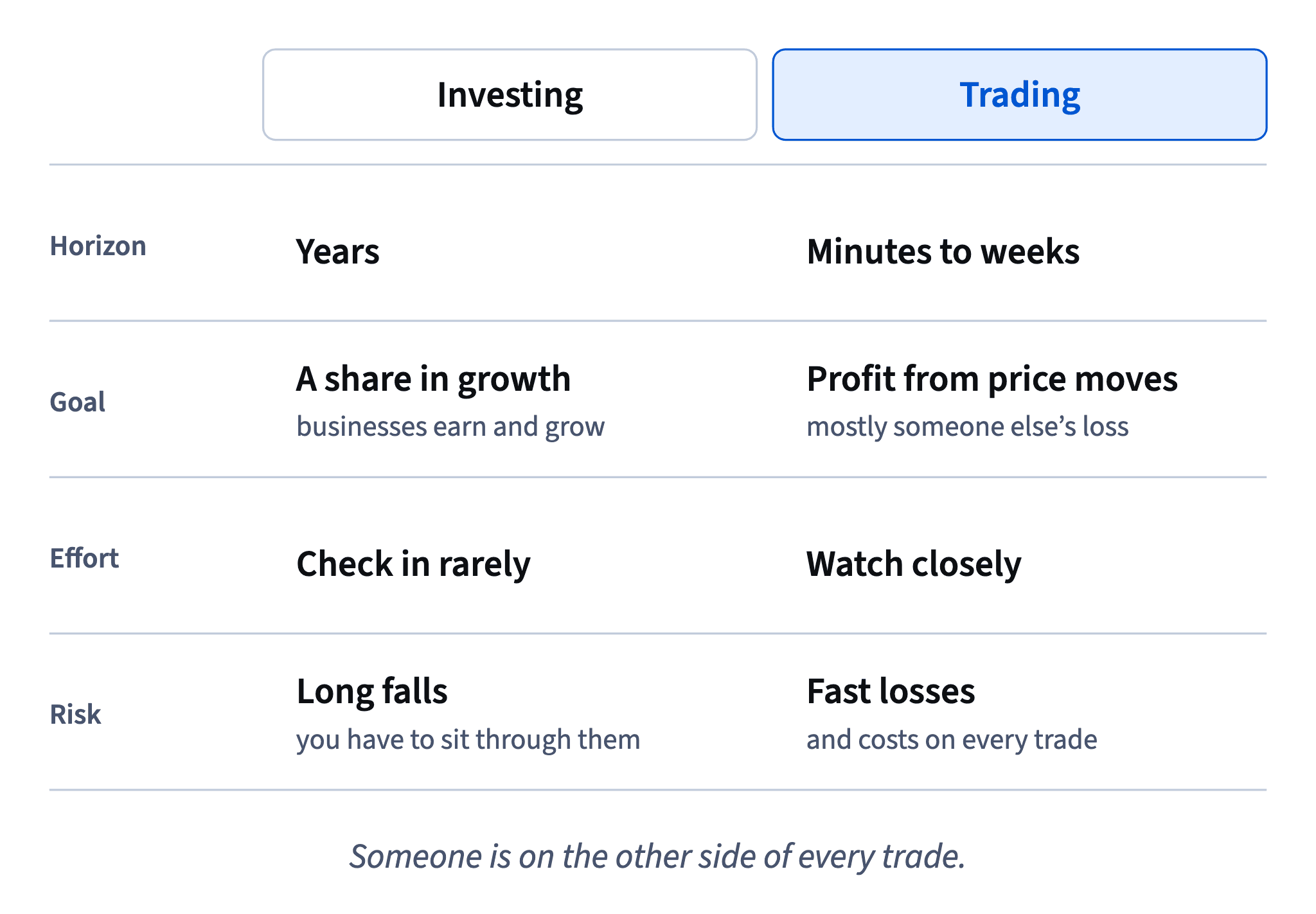
Trading and investing use the same app and the same Buy button, but they are different games. Compare them on four things.
Horizon. An investor holds for years. A trader holds for minutes to a few weeks.
Goal. An investor wants a share in businesses' growth: profits, dividends, a company worth more in ten years. A trader wants to profit from the price moving in a short time.
Effort. Investing needs rare check-ins and a lot of patience. Trading needs close attention, quick decisions and a record of each one.
Risk. An investor must sit through long falls. A trader can lose fast, and every trade pays costs, so trading often multiplies them.
A quick test before any purchase: how long will the money stay in, and what has to happen for it to earn? "Years, and the companies grow" is investing. "Days, and the price moves my way" is trading.
- Do"The fund money stays for years; the trading account has its own rules."
- Don't"Trading is investing, only faster."
Horizon, goal, effort and risk all differ.
Name the game before you press Buy
The same purchase can belong to different games, so name the game first. Two questions decide it: how long will the money stay in, and what has to happen for it to earn?
Investing answers "years" and "the businesses grow". A monthly amount into the Harbor fund for 15 years is investing.
Trading answers "minutes to weeks" and "the price moves my way". Inside trading the horizon still varies: some trades open and close within one day, others last days or a few weeks to catch one swing. Both kinds pay costs on every round, buying and then selling.
Some money belongs to neither game. Rent due next month, the emergency cushion, money you'll need soon: if a fall would force you to sell, it shouldn't be in the market at all. Only money you can afford to lose goes into trading.
Naming the game sets the rules you'll judge yourself by later.
- Do"This is a two-week trade: I'll judge it by the price move, after costs."
- Don't"I'll trade with the rent money and put it back before the 1st."
Money you need soon belongs in neither game.
Someone is always on the other side
Every trade is a deal between two sides. When you buy 10 shares of Northwind Foods, someone sells you those 10 shares at that moment; when you sell, someone buys them. The app only finds that person and records the deal (module 2 shows how).
Who is it? It may be a professional firm with full-time staff and research, a computer program that reacts in thousandths of a second, or another beginner like you. The company behind the share is rarely there: it sold its shares to the market long ago, and day to day they pass between holders.
Why it matters: many on the other side know more, see news sooner or pay less per trade than you. One small disadvantage hardly shows on a single trade, but it repeats on every trade you make.
So "me against the market" is the wrong picture. The useful one is "me against other people and their machines, one trade at a time".
- Do"Before I buy, I ask: why would someone sell this to me at this price?"
- Don't"Nobody is on the other side, the app just fills my order."
The app matches you with a person or a program.
A quick gain is mostly someone else's loss
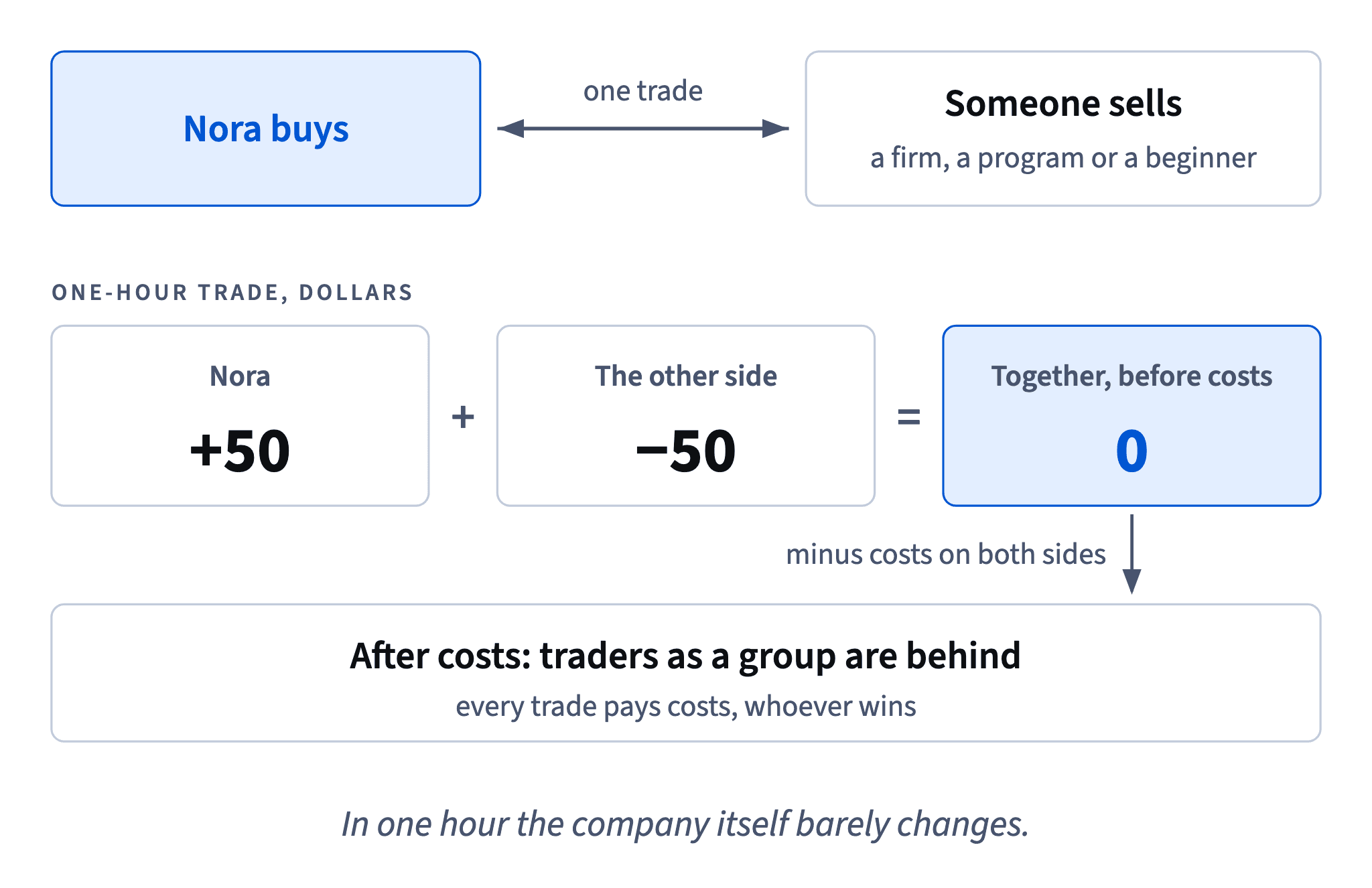
In one hour a company doesn't change in a way that matters: it sells the same products and earns the same profits. So when a share moves within that hour and you gain 50 dollars, the money came mostly from whoever was on the other side of your trade.
Before costs, short-term trading is close to a zero-sum game: the gains and losses of all traders roughly cancel out. Then costs arrive: the difference between buying and selling prices, fees and small price slips are paid on every trade, by winners and losers alike. After costs, traders as a group end up slightly behind. To come out ahead, you must beat the other side by more than your costs, again and again.
That's why Nora's 50 dollars in an hour is real money but not proof of skill, and not "growth". It is one round of a game in which the average player loses a little each round.
- Do"My 50 dollars was someone's loss. Was I better than them, or just lucky?"
- Don't"The company grew this hour, so I earned."
An hour is far too short for a business to grow.
Where a long-term gain can come from
Holding for years works differently from a quick trade. Over years, companies can sell more, earn profits, pay part of them out as dividends and reinvest the rest. A fund that holds 20 companies collects a small share of all that. When the businesses grow, all holders can gain together, without anyone having to lose the same amount: a positive-sum game.
Two honest limits. First, it's a "can", not a promise: companies fail, profits shrink, and prices can fall for months or years. Second, the gain needs time; over an hour or a week the business barely changes, so a short-term price move is still mostly a contest between traders.
So the question "where would my gain come from?" separates the games. If the answer is "the businesses earned more", you're investing. If it is "someone paid me more than I paid", you're trading.
- Do"Over ten years the fund can gain because its companies earn, not because someone else loses."
- Don't"Holding a fund for years is guaranteed to pay off."
Growth is possible, not promised.
Hold return: the result of the whole stretch
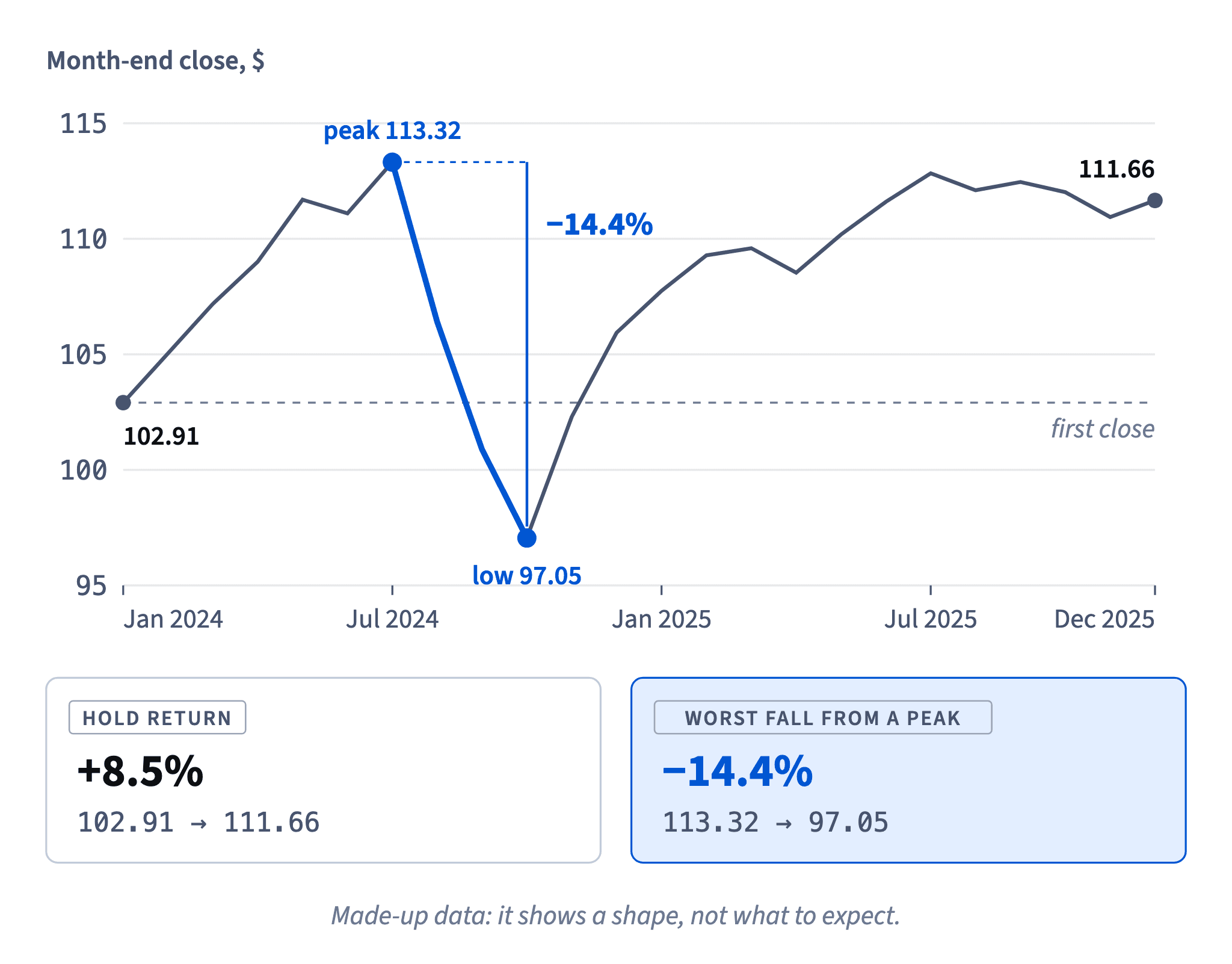
The hold return answers one question: if you had bought at the start and sold at the end, how much would you have gained, as a share of what you paid? Take the change and divide it by the starting price: (last − first) ÷ first.
On Pebble's made-up Harbor 20 Index Fund, a fund of 20 fictional companies, the first month-end close in the data is 102.91 and the last, two years later, is 111.66. The change is 8.75, and 8.75 ÷ 102.91 ≈ 0.085, so about 8.5% over two years.
Dataset · 24 rows
Harbor 20 Index Fund, 24 month-end closes
First 5 of 24 rows
Three habits keep the number honest. Divide by the starting price: 8.75 ÷ 111.66 gives 7.8%, which answers a different question. Say the period: "8.5%" alone hides whether it took two months or two years. Say before fees when fees aren't in it. And remember it is one made-up fund on one stretch, not a forecast.
Chart data
| month | Close |
|---|---|
| 2024-01 | 102.91 |
| 2024-02 | 105.04 |
| 2024-03 | 107.18 |
| 2024-04 | 109.01 |
| 2024-05 | 111.69 |
Show 19 more rows
| 2024-06 | 111.1 |
| 2024-07 | 113.32 |
| 2024-08 | 106.41 |
| 2024-09 | 100.88 |
| 2024-10 | 97.05 |
| 2024-11 | 102.29 |
| 2024-12 | 105.93 |
| 2025-01 | 107.75 |
| 2025-02 | 109.28 |
| 2025-03 | 109.59 |
| 2025-04 | 108.53 |
| 2025-05 | 110.18 |
| 2025-06 | 111.6 |
| 2025-07 | 112.83 |
| 2025-08 | 112.1 |
| 2025-09 | 112.46 |
| 2025-10 | 112.02 |
| 2025-11 | 110.94 |
| 2025-12 | 111.66 |
- Do"Harbor: +8.5% over two years, before fees."
- Don't"Harbor makes 8.5%."
No period, no fees, and it sounds like a promise.
The worst fall from a peak
The hold return shows only the start and the end; it hides the ride in between. The worst fall from a peak shows the hardest part of that ride. Traders call it drawdown.
Find the highest close. Then find the lowest close that comes after it. The drop between them, divided by the peak, is the fall: (peak − low) ÷ peak.
In the Harbor fund data the peak is 113.32 in July 2024, and the lowest close after it is 97.05 in October 2024. The drop is 16.27, and 16.27 ÷ 113.32 ≈ 0.144, so 14.4%. In October the fund even sat below its first price of 102.91, although it ended two years up 8.5%.
Two slips to avoid: a low that comes before the peak doesn't count, and you divide by the peak, not by the low. Module 4 shows why deep falls are so hard to win back.
- Do"+8.5% over two years, with a 14.4% fall from the peak on the way."
- Don't"It ended up, so it never really fell."
The end price hides the fall in the middle.
Neither game is the safe one
It's tempting to call one game safe. Neither is. Each has its own kind of pain.
Investing asks for patience: sitting still through falls like the Harbor fund's 14.4%, when doing nothing feels awful. One Pebble user, Marc, added money right at the fund's July 2024 peak of 113.32 and spent three months in the red.
Trading asks for fast decisions, each one paying costs, against people and programs that may know more. Selling quickly doesn't remove risk; it often just locks in a loss and pays costs again.
Marc's habit is a good model: he keeps the two games in separate accounts. The fund money stays untouched for years; the trading account has written rules and a journal, because there every decision costs something. Pick a game knowing which one you're playing.
How it fits together: the two games differ in horizon, goal, effort and risk; short-term trading is a contest with the other side, and holding has deep falls. Next lesson: where the money goes on every single trade.
- Do"Fund money and trading money live in separate accounts, each with its own rules."
- Don't"Investing is the safe, boring option."
Holding has deep falls too.
Ready to practise?
Answer the lesson's exercises and earn 250 points the first time you finish it.
Start the exercises