

Theory
Case: three promises that sound too good
Judge three ads that promise easy money by what you can check, not by what they promise; find the hidden losses, the guarantee, the pressure and the request for access.
~8 min read · 10 exercises · 250 points
Before you start
Three offers in Nora's inbox
Back on your Pebble practice account, but no chart today. Nora has forwarded three offers she's tempted to pay for, starting with a signal seller whose ad shows 20 trades and not one loss.
This case closes the first module. You'll judge each offer by what you can check rather than by what it promises, and use what you know about costs and beginner losses to decide what Nora should ask before paying anyone.
An ad is a shop window: ask for the full list
Judge an offer by what you can check, not by what it promises. The first check: is this the whole record, or a chosen part of it?
An ad is a shop window. Nobody puts burnt bread in the window, so a seller shows the trades that look best. That needn't involve one fake trade; choosing is enough.
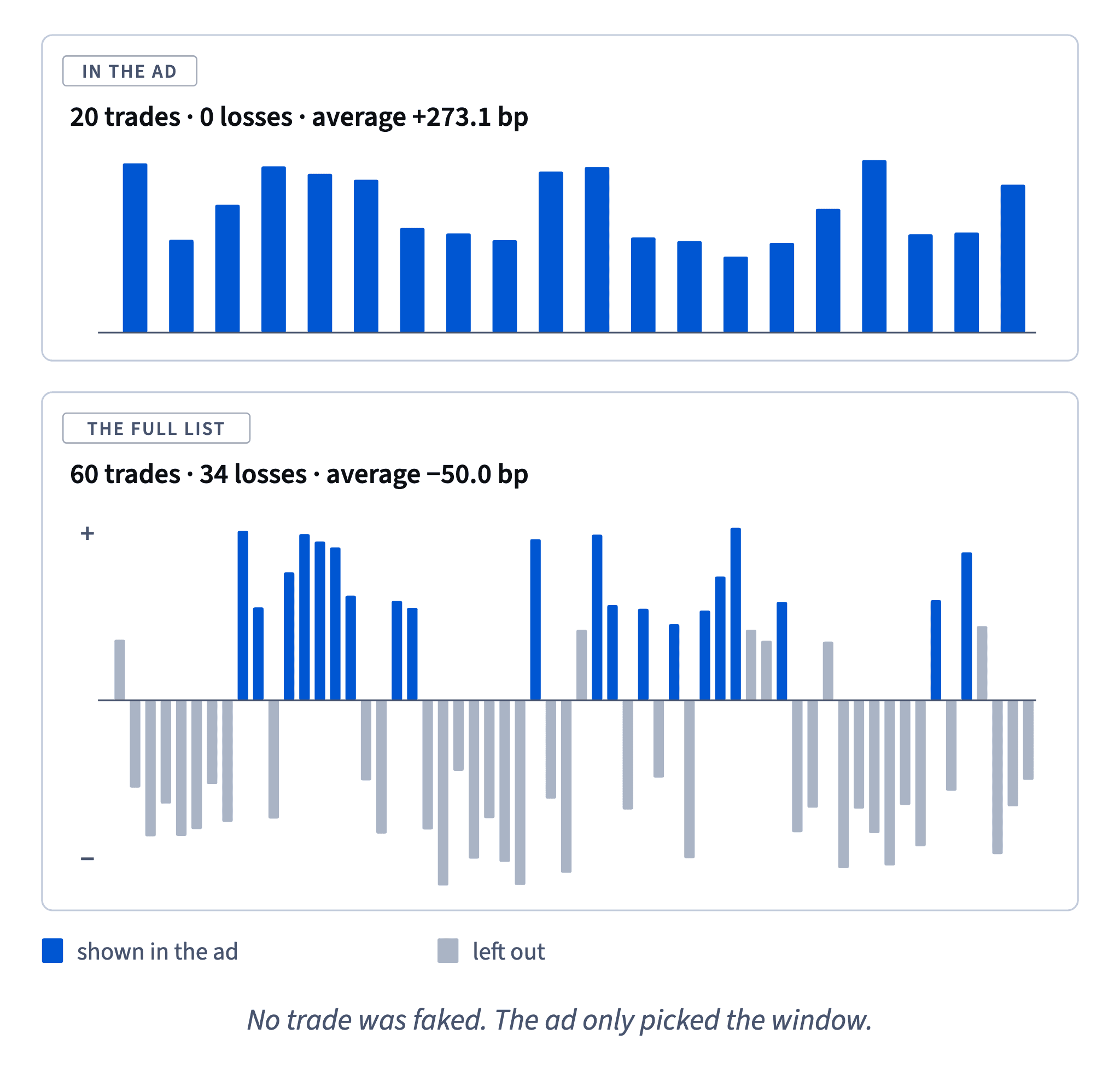
Nora's signal seller advertised 20 trades averaging +273.1 basis points each (a basis point is a hundredth of a percent, so about +2.7% a trade). On request he sent all 60. Their results add up to −3,001 basis points, and −3,001 ÷ 60 = −50.0 per trade, about −0.5%. The same seller, the same trades: +273.1 in the window, −50.0 on the full list.
Dataset · 60 rows
Signal seller: the full list of 60 trades
Sent by the seller on request. The ad showed only the rows marked yes. The list doesn't say whether results are before or after costs.
First 5 of 60 rows
So the first question is always "20 out of how many?" Ask for every trade, losses and costs included, and do the average yourself.

- Do"Please send every trade since you started, losses and costs included."
- Don't"20 wins in the ad, so the service works."
20 chosen trades say nothing about the other 40.
Survivorship bias: you see only what passed the cut
Survivorship bias is judging by the examples that made it through a filter while the rest stay out of sight. Ads, success stories and "top 10" lists are filters by design.
In the signal seller's full list, 34 of 60 trades lost money, more than half. The ad showed none of them: all 20 advertised trades were wins, and all 34 losses sat among the 40 hidden ones. Those 40 add up to −3,001 − 5,462 = −8,463 basis points.
Dataset: Signal seller: the full list of 60 trades · shown above
"Twenty wins in a row" sounds impressive, but it is easy to show when you have other trades to hide. The useful question isn't "how good are the examples?" but "what didn't I see, and how was it chosen?"
The same filter works on people: you hear from the friend who won, not from the ones who quietly closed their accounts. Before you believe a winning streak, count the losers that could have been left out.
- Do"34 of 60 lost, and the ad showed none of them."
- Don't"Not one loss in 20 trades, the man never loses."
The losses were filtered out, not absent.
Ask for a record the seller can't edit
Even a full list can mislead if the seller made it himself. He could have typed it, left out a month, or rounded losses down. So the second check is: who produced this record?
An independent record comes from someone other than the seller, for example a statement from the broker where the trades were made. The seller can't edit it, and it shows every trade with its real fill prices and fees.
Things that look like evidence but aren't: his own spreadsheet, screenshots of big wins (easy to crop or fake), and testimonials on his own page (he chooses which stay).
Add one more question: are the results before or after costs? Nora's seller didn't say. If they're before costs, the spread and fees make the picture worse still.
A seller with a real record usually has no trouble showing it. Trouble showing it is itself an answer.
- Do"Please send the broker statements for these trades, with fees."
- Don't"He sent screenshots of his account, so the results are real."
Screenshots pass through his hands.
A guaranteed return is a red flag
Markets promise nothing. Prices move with news, mood and other traders, and nobody controls them. So anyone who guarantees a trading return is either mistaken or lying.
A guarantee doesn't remove risk; it hides it. The market risk is still there, and a new one appears: the risk that the money never comes back. Nora's bot asks for 300 dollars to join and a deposit of at least 1,000 that its own team holds. That adds the third question of this lesson: follow the money. Who holds it, and is that a licensed firm where you live? If you can't check, don't send.
Watch the wording too: "guaranteed", "risk-free", "can't lose", "fixed weekly profit". In trading, each of these means the same thing: stop and walk away.
- Do"Who holds the deposit, and are you licensed here? Show me where I can check."
- Don't"It's guaranteed in writing, so it's safe."
Paper can't control a market.
Sanity-check a promise with compounding
Small weekly or monthly numbers sound modest. Compounding them shows what is really being promised.
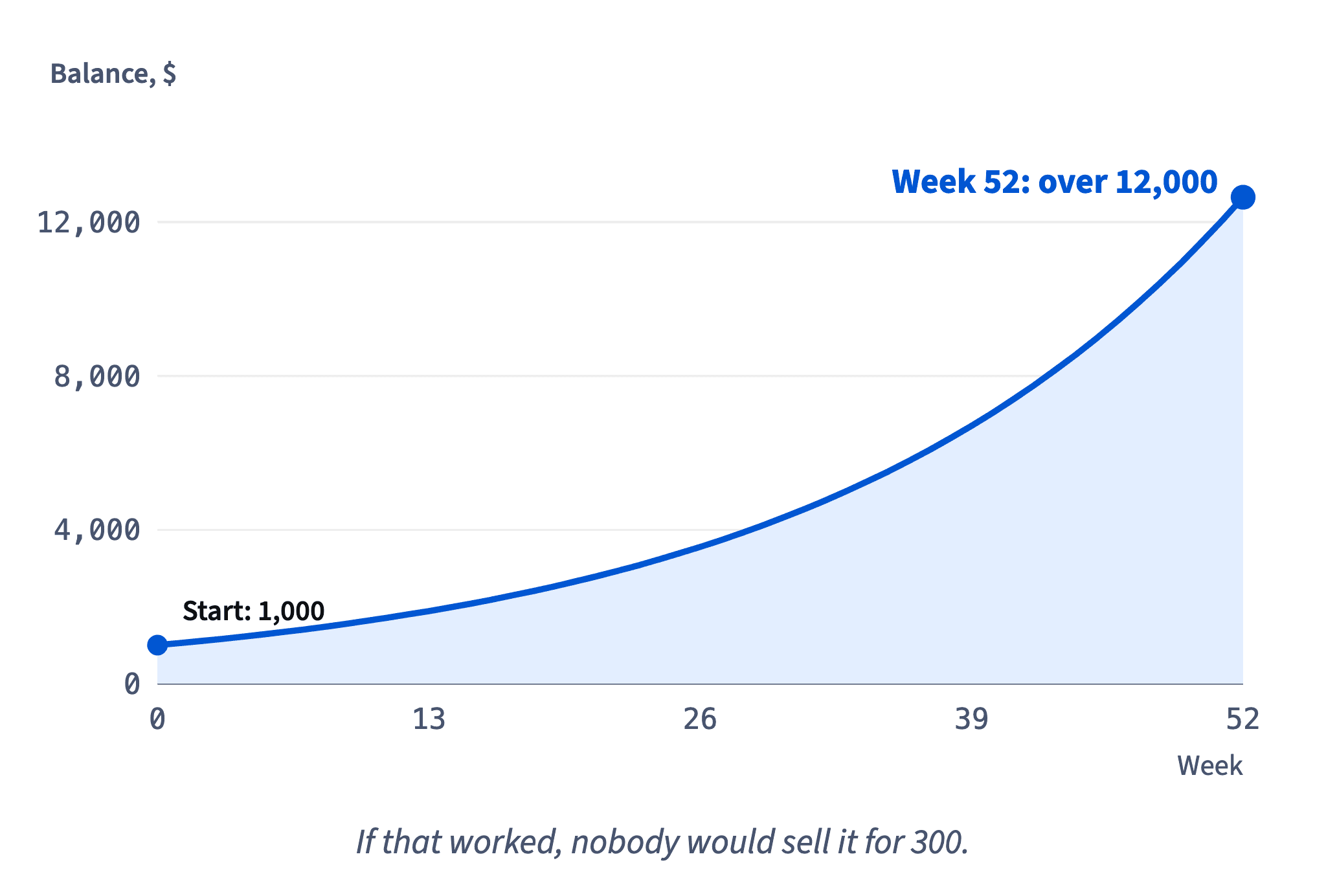
Growing 5% a week means each week's total is 1.05 times the last. After 52 weeks: 1,000 × 1.05^52 ≈ 12,643 dollars. The bot is promising to turn money into more than twelve times itself in a year, every year.
That's the sanity check: if a method really did this, its owner would be rich within a few years and would have no reason to sell it to strangers for 300 dollars. The price of the offer tells you what the seller thinks it's really worth.
Do the same with any "per day", "per week" or "per month" number: turn it into a year by compounding, then ask whether anyone in the world earns that reliably. In practice nobody does. Percentages and compounding are covered step by step in the math basics course.
- Do"5% a week is 1.05^52 ≈ 12.6 times a year. Nobody earns that reliably."
- Don't"Only 5% a week, that sounds modest."
Compounded, it's over twelve times the money in a year.
Never give access, and check who carries the losses
The fourth check is about control. Never give anyone your login and password. With them, a stranger can trade on your account and sometimes withdraw the money. No honest helper needs your password.
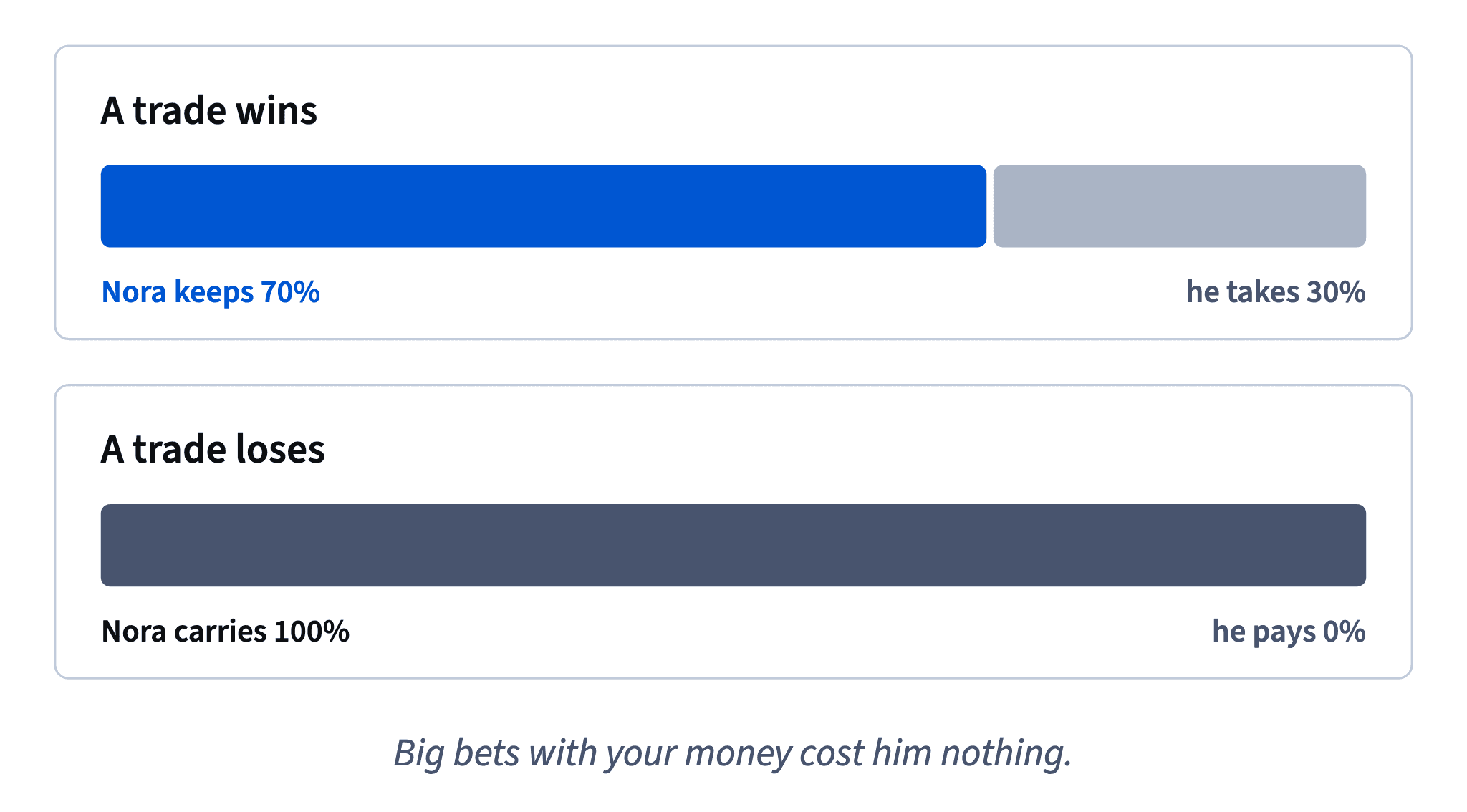
Then look at how the helper is paid. Nora's "account manager" keeps 30% of every profit and pays nothing when a trade loses. Put numbers on it: one trade gains 1,000, another loses 1,000. The trades break even, but Nora keeps only 700 of the win and carries the whole 1,000 loss: −300 for her, +300 for him.
That deal pushes him toward big bets with your money: wins pay him, losses cost him nothing. The same pattern hides in many offers: a fee on profits, a cut of wins, a subscription paid whether you win or lose. Whenever someone earns when you win but doesn't lose when you lose, ask who is really carrying the risk.
- Do"No one gets my login. If you want to help, explain your trades and I'll decide."
- Don't"He only takes a cut when he wins, so I can't lose."
You carry every loss in full.
Pressure and three words that need extra care
The fifth check is time. "Only 12 places left", "ends tonight", "decide by Friday": urgency exists to stop you checking. An honest offer survives a weekend of questions. A good deal on Friday is still good on Monday; one that vanishes wasn't worth the risk.
The right response is to ignore the clock and run your checks. Don't pay a deposit "to hold the place" and don't haggle: both keep you inside the seller's timetable.
Three words deserve extra care in any offer. Leverage (borrowed money) multiplies losses as well as gains. Crypto swings wildly, and made-up coins attract fake price pumps where early sellers dump on late buyers. Signals are paid for whether you win or lose, so the seller earns from subscriptions, not from your results. None of these is automatically a scam, but each makes the checks above even more important.
- Do"I'll decide after I've checked. If the offer is gone by then, fine."
- Don't"Only 12 places left, I'd better pay now."
The deadline is there to stop the checks.
Five checks for any trading offer
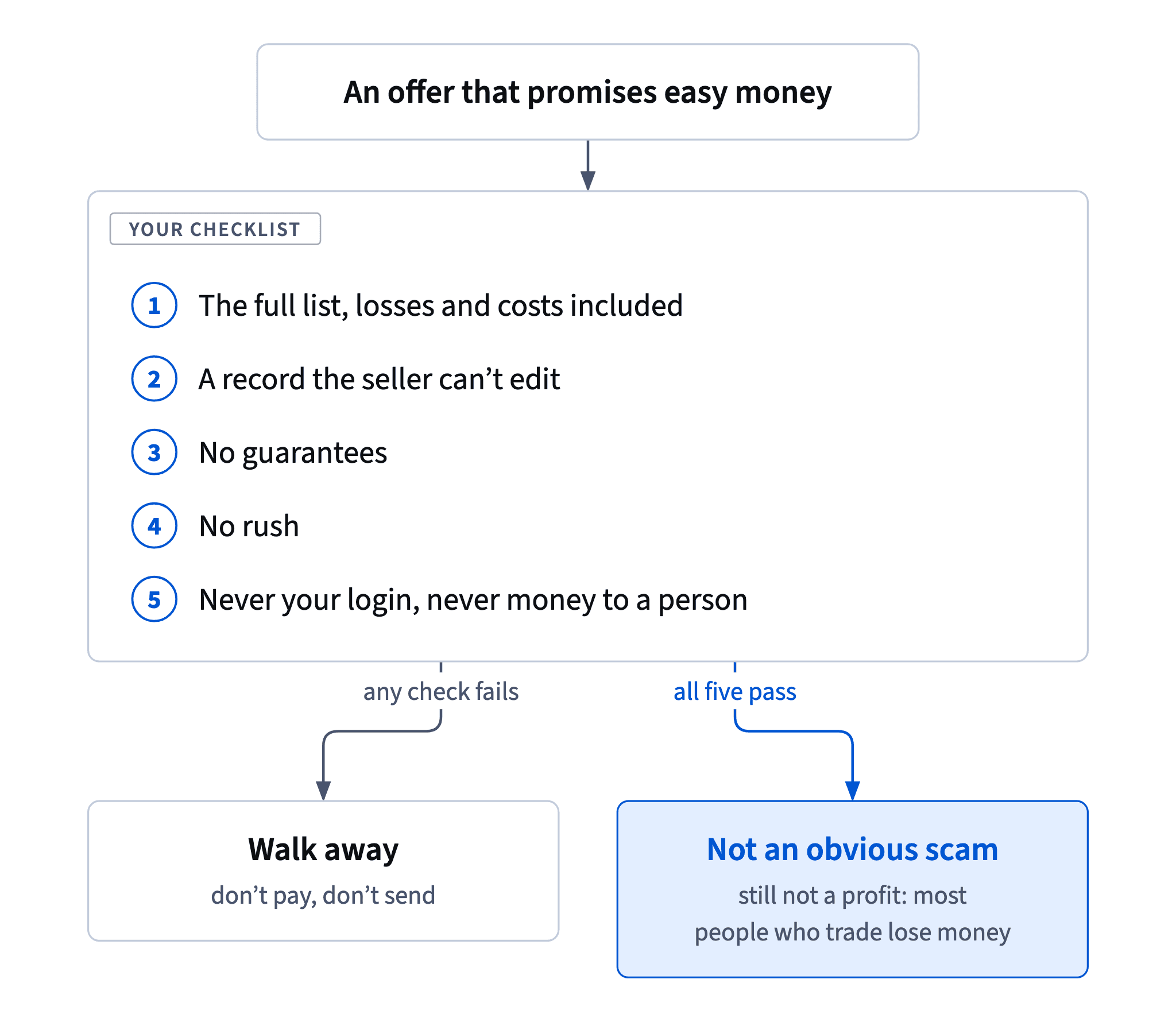
Every red flag switches off one check. Turn the five checks into a list you run on any offer:
- The full list, losses and costs included, not the shop window.
- A record the seller can't edit, such as a broker statement.
- No guarantees: a promised trading return is a red flag on its own.
- No rush: a deadline exists to stop the checks.
- Your control: never your login, never money sent to a person or held by someone you can't check.
And if an offer passes all five? Then it's honest, not profitable. Most people who trade still lose money; passing means "not an obvious scam", nothing more.
How it fits together: this module showed what trading is, what each trade costs, which habits sink accounts and how to test a promise. Next module: how a market works under the hood, from the exchange and the broker to the order you place.
- Do"Full list, broker statement, no guarantee, no rush, no login. Then I'll think."
- Don't"It passed every check, so it will make money."
Passing means honest, not profitable.
Ready to practise?
Answer the lesson's exercises and earn 250 points the first time you finish it.
Start the exercises