

Theory
Product roadmap presentation: one roadmap, four audiences
How to prepare a product roadmap presentation: why share the roadmap at all, how one roadmap becomes a view for the board, sales, engineering and customers, internal vs external roadmaps, the Osborne effect of a public roadmap, and how to present without overpromising.
~11 min read · 12 exercises · 250 points
Before you start
Four audiences in one week
The plan for CatChow is agreed, and now the roadmap has to leave the product team. This week you present it four times: sales and marketing on Wednesday, engineering on Thursday, PurrPoint on Friday and the board on the 16th. Four separate decks would drift apart within a week.
In this lesson you'll turn one roadmap into a view for each audience, decide what stays internal, and learn to present without promising more than the roadmap does.
One roadmap, several views
Once a roadmap is agreed, it has to leave the product team. The workshop had only a few people in it; the engineers and the salespeople who talk to clinics every day weren't there. You share a roadmap for three reasons:
- Inspiration: people see why the work matters.
- Alignment: every team can plan its own work around it.
- Ownership: people care more about a plan they've had a hand in.
The board, sales and marketing, engineering and a partner all need something different, and the tempting answer is a separate roadmap for each. Don't. Separate roadmaps drift apart within weeks, and then two teams plan around two different stories.
Keep one foundation for everyone: vision, objectives, themes and timeframes. Then build a view per audience by adding what that audience needs on top: progress for the board, confidence for sales, dependencies for engineering, conditions for a partner. Change the foundation, and every view changes with it.
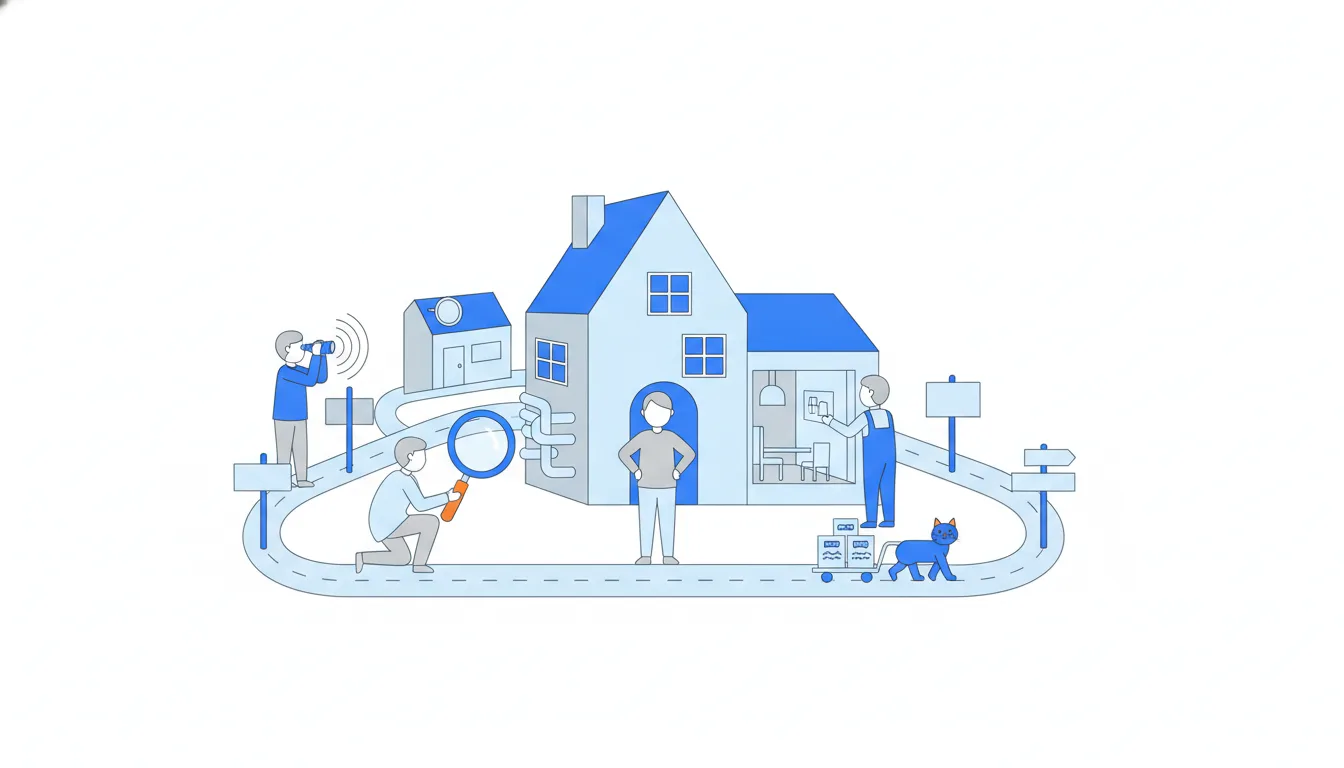
- DoOne roadmap file, with a board view, a sales view and an engineering view built from it
Every view updates when the foundation does.
- Don't“Sales has its own roadmap deck; I'll update it when I get a chance.”
A copy that drifts into a different story.
The board's view
A board thinks in investments and returns. In fifteen minutes it wants to know three things: where the product is going, whether it's working, and what the money buys.
So the board's view adds to the foundation:
- the vision and the objectives, with what their key results show so far;
- what has changed in the market, such as how the clinic channel is developing;
- what next quarter's budget buys.
Keep the details on hand, not on the slides: RICE scores, the warehouse migration plan with its milestones, the stage of every item and the “not now” list. If a director asks about the portal or the quiz, answer briefly and move on.
Putting the full internal roadmap in front of a board looks thorough, but it invites the board to manage the work itself. Fifteen minutes spent re-ranking candidates are fifteen minutes not spent on whether the objectives are worth the money.
- Do“Clinics: 8 of 9 pilot orders came in without a call. Next quarter's budget takes the form to all 14 PurrPoint clinics.”
Objective, evidence, what the money buys.
- Don'tA slide with every candidate and its RICE score “so the board can check the ranking”
Invites the board to re-rank the work.
Read the board's questions
A board's appetite for detail falls as its trust grows. When directors are confident the work is going well, they ask about objectives, the market and money. When they start digging into individual features, how a quiz is designed or which screen comes first, they are usually worried about how the work is going.
That changes what you do next. Adding more feature detail to the next deck feeds the worry; it tells the board that managing the details is now their job. Inviting directors into design sessions does the same.
What rebuilds trust is making progress easy to see:
- what moved: for example, 8 of 9 pilot orders without a call, stock-outs down from 6 to 5 a month;
- what didn't: churn still at 9%, said plainly before anyone asks;
- what happens next, and what it depends on.
The less the board needs to ask, the better it's usually going. Your job is to report so clearly that the digging stops by itself.
- Do“Churn hasn't moved yet: still 9%. Here's what we expect to see first, and when.”
Names what didn't move before anyone asks.
- Don't“The board asked about the quiz, so next time let's add every feature's design.”
Feeds the worry instead of rebuilding trust.
The sales and marketing view
Sales and marketing plan campaigns and customer conversations, so their view adds to the foundation exactly what those plans depend on:
- the stage of each theme: is it being explored, tested or built?
- the target customers: which theme is for subscribers, which for clinics, which for new owners;
- the confidence the team has in each column, so they know what's safe to talk about;
- the external events they plan around, such as the conference on 23 May.
Two things stay out. Prioritization scores such as RICE are internal working material; in a sales deck they invite debates about the method instead of the customer. And a launch date for something that isn't on the plan, like the clinic portal, would turn a wish into a promise the moment a salesperson repeats it to a clinic.
A good test: could a salesperson read this view and know what to say to a clinic tomorrow, and what not to say yet?
- Do“Clinics restock without phoning us. For partner clinics. Stage: Testing. Confidence: about 80%.”
Stage, customers and confidence in one line.
- Don't“Clinic portal: launch 1 May (RICE 412)”
An internal score and a date for an item that isn't on the plan.
Confidence before money is spent
Confidence, the per-column measure from Going deeper, matters most right before money is spent. Brochures, ads and a launch at a stand are bets that something will exist and work by a date. Make them when the item is being built and confidence is high, not while it's still being tested.
Marketing wants to print brochures for the conference on 23 May: “The CatChow clinic portal, now live.” The portal isn't even on the plan; the form is, and it is still being tested. Printing that claim now would turn a candidate into a public promise, and if it slipped, the brochures would go in the bin along with some of your credibility.
That doesn't mean telling marketing to wait with nothing. Give them what is solid:
- the outcome they can plan the stand around: clinics reordering without a phone call;
- a date for the decision: what to print gets decided at the March review, once the form has run in all 14 PurrPoint clinics;
- real proof to use then, such as a pilot clinic's numbers.
- Do“Plan the stand around clinics reordering without a call. We'll decide the printed claim at the March review.”
Gives marketing something solid now and a date for the rest.
- Don't“Print ‘Online ordering for every partner clinic by May’, it's on the roadmap.”
Spends money on a claim that is still being tested.
The engineering view
Engineers read a roadmap to plan the work, so their view goes deepest. Under each theme it adds:
- the likely features: for the clinic theme, the online form for all 14 PurrPoint clinics, then the other partner clinics;
- the stage: testing, building;
- the dependencies: clinic orders move to the new system first, then the form can reach all PurrPoint clinics;
- the risks: parts of the old system nobody documented.
Features go to engineers for feasibility feedback, not as orders with deadlines. They know where the hard parts are, and their answer can change the order.
This view also gives technical debt a line: old shortcuts and features that slow down every change. The example of Lucy, the tech lead, is gift cards: twelve people used them last year, yet the team tests them in every release. On the roadmap, that cost competes for time in the open instead of eating it quietly.
The board doesn't need gift cards and PurrPoint doesn't need dependencies. Same roadmap, different depth.
- Do“Likely: the form for all 14 PurrPoint clinics. Depends on clinic orders moving to the new system. Risk: undocumented parts of the old one.”
Features, dependency and risk for the people who build it.
- Don't“Build the clinic form by 15 February. No changes to scope.”
An order with a deadline, no room for feasibility feedback.
Internal vs external, and the Osborne effect
Picture two scales: how much detail a view carries, and whether the reader is inside the company or outside. Internal views for the board, sales and engineering carry detail and new directions. An external roadmap for customers or the public shows far less of both. The further out the reader, the less detail.
Customers ask for features and dates, but what they usually need is proof that you've heard them, that you're working on their problem, and that you'll tell them more when you know it.
A public roadmap page has three risks:
- Overpromising: anything on it reads as a commitment.
- Competitors read it too, for free.
- The Osborne effect: announcing a better product too early, so customers stop buying the current one and wait for the next. If CatChow announced a clinic portal, new clinics might wait for it instead of signing now, and sales would drop before the portal even existed.
So a public page has to earn its place, and when it exists, it shows what's delivered or contractually fixed.
- DoA public page listing what's delivered, with “more when we know it” for the rest
Shows progress without promising the future.
- Don't“Coming soon: the CatChow clinic portal!” on the website in January
Invites clinics to wait instead of signing now.
Four views, and a page for a partner
Every audience gets the same vision, objectives, themes and timeframes, plus what it needs to act:
- The board judges the investment: progress on the key results, changes in the market, what the budget buys.
- Sales and marketing plan campaigns: stage, target customers, confidence, external events.
- Engineering plans the work: likely features, dependencies, risks, technical debt.
- A partner like PurrPoint needs to see its own problem being solved: what changes for its clinics, what's been delivered, what comes next and on what condition, and a partner disclaimer, one of the audience versions from Timeframes and the roadmap disclaimer.
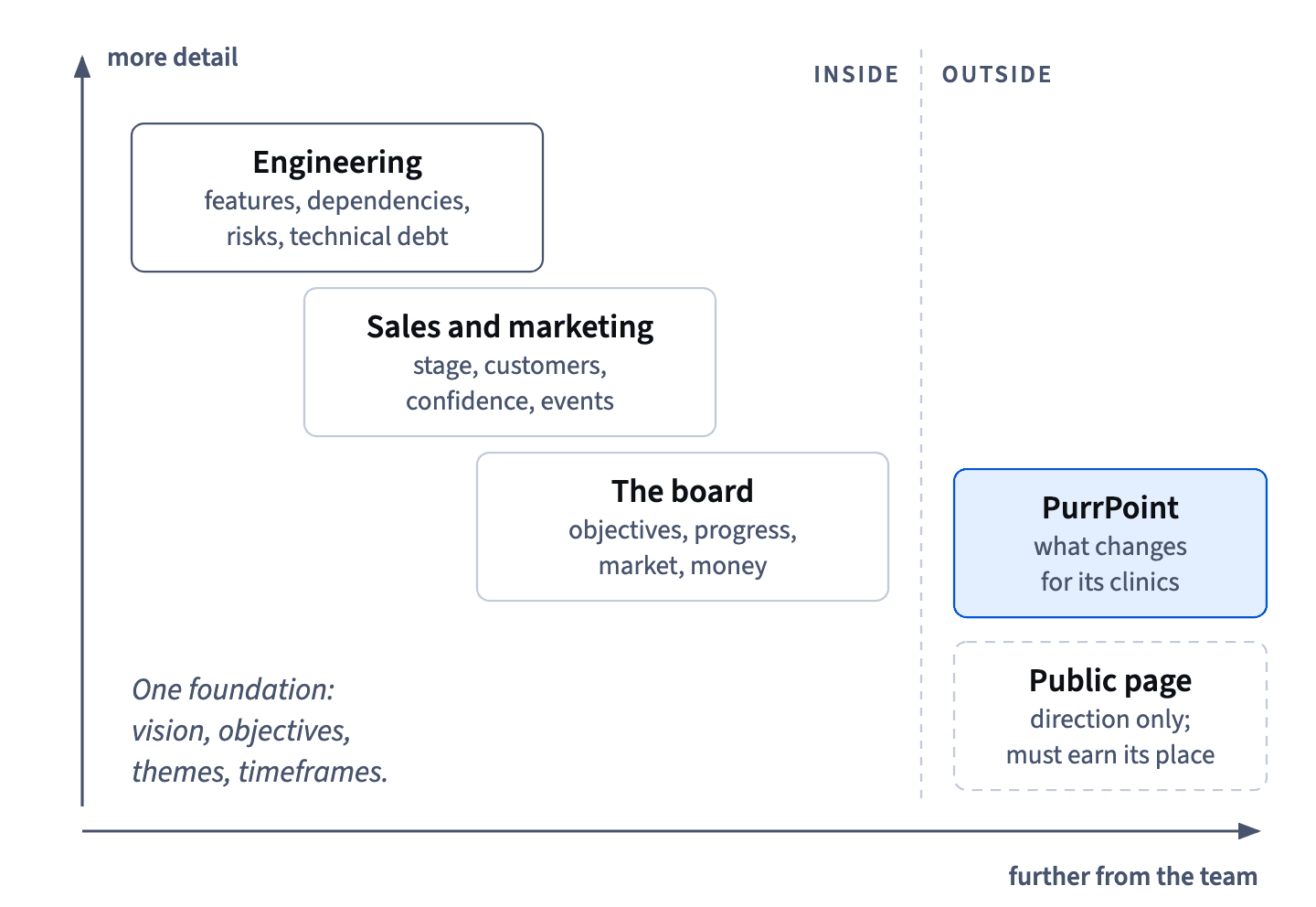
The partner page is the one most easily ruined. Write it for the people who read it, here a procurement manager and her admins. Put their results in (an order now takes about five minutes instead of a twenty-minute call). State the condition next to the date: February for all 14 clinics, once clinic orders move in January. A condition they know about is a plan; a condition they discover later is a broken promise. And leave out everything that isn't theirs: subscribers, other clinics, Later.
- Do“Next: all 14 of your clinics order online, planned for February, once our new warehouse system handles clinic orders.”
The date comes with its condition.
- Don't“All 14 clinics online from 1 February. Also coming: subscriber quiz, new-owner kits.”
A bare date, and other audiences' plans on a partner's page.
Prepare, then tell it in order
You don't need four decks written from scratch. Before each meeting, answer four questions:
- Who's in the room, and what have they seen before?
- What do you want from them: input, agreement, or just awareness?
- What do they care about?
- Which parts of the roadmap answer that?
Then tell it in the same order every time:
- Why: the vision and a real story, like the clinic admin who used to lose her Monday mornings on the phone.
- Progress since last time: what's live, what the pilot showed, and what hasn't moved yet.
- The near term: the next quarter and what it depends on.
- The longer term, with confidence clearly falling.
Progress comes before the plan because trust comes from what you've done, not what you promise. For a two-minute opening, use only the first two parts, with real numbers, including the ones that haven't moved.
How it fits together: One foundation, a view for each audience, and the same telling order every time: why, progress, near, long. Next, Keeping it fresh: what happens when the plan meets the next month.
- Do“In our pilot clinics, 8 of 9 orders came in without a call. Churn is still 9%, and here's why we expect it to move.”
Progress with real numbers, including what hasn't moved.
- Don'tOpening with the full plan for the next nine months, then “and here's what we did”
Promises before proof.
Ready to practise?
Answer the lesson's exercises and earn 250 points the first time you finish it.
Start the exercises