

Theory
Slope as a marginal quantity
What one more unit adds: marginal vs average CAC and cost, operating leverage as 1 ÷ margin of safety, and price elasticity as a ratio of relative changes.
~9 min read · 9 exercises · 250 points
Before you start
The next step, not the whole road
Back on Klasna's product team. Marketing tested its social channel at four monthly budgets and counted the new families each one brought. Dividing everything spent by everyone acquired gives a reassuring cost per family.
You'll ask a different question: what did the last step of budget buy? You'll read slope as a marginal quantity, compare average and marginal cost, and see why decisions about the next hryvnia need the second one.
Average and marginal
Two numbers answer two different questions.
- The average divides a total by a total: everything spent ÷ everyone acquired. It answers "how did we do overall?"
- The marginal quantity compares two neighbouring points: Δy ÷ Δx, the change in one over the change in the other (Δ as in Notation: indices, bars, hats and Greek letters). It answers "what does the next step buy?"
Klasna's social channel brought 25 new families at 50,000 UAH a month, 40 at 100,000, 50 at 150,000 and 55 at 200,000. At 200,000 the average CAC is 200,000 ÷ 55 ≈ 3,636 UAH. But the last 50,000 bought only 55 − 50 = 5 families: 10,000 each.
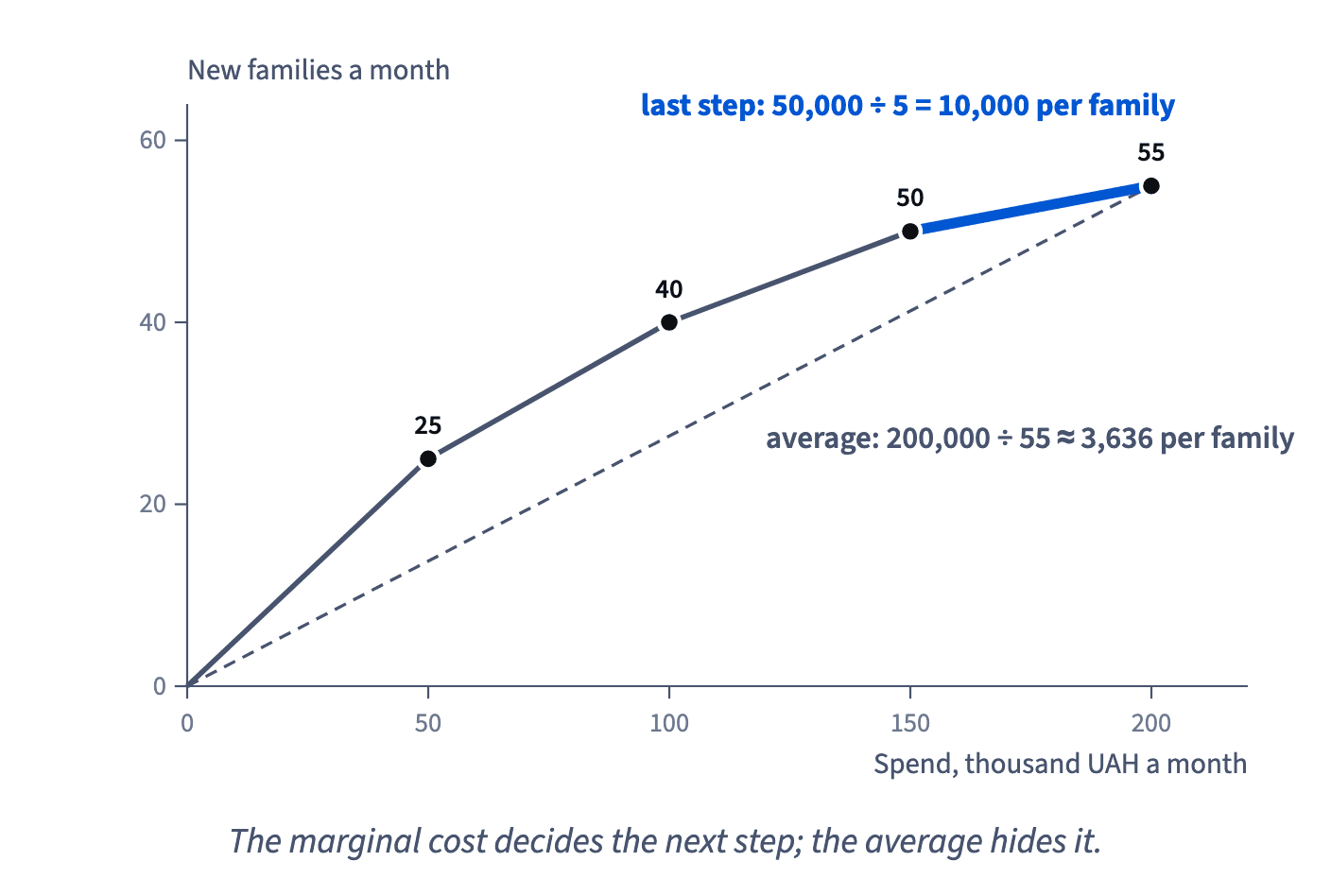
On a straight line through zero the two numbers are equal. On a curve that flattens, as most channels do once the easy audience is reached, the marginal number runs away from the average. The average is the slope of the line from zero to the point; the marginal is the slope of the last step.
- Do"The last 50,000 bought 5 families: 10,000 per family at the margin."
- Don't"A family costs us 3,636, so every extra family costs 3,636."
The average is not the price of the next customer.
Computing a marginal CAC
Marginal CAC = Δspend ÷ Δcustomers, taken between two neighbouring budgets. Order the budgets, then divide each step's extra spend by the extra customers that step brought.
Example: a search-ads test at Klasna brought 20 new families at 30,000 UAH a month, 32 at 60,000 and 38 at 90,000.
- 0 → 30,000: 30,000 ÷ 20 = 1,500 per family;
- 30,000 → 60,000: 30,000 ÷ 12 = 2,500;
- 60,000 → 90,000: 30,000 ÷ 6 = 5,000.
The averages look calm: 1,500, then 60,000 ÷ 32 = 1,875, then 90,000 ÷ 38 ≈ 2,368. The marginal numbers show the real trend: each step costs about twice the one before.
Two slips mix a total with a step: dividing the whole budget by the extra customers (90,000 ÷ 6) and dividing the extra spend by all customers (30,000 ÷ 38). Both Δs must belong to the same step.
- Do(60,000 − 30,000) ÷ (32 − 20) = 2,500 per family.
- Don't90,000 ÷ (38 − 32) = 15,000 per family.
The whole budget divided by one step's customers.
The rule: compare the margin with the value
When a decision only adds a step, judge it by what that step adds. Buy the next step of spend while its marginal CAC is below what a new customer is worth; stop where it rises above.
Say a new family leaves Klasna 4,000 UAH of contribution over its time with the school, and the search-ads steps cost 1,500, 2,500 and then 5,000 per family (20 families at 30,000 a month, 32 at 60,000, 38 at 90,000). The first two steps pay; the third doesn't. Stop at 60,000. The last 30,000 would bring 6 × 4,000 = 24,000 of contribution: a loss of 6,000 a month.
Meanwhile the average at 90,000, 90,000 ÷ 38 ≈ 2,368, still sits well below 4,000. It looks fine only because the cheap early families are mixed in. A decision about the extra money needs the extra numbers.
The average answers a different question, whether the channel as a whole paid back, and is the right number for that one.
- Do"The third step costs 5,000 per family and a family brings 4,000: stop at 60,000."
- Don't"Average CAC is 2,368, below 4,000, so spend the full 90,000."
The average hides the loss on the last step.
Marginal cost and average cost
Costs split the same way. Klasna's own video classroom would cost 120,000 UAH a month plus 8 UAH per lesson, a line as in The linear function.
- Marginal cost: what one more lesson adds, the slope: 8 UAH at any volume.
- Average cost: total ÷ lessons = 120,000 ÷ n + 8. It falls as volume grows, because the fixed part is spread thinner: 5,000 lessons give 24 + 8 = 32 UAH a lesson, 12,000 lessons give 10 + 8 = 18 UAH.
The average comes ever closer to the marginal cost but never reaches it.
Which one to use? "Should we take one more lesson, or one big extra order?" needs the marginal cost. "What did a lesson cost us this month?" and any price that must cover the fixed part need the average. Pricing one special deal at the marginal 8 UAH can be fine; pricing everything there leaves the 120,000 uncovered.
- DoAverage at 5,000 lessons = 120,000 ÷ 5,000 + 8 = 32 UAH.
- Don't"An extra lesson costs us 32 UAH."
One more lesson adds only the slope, 8 UAH.
Step costs at the margin
A step cost turns the marginal picture upside down. Support coordinators cost ⌈learners ÷ 400⌉ × 38,000 UAH a month: one coordinator per 400 learners, rounded up.
At 1,200 learners Klasna pays 3 coordinators, 114,000 UAH, an average of 95 UAH per learner. Learners 801 to 1,200 cost nothing extra at the margin: the third coordinator has room for them. But learner 1,201 needs a fourth coordinator, so at the margin that one learner costs 38,000 UAH.
Near a step, the marginal cost is either zero or a whole salary, and the average hides both. In practice: right before a step, growth is nearly free; right after it, the new capacity is paid for before it fills up.
So plan growth in blocks, here of 400 learners, and judge the block rather than the single learner: once the new coordinator is full, 38,000 ÷ 400 = 95 UAH per learner again.
- Do"Going from 1,200 to 1,600 learners adds one coordinator: 38,000 for 400 learners."
- Don't"Each new learner costs 95 UAH of support."
At the margin it's 0 or 38,000, never 95.
Operating leverage: a slope in percentages
Sometimes the slope is measured in percentages. Operating leverage (DOL) asks: if volume grows by 1%, by how many percent does profit grow? DOL = %Δprofit ÷ %Δvolume = contribution ÷ profit.
A quick estimate: DOL ≈ 1 ÷ margin of safety, where the margin of safety, (actual − break-even) ÷ actual, says how far a month sits above break-even. In March Klasna ran 24.11% above break-even, so DOL ≈ 1 ÷ 0.2411 ≈ 4.15: +10% lessons gave about +41% profit.
Why so strong? Fixed costs don't grow with volume, so the extra contribution goes straight to profit, and profit is a small base. The closer to break-even, the smaller that base and the larger the swings: at 10% above break-even DOL ≈ 10, and a 5% dip in lessons wipes out half the profit.
It works in both directions, which is what people forget: a business with high leverage loses as fast in a bad month as it gains in a good one.
- DoMoS = 0.25 → DOL ≈ 4 → −5% lessons ≈ −20% profit.
- Don't"Lessons fell 5%, so profit will fall about 5% too."
With fixed costs, profit moves several times faster than volume.
Price elasticity
Price elasticity compares two relative changes: e = %ΔQ ÷ %ΔP, the percentage change in quantity sold over the percentage change in price.
In the finance course, a 10% discount brought 30% more packages: e = +30% ÷ −10% = −3. The sign is negative because price and quantity usually move in opposite directions, so people compare the size, |e|:

- |e| > 1: elastic demand, buyers react more strongly than the price moved;
- |e| < 1: inelastic demand, they react less.
Watch the order: quantity on top, price below. Swapping them gives −0.33 instead of −3 and the opposite reading. Use percentage changes for both, never one in UAH and the other in percent.
An elasticity measured for one change, such as a 10% discount in exam season, is a local number: it says little about a 40% cut or another season.
- Doe = %ΔQ ÷ %ΔP = +30% ÷ −10% = −3.
- Don'te = %ΔP ÷ %ΔQ = −10% ÷ +30% ≈ −0.33.
Quantity goes on top.
What elasticity says about revenue, and what it doesn't
Revenue is price × quantity, so after a change it is multiplied by (1 + %ΔP) × (1 + %ΔQ), a product of factors as in Products of shares: funnels and metric trees.
- Elastic demand and a cut: −10% price, +30% packages → 0.9 × 1.3 = 1.17, revenue +17%.
- Inelastic demand and a rise: +5% price, −4% sales → 1.05 × 0.96 = 1.008, revenue +0.8%.
With elastic demand a cut lifts revenue and a rise lowers it; with inelastic demand it's the other way round. Don't just add the percentages: −10% + 30% = +20% overstates the 17%.
Revenue is not profit, though. The 10% cut above lowered contribution by 12.6%, because the discount came out of a thin margin while every extra package still cost tutors' time. Check contribution before calling a price change a win.
Picture: Elastic demand lifts revenue; it can still lower profit. · shown above
How it fits together: a marginal quantity is the slope of one step, Δy ÷ Δx; marginal CAC and marginal cost decide "one more step?", while operating leverage and elasticity are the same idea in percentages. The next lesson handles formulas with several inputs and finds which one matters most.
- DoRevenue factor = 1.10 × 0.85 = 0.935, so −6.5%.
- Don't"Revenue rose 17%, so the discount paid off."
Contribution fell 12.6% in the same month.
Ready to practise?
Answer the lesson's exercises and earn 250 points the first time you finish it.
Start the exercises