

Theory
Rounding: at the end, and sometimes up
Compute from unrounded values, round once at the end, and round up whenever you need enough: break-even, staff, test length.
~8 min read · 9 exercises · 250 points
Before you start
Round once, at the end
Back at Klasna after the detour, still on the product team. March's numbers are in: the contribution margin from 7,840 lessons and the month's fixed costs. The question sounds simple: how many lessons cover those costs?
You'll see how rounding too early quietly moves an answer, when to round and to how many digits, and why some answers, such as how many tutors or lessons you need, must always be rounded up.
Round once, at the end
Rounding throws a little information away, and a little can be multiplied into a lot. In March Klasna earned 1,367,884 UAH of contribution margin on 7,840 lessons, 174.475 UAH a lesson, and its fixed costs were 1,038,000 UAH. Divide by the full value and break-even is 5,949.3 lessons. Round the contribution to 174 first and you get 5,965.5. Dropping less than half a hryvnia moved the answer by 16 lessons, because the tiny error sits in the denominator and is multiplied across a million hryvnias.
The rule: compute with full precision and round once, when you report. In a spreadsheet that means referencing cells instead of retyping rounded numbers, and rounding only the cell you show, or only its display format.
Rounding for display is harmless; rounding inside a calculation is not. If a number feeds another formula, keep all its digits.

- DoDivide by the cell that holds 174.475, get 5,949.3
- Don'tRetype "174" into the next formula
Sixteen lessons of drift.
Subtracting rounded rates
Each rounded number can be off by up to half of its last shown digit. Shown to one decimal, 12.6% could be anything from 12.55% to 12.65%. Subtract two such numbers and the errors can add up, so the gap between them can be off by a whole unit of that last digit, 0.1 pp.
That matters most when the gap is small, which is exactly when you care about it. Two versions of a sign-up screen: in A, 412 of 3,280 new users subscribed (12.561%); in B, 455 of 3,310 (13.746%). A dashboard rounding to one decimal shows 12.6% and 13.7%, a gap of 1.1 pp. From the unrounded rates the gap is 13.746 − 12.561 = 1.185, about 1.19 pp: the display understated it by about 7%.
So compute gaps from counts or unrounded rates, never from the labels on a chart. Two rates shown as 12.5% and 12.5% are not necessarily equal; they can differ by almost 0.1 pp.
- Do(455 ÷ 3,310 − 412 ÷ 3,280) × 100 ≈ 1.19 pp
- Don't13.7 − 12.6 = 1.1 pp, read off the dashboard
Two rounding errors added together.
How many digits to report
Rounding once at the end still leaves a choice: to how many digits? Report as many as the decision needs, and no more.
- Money: to the kopiyka or the cent for an amount per unit (174.48 UAH a lesson), to thousands or millions in a plan.
- Rates in percent: one or two decimals, enough to see the gaps you compare. If two versions differ by 1.19 pp, showing 13% and 14% blurs the result.
- Counts of people, lessons or weeks: whole numbers, rounded in the direction the question needs.
Extra digits are not more honest. "174.4750000 UAH" or "5,949.28 lessons" suggest a precision nobody uses and make the report harder to read. Too few digits hide differences that matter.
Keep the full value in the cell and change only how it is shown. Then the next formula still uses every digit.
- DoConversion 12.56%, CM 174.48 UAH per lesson, break-even 5,950 lessons
- Don'tBreak-even: 5,949.28 lessons
Nobody teaches 0.28 of a lesson.
Round up when you need enough
Ordinary rounding goes to the nearest whole number. Some questions can't accept that, because falling short is the risk.
Break-even asks how many lessons are enough to cover fixed costs. 5,949.3 to the nearest is 5,949, but 5,949 lessons leave March a little short. So you round up: 5,950. Math writes it with corner brackets, ⌈x⌉, the ceiling: the smallest whole number not below x. Break-even becomes Q_BE = ⌈F ÷ c⌉. In a spreadsheet: ROUNDUP(x, 0).
Formula: Q_BE: break-even lessons; F: fixed costs; c: contribution per lesson. ⌈x⌉, the ceiling, is the smallest whole number not below x; ⌊x⌋, the floor, the largest not above x. In most spreadsheets: ROUNDUP(x, 0) and ROUNDDOWN(x, 0). · shown above
Step costs work the same way. A Klasna support coordinator looks after up to 400 active learners. For 1,260 learners, 1,260 ÷ 400 = 3.15, and 0.15 of a person can't answer chats, so you need ⌈3.15⌉ = 4 coordinators. With 3, the last 60 learners have nobody.
The test: is a fraction of the thing useless, and is too few the danger? Then round up, even from 3.01.

- Do⌈3.15⌉ = 4 coordinators for 1,260 learners
- Don't1,260 ÷ 400 ≈ 3 coordinators
60 learners are left without support.
Round down when you count what fits
The opposite question is "how many whole things fit?" A fraction is just as useless here, but rounding up would promise something that isn't there, so you round down. Math writes it ⌊x⌋, the floor: the largest whole number not above x. In a spreadsheet: ROUNDDOWN(x, 0).
Full groups of four from 138 learners: 138 ÷ 4 = 34.5, so ⌊34.5⌋ = 34 groups, with 2 learners left over. A tutor with 37 free hours and classes of 1.5 hours: 37 ÷ 1.5 = 24.67, so 24 classes and an hour to spare. Whole packages a budget can buy, full boxes a shelf can hold: all floors.
Rounding to the nearest here would overpromise: a 25th class needs 37.5 hours.
What's left over is information too. Two learners without a group or an unused hour are worth reporting next to the floor.
- Do⌊34.5⌋ = 34 groups, 2 learners left over
- Don't138 ÷ 4 ≈ 35 groups
The 35th group has two people.
The question decides the direction
There are three ways to round, and the question tells you which:
- up (⌈x⌉) when you need enough and falling short is the risk: break-even, staff, servers, test weeks, users per variant from a sample-size formula;
- down (⌊x⌋) when you count what fits: full groups, whole packages, classes in a week;
- to the nearest when you only describe: a conversion rate in a report, an average price.
Before rounding, say the question out loud. "How many coordinators do 1,610 learners need?" is about enough: 1,610 ÷ 400 = 4.025, so 5. "How many full groups of four can 138 learners form?" is about what fits: 34. "What was conversion this week?" only describes, so 12.56% stays 12.56%.
A wrong direction is not a small error. Round coordinators to the nearest and 10 learners are left uncovered; round groups up and you plan a class that can't be filled.
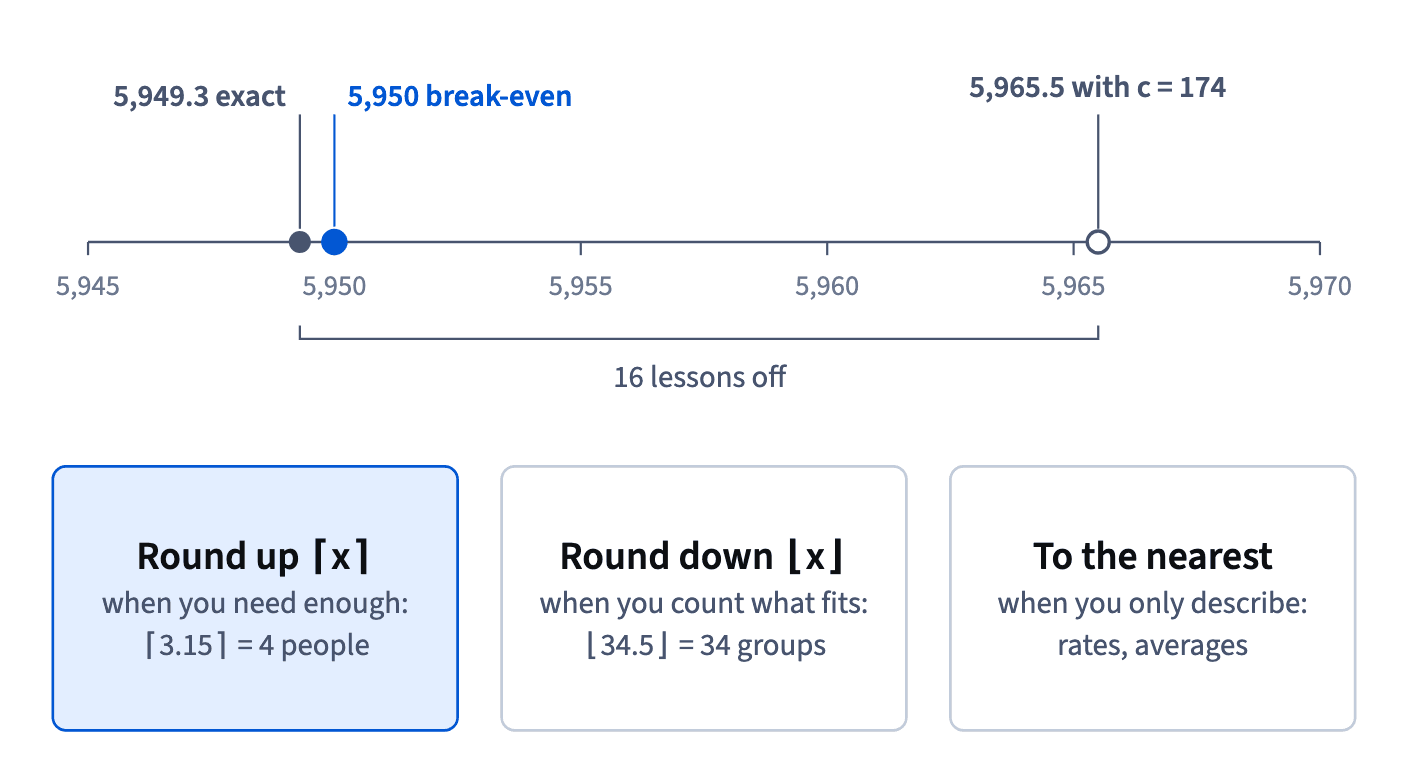
- Do"Enough coordinators?" → ⌈4.025⌉ = 5
- Don'tRounding every result to the nearest by habit
The habit ignores what the number is for.
Whole weeks for a test
A test-length question rounds up in two ways at once. Say a test needs 9,200 users in each of two variants, and about 2,600 new users a week enter it in total. Users needed: 2 × 9,200 = 18,400; weeks: 18,400 ÷ 2,600 = 7.08.
First, up, because the test was sized for 18,400 users and stopping after 7 weeks leaves it short. Second, to whole weeks, on purpose: behavior has a weekly rhythm, and weekends differ from weekdays, so seven and a half weeks would over-count some days. The answer is 8 full weeks.
Two slips to avoid. Dividing the users of one variant by the weekly traffic of both (9,200 ÷ 2,600 ≈ 3.5 weeks, half of what's needed). And stopping early because the result already "looks clear": the length is fixed before the test starts.
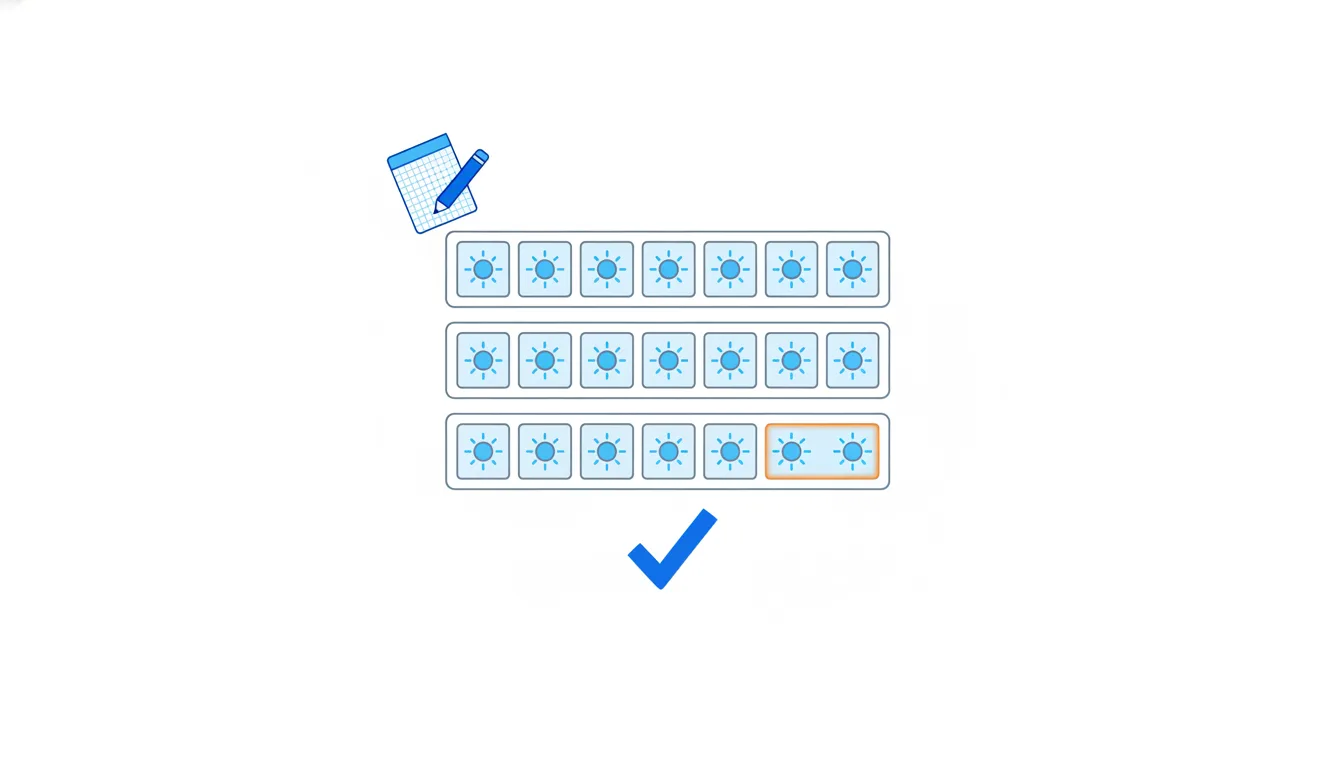
- Do18,400 ÷ 2,600 = 7.08 → 8 full weeks
- Don't"7.08 weeks, so 7 is close enough"
Short of users and cut mid-week.
A routine for any formula
The lesson fits into one routine you can apply to any formula in the other courses:
- compute from the raw totals with full precision;
- feed the unrounded results into every next step;
- round once, in the direction the question needs: up for enough, down for what fits, to the nearest to describe;
- check the result against what it has to cover;
- report with as many digits as the decision needs.
For March break-even: 1,367,884 ÷ 7,840 = 174.475; 1,038,000 ÷ 174.475 = 5,949.3; round up to 5,950; check: 5,950 × 174.475 ≈ 1,038,126, just above 1,038,000; report 5,950 lessons and 174.48 UAH a lesson.
Formula: Q_BE: break-even lessons; F: fixed costs; c: contribution per lesson. ⌈x⌉, the ceiling, is the smallest whole number not below x; ⌊x⌋, the floor, the largest not above x. In most spreadsheets: ROUNDUP(x, 0) and ROUNDDOWN(x, 0). · shown above
How it fits together: precision stays inside the calculation, rounding happens once, and its direction comes from the question. Next lesson: estimating a number in your head before you trust the spreadsheet.
- DoCheck: 5,950 × 174.475 ≈ 1,038,126 ≥ 1,038,000
- Don'tRounding every step "to keep it simple"
The errors pile up: rounding 174.475 to 174 already moves break-even by 16 lessons.
Ready to practise?
Answer the lesson's exercises and earn 250 points the first time you finish it.
Start the exercises