

Theory
Order of operations, ratios and multiples
Read a business formula in the right order, tell a share from a ratio, and turn a multiple into a value.
~10 min read · 10 exercises · 250 points
Before you start
Math for the numbers at Klasna
Klasna is an online tutoring school from Kyiv that sells prepaid packages of English, exam math and programming lessons. It is growing, and more of its decisions now rest on formulas in spreadsheets, where one wrong bracket can quietly cost real money.
You've joined Klasna's product team to help with the math behind its numbers: percentages, averages, growth, probability, the same formulas the statistics, finance and product-analytics courses use. Module 1 asks one question: can you trust a number before you build on it? This first lesson covers the order of operations, shares and ratios, and multiples.
Order of operations: the rule behind every formula
A formula is a recipe, and the order of operations says which step comes first. The levels, from first to last:
- brackets;
- powers and roots;
- multiplication and division;
- addition and subtraction.
Within one level you go left to right. So in 200 − 40 ÷ 4 × 2 the subtraction waits: first 40 ÷ 4 = 10, then 10 × 2 = 20, and only then 200 − 20 = 180.
This is not school pedantry. Spreadsheets and calculators apply exactly the same levels, so a formula typed in the order you would read it aloud can return a confident, wrong number without any warning. When you want a different order, you have to say so with brackets: (200 − 40) ÷ 4 × 2 = 80 is a different question with a different answer.

- Do
=200-40/4*2returns 180: ÷ and × before −The sheet and the rule agree.
- Don'tReading 200 − 40 ÷ 4 × 2 left to right and getting 80
That silently adds brackets nobody wrote.
Reading a business formula step by step
The finance course writes what one Klasna lesson earns as CM = P − T − 0.025 × P − V: the price, minus the tutor's payout, minus a 2.5% payment fee, minus video and AI costs. CM is the contribution margin, what the lesson leaves after the costs that come with it.
Read a formula like this in three moves:
- Substitute. Put a number in place of each letter. For an English lesson from the 16-lesson package: P = 620, T = 390, V = 30 UAH.
- Multiply first. 0.025 × 620 = 15.50 UAH of fee.
- Then subtract, left to right. 620 − 390 − 15.50 − 30 = 184.50 UAH.
Typed left to right as (620 − 390 − 0.025) × 620 − 30, the same symbols give about 142,555 UAH for one lesson: the fee turned into a plain number, and the price multiplied everything before it.
Notice what each term is. 0.025 × P is a percent of the price, so it moves when the price moves; T and V are fixed amounts per lesson.
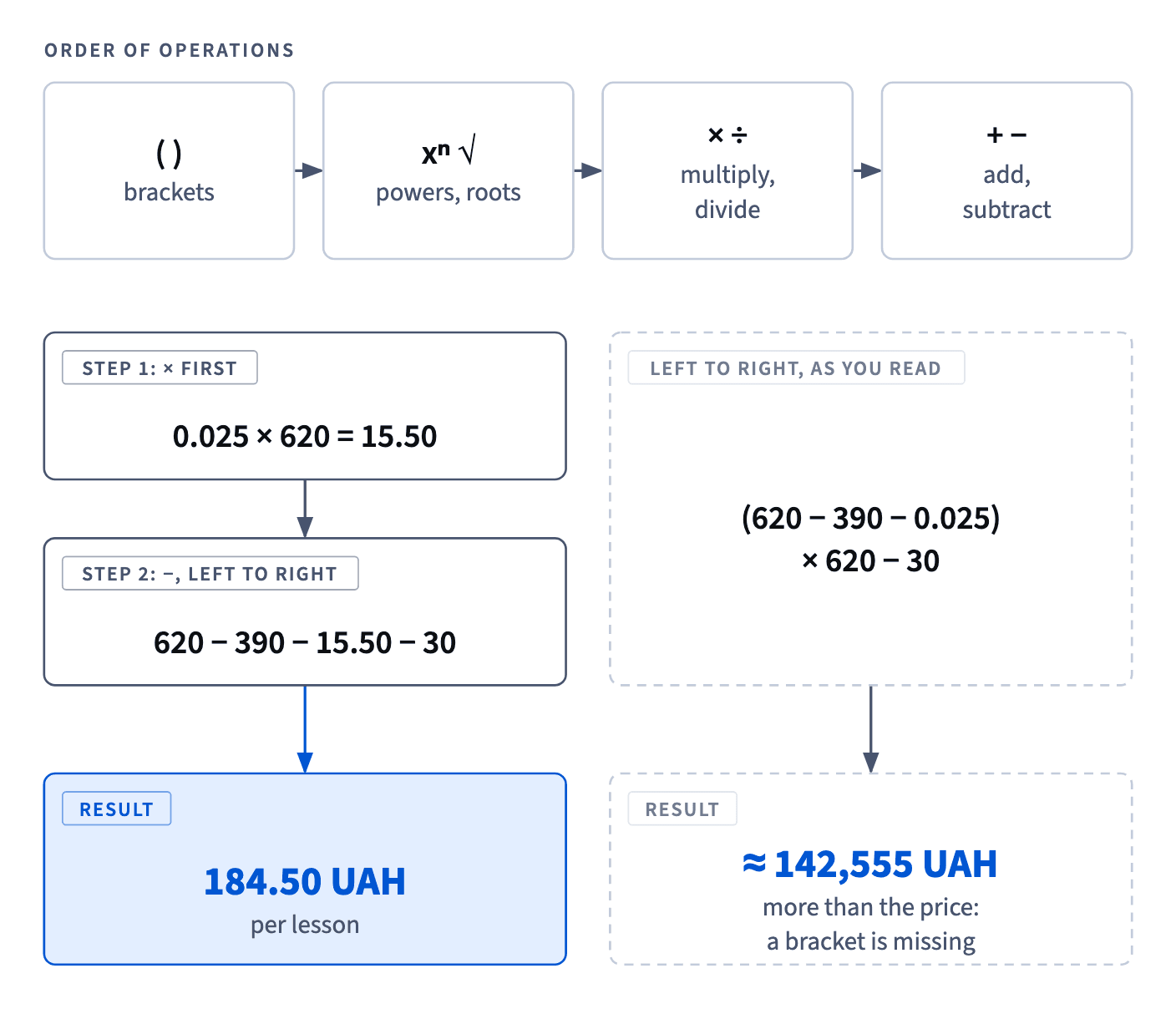
- Do0.025 × 620 = 15.50 first, then 620 − 390 − 15.50 − 30 = 184.50 UAH
- Don't(620 − 390 − 0.025) × 620 − 30 ≈ 142,555 UAH per lesson
A lesson can't leave more than its own price.
Share or ratio: read the line as "out of" or "per"
A fraction line reads as "out of" or "per", and what sits below it decides what the number means.
A share is a part divided by the whole it belongs to. 184.50 ÷ 620 = 0.2976 says that out of every hryvnia a family pays for a lesson, about 30 kopiykas stay with Klasna after the lesson's own costs; times 100, that is 29.76%. Because the part sits inside the whole, a share is always between 0 and 1, or 0% and 100%.
A ratio divides two different things: 7,840 lessons ÷ 1,120 learners = 7 lessons per learner, or LTV ÷ CAC (what a customer brings in over their whole time with the product ÷ what it cost to win them). A ratio can be 7 or 0.3; it says how many times one quantity is the other. A price per unit (9,920 UAH ÷ 16 lessons = 620 UAH a lesson) is a ratio too, and so is a multiple such as an offer divided by a year's revenue.
Quick test: could the top ever be bigger than the bottom? If it can't, you are looking at a share.
- DoLearners who renewed ÷ all learners whose package ended = 0.64, a share
The renewers are part of that whole, so 64%.
- Don'tCalling 7 lessons per learner "a 700% share"
Lessons and learners are different things, so it's a ratio.
Always say "per what"
The same lessons can be described with different denominators, and each gives a different-looking number. One English lesson leaves 184.50 UAH of contribution margin; a 16-lesson package of the same lessons leaves 184.50 × 16 = 2,952 UAH. Neither number is wrong. Without its "per what", though, each is useless: a reader will put 2,952 next to someone else's 184.50 and decide one product is sixteen times better.
So every share and ratio carries its denominator in words: "per lesson", "per package", "per active learner", "of the price". Time is a denominator too: 165,000 UAH a month and 1,980,000 UAH a year can be the same revenue.
When two numbers look wildly different, compare the denominators before you check the arithmetic. Product analytics meets this constantly: ARPU and ARPPU share one numerator, revenue, and differ only in what it is divided by, all users or paying users only.
- DoCM: 184.50 UAH per lesson, 2,952 UAH per 16-lesson package
- Don'tCM: 2,952
Per lesson? Per package? Per month?
A fraction on one line: bracket the top
On paper a fraction line groups things for you: everything above it is divided by everything below it. A spreadsheet has no fraction line, only one row of symbols, so you have to group by hand.
CM% = CM ÷ P × 100 is the contribution margin as a share of the price. CM is itself a formula, P − T − 0.025 × P − V, and all of it has to be divided by P. Typed as =620-390-0.025*620-30/620*100, the sheet divides only the last number, 30, because ÷ comes before −, and returns 209.66 instead of 29.76.
Formula: CM: contribution margin per lesson; P: price per lesson; T: tutor payout; V: video and AI per lesson; 0.025 × P: a 2.5% payment fee. · shown above
The fix is to put the whole numerator in brackets: =(620-390-0.025*620-30)/620*100 gives 184.50 ÷ 620 × 100 = 29.76%. If the bottom has several parts, bracket it too: =x/(a+b).
Better still, compute CM in its own cell and divide that cell by the price. Short formulas that point at cells are far easier to check than one long line.
- Do
=(620-390-0.025*620-30)/620*100→ 29.76 - Don't
=620-390-0.025*620-30/620*100→ 209.66Only the 30 was divided by the price.
Check the size before you trust the number
A spreadsheet never warns you that a bracket is in the wrong place. It applies the order of operations perfectly to whatever you typed, so your only defence is to know roughly what the answer should be before you look at it.
The bounds come from what the formula means:
Formula: CM: contribution margin per lesson; P: price per lesson; T: tutor payout; V: video and AI per lesson; 0.025 × P: a 2.5% payment fee. · shown above
- a lesson can't leave more than its price, so CM for a 620-UAH lesson sits between 0 and 620;
- a share of the price sits between 0% and 100%;
- a price per lesson worked out from a package lands near the list price, not at ten times it.
A result outside its bounds isn't "surprising"; it's a bug, almost always a bracket or a percent typed as a whole number (2.5 instead of 0.025 or 2.5%). A margin of 142,555 UAH per lesson fails the first check by a factor of more than 200. Read the formula back in words, find where the order changed, fix it and check the size again.
- Do184.50 UAH for a 620-UAH lesson is inside 0–620, so it's plausible
- Don't"CM% came out at 214.5, margins must be up!"
A share above 100% is impossible; look for the bracket.
Multiples: a ratio read backwards
A multiple compares a value with a base: m = value ÷ base. Read the other way round, it turns a base into a value: value ≈ base × m.
Small businesses are often priced this way. GarageDesk, a subscription app for car repair shops, has monthly recurring revenue (MRR) of 165,000 UAH, so its annual recurring revenue is ARR = 165,000 × 12 = 1,980,000 UAH. If buyers pay about 3× ARR for businesses like it, the value is V ≈ 1,980,000 × 3 = 5,940,000 UAH.
The other direction tells you what an offer means. A buyer offering 4,000,000 UAH pays 4,000,000 ÷ 1,980,000 ≈ 2.02× ARR, a third less than the 3× benchmark. Writing the multiple with its × sign keeps it from being read as a percent or as hryvnias.
The ≈ matters: a multiple is a rule of thumb taken from comparable deals, not a law. The real price also depends on growth, churn and how much the business leans on its owner.
- Do4,000,000 ÷ 1,980,000 ≈ 2.02× ARR
- Don't"The offer is 2.02% of ARR"
A multiple counts times, not percent.
A multiple means nothing without its base
"Three times revenue" sounds precise, but it isn't until someone says which revenue. The multiple is only half of the number; the base is the other half.
With GarageDesk's MRR of 165,000 UAH:
- 3 × a month's revenue = 495,000 UAH;
- 3 × ARR = 3 × 1,980,000 = 5,940,000 UAH.
The same "3×", twelve times apart. The base can also be all revenue or only the recurring part, last year's figure or the next twelve months', revenue or profit. Each choice gives a different value for the same business.
That's why sellers like to quote the biggest base and buyers the smallest, and why a multiple without its base is a negotiating move rather than a fact. Whenever you see a multiple, ask "times what?" and write the answer next to it: 3× ARR, 8× monthly profit.
- Do"3× ARR, that is 5,940,000 UAH"
- Don't"We'll pay three times your revenue"
That could mean 495,000 or 5,940,000.
Three times as much is +200%
A multiple and a percent change describe the same jump in two ways, and they are off by one.
"Three times as much" compares the new value with the old: new ÷ old = 3. A percent change measures only the increase: (new − old) ÷ old. When GarageDesk's ARR goes from 660,000 to 1,980,000 UAH, the ratio is 3, but the increase is 1,320,000, twice the old value: +200%. The original 100% is already inside the three.
The general link: a multiple m is a change of (m − 1) × 100%. Twice as much is +100%, 1.5 times is +50%, half as much (0.5×) is −50%.
How it fits together: read a formula in the order of operations; treat each fraction as a share or a ratio with a stated denominator; read a multiple as a ratio backwards, always with its base. Next lesson: percent and percentage points, and why "+1%" can mean two different things.
- Do"ARR tripled: +200%"
- Don't"ARR tripled: up 300%"
That would be four times the old value.
Ready to practise?
Answer the lesson's exercises and earn 250 points the first time you finish it.
Start the exercises