

Theory
Back-of-the-envelope estimates
Check any number in ten seconds: round to one significant figure, count the zeros, and give a range instead of false precision.
~8 min read · 10 exercises · 250 points
Before you start
Is this number even possible?
You're still on Klasna's product team, checking the math behind its numbers before they reach a slide. A report says March lesson sales were 48.7 million UAH, and it's about to go into a presentation.
This lesson closes module 1 with a habit that catches such errors in seconds: estimating in your head. You'll round to one significant figure, multiply powers of ten, and sanity-check a number against what you already know about the school.
Estimate with one significant figure
Before you trust a big number, check it in your head. Round each input to one significant figure, its first non-zero digit followed by zeros, and multiply.
A report says Klasna's lesson sales in March were 48.7 million UAH. March had 7,840 lessons at roughly 600 UAH each: 8,000 × 600. Multiply the leading digits, 8 × 6 = 48, then add the zeros, three and two: 4,800,000. About 5 million, not 50. The real figure is 4,868,640 UAH, but you didn't need it to see that 48.7 million was impossible.
That's thinking in orders of magnitude: which power of ten a number lives in, thousands, millions or billions. An estimate built from one-digit numbers is often off by 20% or so, and that's a detail. Being out ten times means something is broken: an extra zero, a wrong column, the wrong unit.
- Do8,000 × 600 = 4.8 million, so 48.7 million can't be right
- Don't"Looks fine, it's millions anyway"
4.87 and 48.7 million are ten times apart.
Powers of ten keep the zeros in order
Long rows of zeros are where estimates go wrong, so write big numbers as a short number times a power of ten: 4,800,000 = 4.8 × 10⁶. The exponent counts the places the decimal point moves.
Each step of three in the exponent has a name:
- 10³ = 1,000, a thousand;
- 10⁶ = 1,000,000, a million;
- 10⁹ = 1,000,000,000, a billion.
Negative exponents go the other way: 10⁻¹ = 0.1, 10⁻² = 0.01, a hundredth. That's the unit behind percent: 1% = 1 × 10⁻², and 2.5% = 2.5 × 10⁻² = 0.025. A fee of 2.5% typed into a formula as 2.5 instead of 0.025 is off by exactly 10².
Saying a number's exponent out loud is a check in itself: Klasna's monthly lesson sales are in the millions (10⁶), its yearly lessons in the tens of thousands (10⁴). A figure with another exponent needs a reason.
- Do4,868,640 ≈ 4.9 × 10⁶
- Don'tA 2.5% fee typed as 2.5
A hundred times too big.
Multiply the numbers, add the exponents
With numbers in powers of ten, a product splits into two easy jobs: multiply the short numbers, then add the exponents. 10⁴ × 10² is four tens times two more, six in all: 10⁶.
(3 × 10⁴) × (2 × 10²) = (3 × 2) × 10⁴⁺² = 6 × 10⁶.
So roughly 30,000 lessons a quarter, each leaving about 200 UAH of contribution margin, bring about 6 million UAH. Division works the other way: subtract the exponents. 4.8 × 10⁶ UAH ÷ (8 × 10³ lessons) = 0.6 × 10³ = 600 UAH a lesson.
If the short numbers multiply to 10 or more, move one ten into the exponent: 8 × 10³ × 6 × 10² = 48 × 10⁵ = 4.8 × 10⁶.
Two slips are common: multiplying the exponents (10⁴ × 10² is not 10⁸) and adding the leading numbers instead of multiplying them.
- Do8 × 10³ × 6 × 10² = 4.8 × 10⁶
- Don't10⁴ × 10² = 10⁸
In a product, exponents add.
Estimate first, compute second, compare
Any formula in the other courses deserves a ten-second sanity check: estimate first, compute second, then compare the two. If they agree within a few tens of percent, move on. If they're ten times apart, stop.
The check works best on small lines nobody looks at. Video and AI cost Klasna about 30 UAH a lesson. March had 7,840 lessons, so the line should say about 8,000 × 30 = 240,000 UAH, a quarter of a million. A dashboard showing 2.4 million is one order of magnitude too big: most likely an extra zero, a wrong column or a total for the wrong period. The real March figure was 243,040 UAH.
Make the estimate before you look at the computed number. Once you've seen 2.4 million, it's tempting to find reasons why it might be right.
The estimate doesn't replace the calculation; it tells you whether to trust it.
- DoEstimate 8,000 × 30 ≈ 240,000, then open the dashboard
- Don't"2.4 million: AI must be getting expensive"
Explaining a number before checking its size.
A chain of guesses
When there's no report at all, build the number from a short chain of things you know. Each link should be something you could defend.
How many lessons does Klasna give in a year? Months swing from about 2,600 lessons in July to 9,600 in May; a typical month is around 6,000. Times 12: about 72,000 a year. The real total for the 2025/26 school year was 71,563. This time the guess was lucky; what counts is the method: few steps, round numbers.
Ratios make good links because they carry over. In March 7,840 lessons went to 1,120 active learners, 7 lessons each. So 20,000 lessons a month would need about 20,000 ÷ 7 ≈ 2,900 active learners, more than twice the May peak of 1,300. One division turned a slogan into a question about growth.
Keep chains short. Every extra link adds its own error, and three or four guesses are usually enough.

- Do20,000 lessons ÷ 7 per learner ≈ 2,900 learners
- Don'tA ten-step model for a number two steps can estimate
Each step adds its own error.
Give a range, not a point
An estimate is a guess, and an honest guess shows how far it could be off. When you're unsure about a link in the chain, push the low and the high guess through it and report a range next to the central figure.
A typical Klasna month is around 6,000 lessons, so the central estimate for a year is 6,000 × 12 = 72,000. But months swing from about 2,600 in July to 9,600 in May. A year of July-like months gives 2,600 × 12 = 31,200; a year of Mays gives 9,600 × 12 = 115,200. "Most likely around 70,000, between about 30 and 115 thousand" is the honest answer, and the real 71,563 sits inside.
A wide range isn't a failure. It shows which link matters most and where better data would pay off; here it's lessons per month.
A range that's too narrow is worse than none: it claims a certainty the inputs don't have.
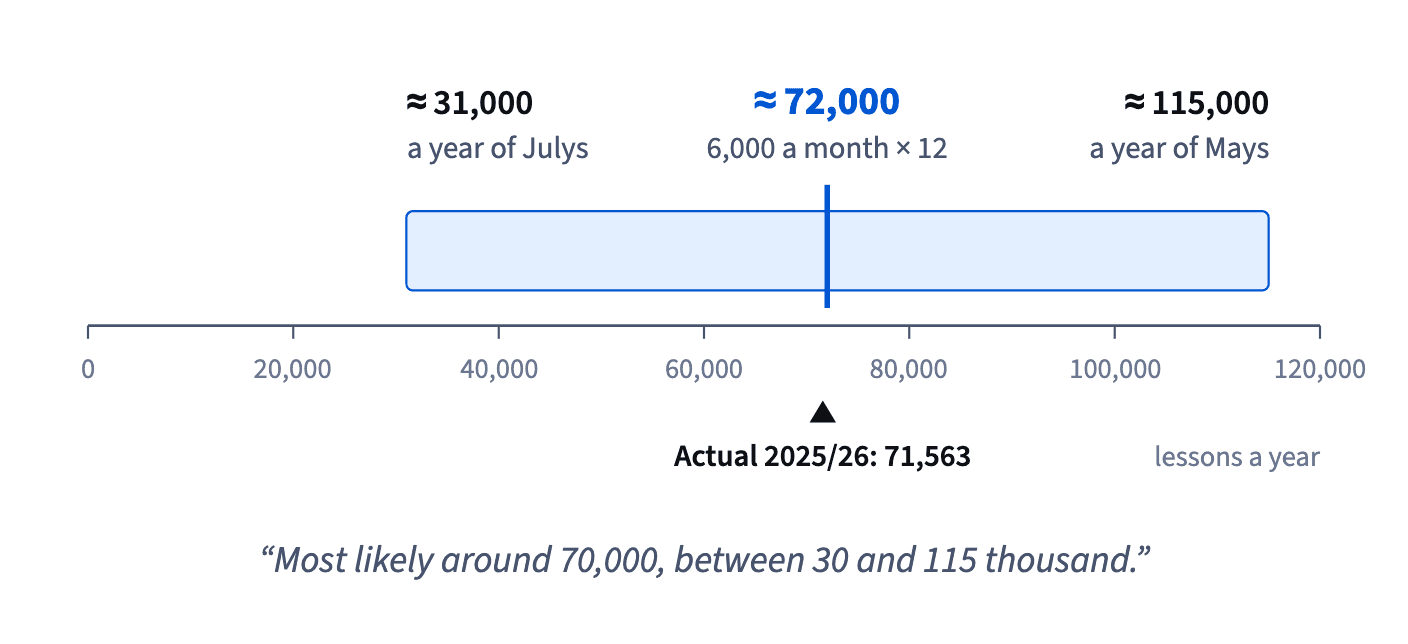
- Do"About 72,000, likely 31,000–115,000"
- Don't"72,000 ± 4,000" with no reason for the ±
A made-up narrow range.
Three slips behind most wrong numbers
When a result fails the sanity check, the size of the miss often tells you where to look. Most wrong numbers in a spreadsheet come from three slips:
- ×100: a percent typed as a whole number, 2.5 instead of 0.025 or 2.5%;
- ×12: a month mixed up with a year, such as a yearly total in a monthly cell or a monthly price used as an annual one;
- ×1,000: a column kept in thousands read as units, or the other way round.
So divide the suspicious number by your estimate. Klasna's May coordinator costs should be about 4 × 38,000 = 152,000 UAH. A sheet showing 1,824,000 is 1,824,000 ÷ 152,000 = 12 times too big: look for a year where a month should be. A miss of 1.2 or 1.3 times is a different story: that's an assumption to revisit, not a slip.
Fix the source of the error, not the number, or the slip comes back next month.
- Do1,824,000 ÷ 152,000 = 12, so look for a yearly figure
- Don'tOverwriting the cell with 152,000 by hand
The formula still holds the slip.
False precision
The opposite mistake to a wild number is false precision: more digits than the inputs justify. If a plan multiplies three guesses that could each be off by 20–30%, the product can easily be off by half. Writing it as 73,418 lessons tells the reader you know the last three digits, and you don't.
A number built from guesses should look like one: one or two significant figures and, ideally, a range. "About 70,000 lessons, likely 60–85 thousand" carries the same estimate and its honesty. Precise-looking numbers are also harder to challenge, because readers assume someone measured them.
Keep all the digits in the spreadsheet if you like; round what you show.
How it fits together: estimate with one significant figure, keep the zeros straight with powers of ten, compare the estimate with the computed number, and report guesses as ranges. Next module: the language of formulas, starting with notation.
- Do"About 70,000, likely 60–85 thousand"
- Don't"73,418 lessons next year"
Five digits from three guesses.
Ready to practise?
Answer the lesson's exercises and earn 250 points the first time you finish it.
Start the exercises