

Theory
Rules made in calm weather: a one-page investment policy
Goal, horizon, mix, monthly amount, rebalancing rule, what to do in a fall and a small capped play bucket.
~7 min read · 7 exercises · 250 points
Before you start
Decide before the storm
Late September at Zapas. The behavior numbers convinced Ethan, and your team, with you as the PM, gets two weeks to build a "My plan" screen before launch.
Grace's idea: in a fall people decide with their stomach, so ask them to decide earlier, on a calm day, and write it down. Ethan doubts anyone will read a policy document. You'll shape a one-screen plan whose every line answers a question the user would otherwise answer in a panic.
A one-page investment policy
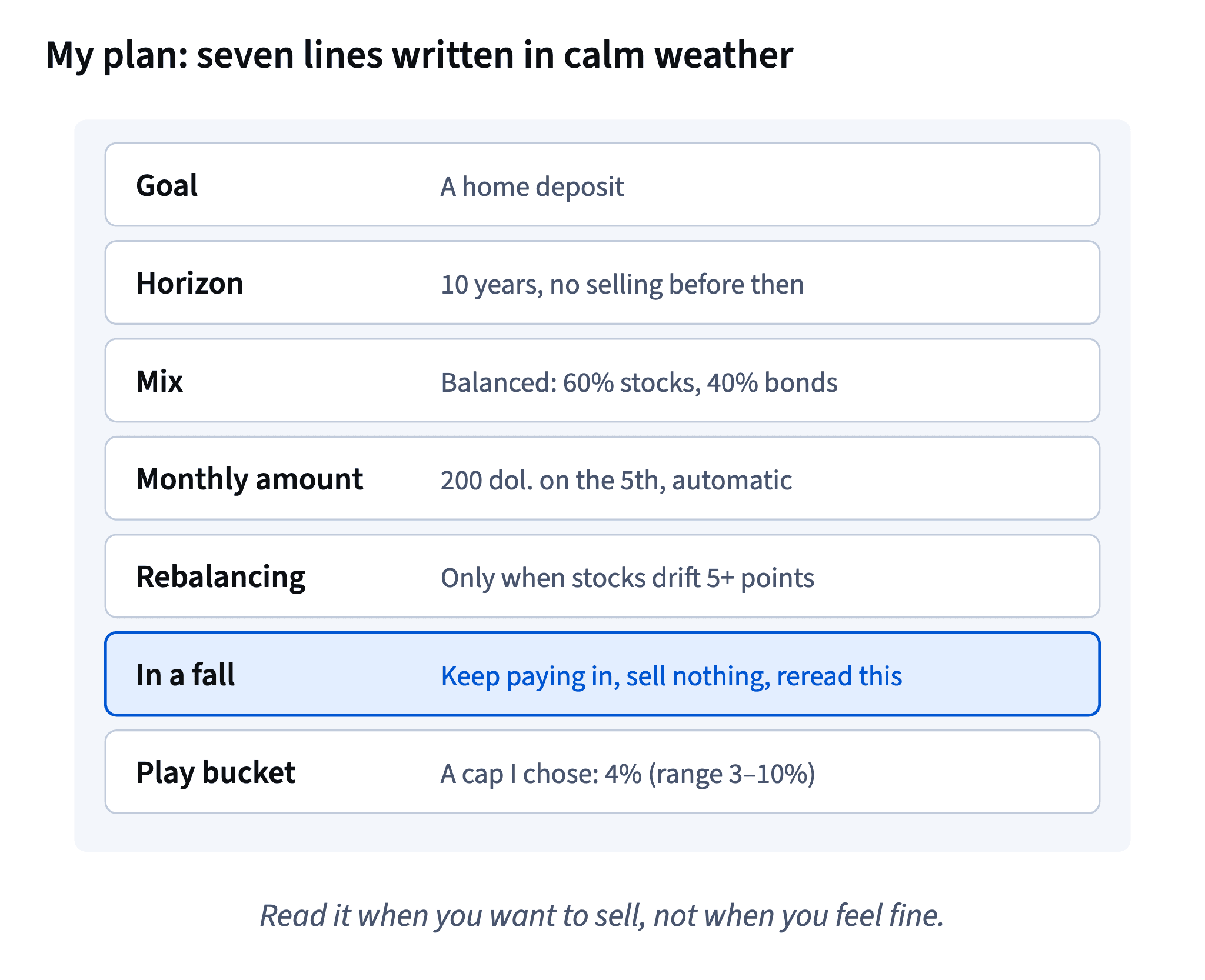
An investment policy is a short written plan that answers, in advance, the questions you'd otherwise answer under stress. One page is enough; seven lines cover it:
- Goal: what the money is for (a home deposit, retirement, a child's studies).
- Horizon: when you can need it. Before that date, a fall is a price change, not a reason to sell.
- Mix: the share of stocks and bonds, chosen for the falls you can live through.
- Monthly amount: how much goes in, when, automatically.
- Rebalancing rule: when money moves back to the mix (for example, when stocks drift 5 points or more).
- In a fall: what you will do, in words concrete enough to follow.
- Play bucket: the most that may go into themes or speculation, as a share of the total.
The point is timing: you write it on a calm day and read it on a bad one.
- Do"Horizon: 10 years. I don't sell before then."
- Don't"Horizon: long-term, as long as it goes well."
A fall rule you can follow
The "in a fall" line works only if a frightened person can follow it without deciding anything new. Three parts make that possible:
- A trigger: a clear condition, such as "my plan is down 20% or more" or "the market message from Zapas arrives".
- Actions: things to do and not do, in plain verbs. "Keep the monthly deposit. Sell nothing. Reread this page."
- A review date: when the mix may be reconsidered, set in advance (a yearly check), not "when things calm down".
Feelings ("stay calm", "be brave") and open questions ("think it over") are not rules: they hand the decision back to the moment when judgement is worst.
In the beta, users who kept depositing through the 22% fall finished ahead of the fund; the 52 who sold averaged −6.8%. A good fall rule simply writes down the first behavior.
- Do"Down 20%+: keep the deposit, sell nothing, review in January."
- Don't"If it gets really bad, I'll decide then."
Automation as part of the policy
A policy is easiest to keep when the product does the routine parts for you:
- Automatic monthly deposits on a fixed date. They keep buying in falls, which is when deposits do the most good.
- Rebalancing by rule. From the summer work on model portfolios: a 60/40 mix started with 1,000 dol. in our synthetic history.
- Band rule (rebalance only when stocks drift 5 points from 60%): 10 rebalances in 40 years, worst fall −22.8%, 20,173 dol.
- Yearly rule: 39 rebalances, worst fall −22.8%, 19,960 dol.
- Never: stocks drifted to 88.5%, worst fall −33.8%. It "earned" more, 23,453, only by turning into a much riskier portfolio than planned.
- A yearly review date, when goal, horizon and mix may change for life reasons.
The user chooses the rules once, on a calm day. After that, the app follows them, and the user can always step in.
- Do"Rebalance when stocks are outside 55–65%."
- Don't"Rebalance when it feels like the right moment."
The play bucket and its cap
Some people will want a theme or a single bet (one company, one coin), however good the plan is. Forbidding it often ends with the bet made outside the plan, with no limit at all. A play bucket gives it a fenced place:
- a cap the user sets, as a share of the whole plan, say somewhere in 3–10%: a trade-off between scratching the itch and protecting the core;
- money you can lose completely without changing your goal;
- no top-ups from the core after a loss, and no moving winnings in to "double down".
The cap is what keeps a bad bet survivable. In the beta, Robo Theme lost 43.0% from the start of month 4. As a share of the whole portfolio that is −1.29% with a 3% bucket, −3.44% with 8%, −4.3% with 10%, −12.9% with 30%, and −43% with everything in.
The number in the cap is a choice, not a law. What matters is that it's written down before the excitement starts.
Chart data
| Play bucket, % of the portfolio | Loss on the whole portfolio, % |
|---|---|
| 3 | 1.29 |
| 5 | 2.15 |
| 8 | 3.44 |
| 10 | 4.3 |
| 30 | 12.9 |
Show 1 more row
| 100 | 43 |
- Do"Play bucket: 4% of my plan, the cap I chose; no top-ups after a loss."
- Don't"I'll move more in if the theme keeps going up."
Change the plan for life, not for prices
A plan that is rewritten after every fall is not a plan. A plan that never changes ignores real life. The line between them:
Good reasons to review (life changes):
- the goal date moves, or the goal itself changes;
- income becomes less stable (a salaried job turns into a business) or more stable;
- a new dependant, a big debt, a health change;
- the money will be spent in another currency.
Not reasons to review (price changes):
- a fall of any size, which the mix was chosen for;
- a rise somewhere else, which belongs at most in the play bucket;
- headlines and forecasts.
A yearly review date handles the first group calmly: once a year the app asks whether the goal, the income or the spending currency has changed, and offers to review the plan. For the second group, the "in a fall" line already holds the answer, and nothing needs rewriting.
- Do"The goal moved to 2030, so I review the mix at my January check."
- Don't"Markets are scary right now, so I'll switch to bonds."
Filling in the plan, top to bottom
The seven lines are not a random form: each depends on the ones above it, so the screen should ask for them in that order.
- Goal, because it gives a date and an amount.
- Horizon, from the goal's date. Money needed within a few years needs a different home from money for 20 years.
- Mix, limited by the horizon and by how much of a fall the user can carry (income, other savings) and stomach.
- Monthly amount, from the goal and the budget; with a fixed date, automated.
- Rebalancing rule, which only makes sense once the mix is known.
- In a fall: the trigger, the actions and the review date, written with everything above in view.
- Play bucket: last, so the core is settled before any speculation is discussed.
A product that starts with "Pick a fund!" skips the four lines that make the choice of a fund meaningful.
- DoGoal → horizon → mix → amount → rule → fall line
- Don't"Pick your fund" as the first onboarding screen
Writing a default people will keep
Most users never edit a default, so the pre-filled "In a fall" line is effectively Zapas's advice to everyone. It has to be followable and editable.
A good default:
- has a trigger with a number ("down 20% or more from its high");
- lists actions in plain verbs ("keep my monthly deposit going, sell nothing, reread this page");
- sets a review tied to life, not prices ("at my yearly check in January, or earlier if my goal date or income changes");
- adds the play bucket with a cap and a "no top-ups" rule.
And it never removes the user's control: it describes what the user plans to do, not what the app will stop them doing. The words are first person, because the plan belongs to the user.
- Do"If my plan is down 20%+, I keep depositing and sell nothing."
- Don't"Zapas will block selling during falls."
Ready to practise?
Answer the lesson's exercises and earn 250 points the first time you finish it.
Start the exercises