

Theory
Every layer of cost: fee, spread, FX, platform, tax drag
Follow 1,000 dollars through every cost of owning a fund and add them up all-in.
~6 min read · 7 exercises · 250 points
Before you start
Fees from 0.2%?
June 2027 at Zapas, five months after you joined as PM. The beta is busy and the public launch is still set for November. This month is about money that quietly disappears.
Ethan wants "Fees from 0.2%" in big letters on the landing page, since the world fund's charge is that low. Grace suggests following one user's 1,000 dollars through a single flat year instead. You'll count every layer of cost the user meets on the way in, during the year and on the way out.
All-in cost: add every layer
A fund's ongoing charge is the yearly fee the fund takes from its own assets. It is the number on the label, but a user pays more than that. The all-in cost adds every layer between the user's money and the market:
- FX conversion when hryvnias become dollars and back;
- the bid-ask spread: you buy a little above and sell a little below the middle price;
- the fund's ongoing charge;
- a platform fee for the app or the broker account;
- tax drag: tax withheld on dividends before they reach you.
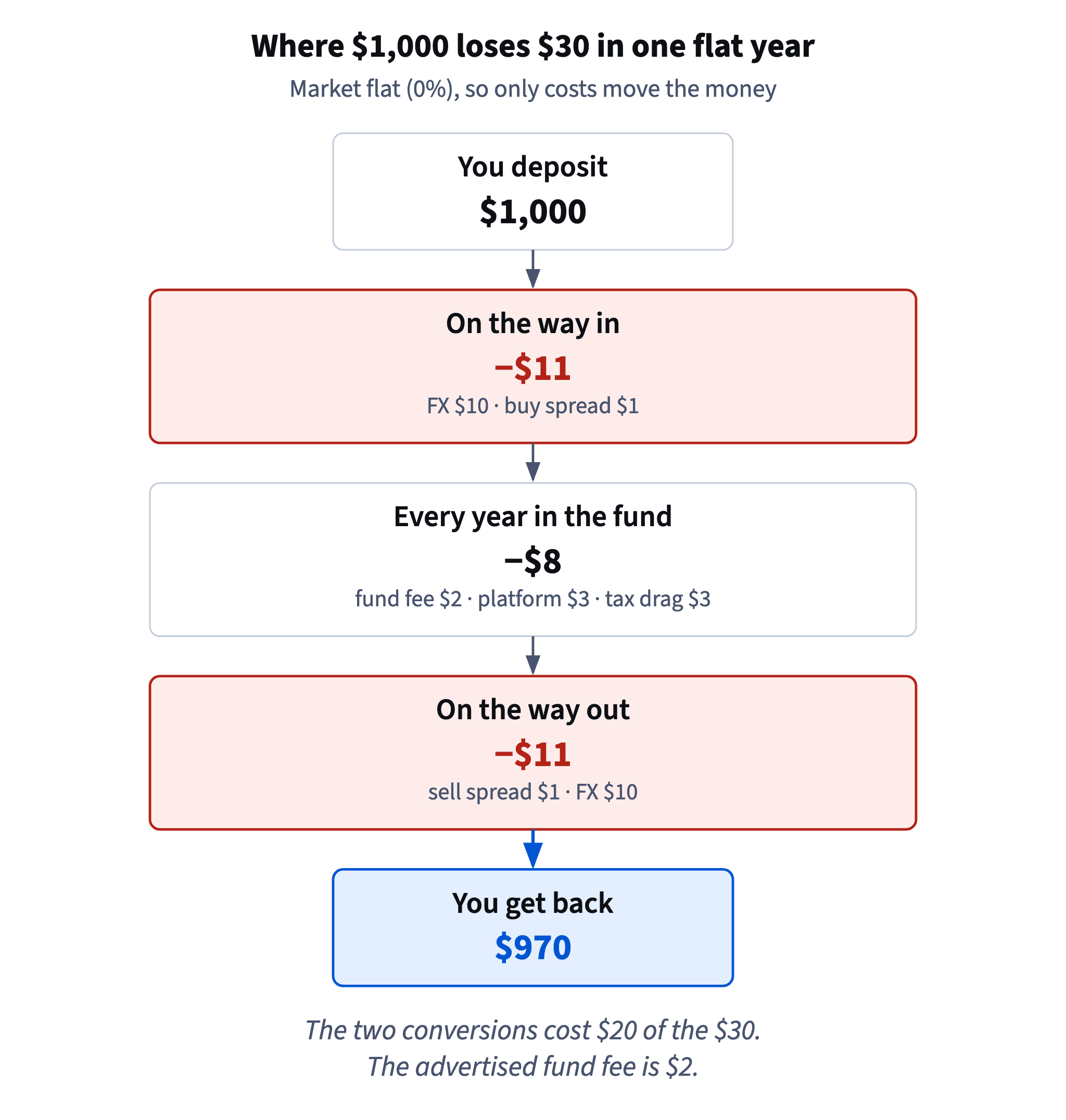
In our synthetic example a flat year costs $30 on $1,000, or 3.0%. Only $2 of it is the fund fee. When you compare two products, compare these totals, never one layer against one layer.
Chart data
| Layer | Cost |
|---|---|
| 1 FX on deposit | 10 |
| 2 buy spread | 1 |
| 3 fund fee | 2 |
| 4 platform fee | 3 |
| 5 tax drag | 3 |
Show 2 more rows
| 6 sell spread | 1 |
| 7 FX on withdrawal | 10 |
- Do“All-in, a year with us costs about $30 on $1,000, including both conversions.”
- Don't“Fees from 0.2%.”
True about one layer, silent about the other 28 dollars.
Currency conversion: the hidden biggest layer
If you earn and spend in hryvnias and the fund is priced in dollars, your money changes currency twice: on the way in and on the way out. Each conversion costs the gap between the rate you get and the middle market rate, plus any explicit fee. It rarely appears on a fund's label, because it isn't the fund's cost; it belongs to the bank, broker or app that converts.
In our example each conversion is 1%, so $10 on the way in and $10 on the way out: $20 of the $30, two thirds of everything. The fund's own fee is $2, about 7%.
That changes where a product team should look first. Cutting the fund fee from 0.2% to 0.1% saves $1 a year on $1,000. Halving the conversion cost saves $10 on the round trip.
- Do“Show the exchange rate and the gap to the market rate before the user confirms.”
- Don't“Conversion is free” while the rate quietly includes a 1% margin.
A margin inside the rate is still a cost.
One-off vs yearly costs
Sort every cost by when it is charged:
- one-off costs come with a trade: conversion on the way in, the spread when you buy, the spread when you sell, conversion on the way out. In the example: $22;
- yearly costs keep coming while you hold: the fund's ongoing charge, the platform fee and tax drag. In the example: $8 a year.
For a user who stays one year the one-off part dominates: $22 of $30. For a user who stays ten years the yearly part repeats ten times, about $75 or more, and the one-off $22 becomes a smaller share.
Two practical rules follow. To compare products for a long holder, turn one-off costs into a yearly figure by dividing them by the years held. And trading often makes one-off costs repeat, so they stop being one-off at all.
Picture: Most of the cost sits at the doors, not inside the fund. · shown above
- Do“$22 one-off over 10 years is about 0.2% a year on $1,000.”
- Don't“Spreads don't matter, I pay them only once” while switching funds every month.
Costs compound too
Compounding works on costs in the same way it works on returns. A yearly cost is a percentage of what is left that year, so the money shrinks by a factor every year, and the factors multiply.
In the example the three yearly layers together take about 0.8% a year: each year the balance is multiplied by 0.998 × 0.997 × 0.997 ≈ 0.992. Ten such years multiply it by about 0.923. Add the one-off layers at the start and the end and $1,000 becomes $902.63: $97.37, or 9.7%, gone without the market moving at all.
In a real market the return and the costs run side by side, so costs take a share of the growth, not only of the money you put in. That is why the next lesson stretches the same arithmetic to forty years.
- Do“Ten years at about 0.8% a year plus the doors: roughly 10% of the money.”
- Don't“0.8% a year for ten years is just 8%.”
Add the one-off layers too; and over decades the compounding matters more.
An honest cost line
A cost claim is honest when a user can compare it with another offer and reach the right conclusion. "Fees from 0.2%" fails that test: it quotes the smallest layer, and "from" hints that some users pay even less.
A better line has three parts. First, the yearly all-in cost: everything charged while the money stays invested, here about 0.8%. Second, the one-off costs of getting money in and out, here about 2.2% for the two conversions and the spreads. Third, a link to the full breakdown, layer by layer, with the assumptions (amount, currency, dividends).
It looks less exciting than one tiny number. But costs are the one part of investing a product can promise in advance, and users who later find a hidden layer stop trusting the rest of the screen too.
- Do“About 0.8% a year all-in, plus one-off conversion costs. Full breakdown →”
- Don't“Fees from 0.2%*” with the rest in a footnote.
Platform fee and tax drag
Two yearly layers are easy to forget because they don't sit inside the fund's own numbers.
The platform fee is what the app or broker charges for holding the account: a percentage of the balance, a fixed monthly amount, or both. A fixed fee hurts small balances most: $3 a month is 3.6% a year on $1,000 but 0.36% on $10,000.
Tax drag comes from dividends. When the companies in a fund pay dividends, a tax is often withheld before the money reaches the fund or you. In the example dividends are 2% a year and 15% of them is withheld, so 0.3% of the balance a year never gets invested. How much is withheld depends on where the fund is registered and on tax treaties; a later lesson reads that line on a factsheet.
Neither layer shows up in "fees from 0.2%", and together they are four times the fund fee here.
Chart: Cost of each layer on \$1,000, first year · shown above
- Do“2% dividends × 15% withheld = 0.3% a year lost to tax.”
- Don'tComparing a fund fee of 0.2% with a rival's 0.25% and ignoring a $3 monthly account fee.
Ready to practise?
Answer the lesson's exercises and earn 250 points the first time you finish it.
Start the exercises