

Theory
Case: the "market is down 30%" message
Write the in-app message for a deep fall and decide when it should appear.
~7 min read · 7 exercises · 250 points
Before you start
When the market is down 30%
Last March task at Zapas. This month has already covered a bad year, the deepest drawdown and how long holding windows behave. Today you design the message users get when the world fund is down 30%.
Ethan's draft is upbeat: stocks are on sale, the bottom is in, markets always come back within a year. You'll pick the two or three numbers a worried user needs and write a message that promises nothing Zapas can't keep.
Choosing a trigger
A trigger decides when a message appears. For a fall message it should be measured the way users feel the loss: how far the fund is below its peak, not how much it fell today or this month.
Three checks for a good trigger:
- Rare enough to matter. In our 480 synthetic months, a −30% drawdown happened only in the big crash; ordinary bad years never reached it. A message that fires every month gets ignored.
- Measured on what the user holds. The world fund for a world portfolio; a theme fund can hit −30% much more often.
- Fired once per episode. In the Tessaro crash the fund stayed 30% or more below the peak in 22 months. Users need one clear message and a quiet follow-up, not a daily alarm.
In the crash window the trigger would have fired first in month 27, 15 months after the peak, with the bottom still nine months away.
Chart data
| Month of the window | Drawdown |
|---|---|
| 1 | 0 |
| 2 | 0 |
| 3 | -1.4 |
| 4 | 0 |
| 5 | 0 |
Show 91 more rows
| 6 | 0 |
| 7 | 0 |
| 8 | -0.8 |
| 9 | 0 |
| 10 | 0 |
| 11 | 0 |
| 12 | 0 |
| 13 | -3.1 |
| 14 | -9.1 |
| 15 | -5.1 |
| 16 | -13 |
| 17 | -17 |
| 18 | -11.1 |
| 19 | -14.5 |
| 20 | -22.3 |
| 21 | -19.8 |
| 22 | -24.4 |
| 23 | -18 |
| 24 | -22 |
| 25 | -27.7 |
| 26 | -21.6 |
| 27 | -30.3 |
| 28 | -33.4 |
| 29 | -26.5 |
| 30 | -32.8 |
| 31 | -37.2 |
| 32 | -34.8 |
| 33 | -41.2 |
| 34 | -43.2 |
| 35 | -40.6 |
| 36 | -45.4 |
| 37 | -38.9 |
| 38 | -35.2 |
| 39 | -38.1 |
| 40 | -32.8 |
| 41 | -31 |
| 42 | -32.7 |
| 43 | -30.2 |
| 44 | -29.1 |
| 45 | -31.6 |
| 46 | -30 |
| 47 | -29.3 |
| 48 | -30.1 |
| 49 | -31.5 |
| 50 | -30.2 |
| 51 | -30.6 |
| 52 | -24.9 |
| 53 | -23.3 |
| 54 | -22.5 |
| 55 | -19.8 |
| 56 | -17.7 |
| 57 | -20.7 |
| 58 | -21.1 |
| 59 | -18.7 |
| 60 | -17.5 |
| 61 | -19.1 |
| 62 | -23 |
| 63 | -21.1 |
| 64 | -18.3 |
| 65 | -21.1 |
| 66 | -18.8 |
| 67 | -18.8 |
| 68 | -17.6 |
| 69 | -13.5 |
| 70 | -9.2 |
| 71 | -4.5 |
| 72 | -5.1 |
| 73 | -6 |
| 74 | -2.3 |
| 75 | -7.4 |
| 76 | -7.2 |
| 77 | -4.6 |
| 78 | -7.9 |
| 79 | -13.1 |
| 80 | -13 |
| 81 | -11.2 |
| 82 | -5.1 |
| 83 | -3.4 |
| 84 | 0 |
| 85 | 0 |
| 86 | 0 |
| 87 | -1.6 |
| 88 | -2.4 |
| 89 | -4.7 |
| 90 | -1 |
| 91 | -1.5 |
| 92 | -8.9 |
| 93 | -8.2 |
| 94 | -6.1 |
| 95 | -7.5 |
| 96 | -7.8 |
- Do"Fire once when the world fund is 30% below its peak; follow up quietly."
- Don't"Alert every day the market falls 2%."
Trains users to check and worry.
Nobody knows where the bottom is
The most tempting sentence in a fall message is "the worst is behind us". It sounds kind, and it is a forecast nobody can make.
In the Tessaro crash, a user reading a −30% message in month 27 still had nine months of falling ahead: from 80.8 the value slid to 63.32, another 21.6%, before the trough in month 36. A message that called the bottom at −30% would have been wrong for most of a year, and users would remember that.
What a message can say honestly is what has happened before: how deep the worst fall in our history went (−45.4%) and how long it took to get back (72 months in dollars). That gives scale without pretending to know the path.
The same applies to "buy now": it's a timing call dressed up as encouragement. A plan that keeps regular deposits running is fine; a nudge to bet on the bottom is not.
- Do"In our history the deepest fall was 45.4%; nobody knows if this one is over."
- Don't"The bottom is in!"
Four parts of a fall message
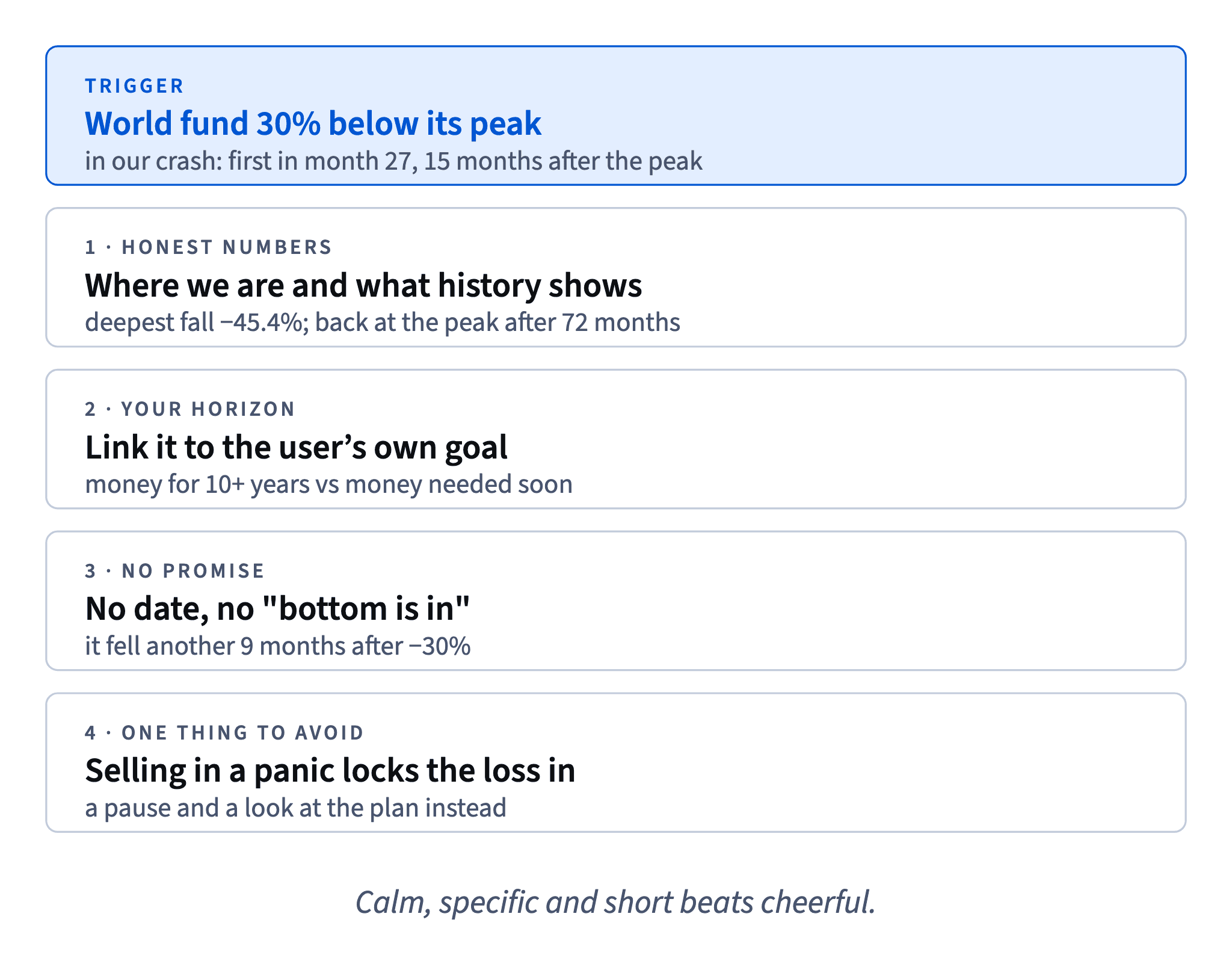
A good "down 30%" message is short, calm and specific. It has four parts.
- Honest numbers. Where the fund stands ("30% below its peak") and what our history shows: the deepest fall was 45.4%, and the peak came back after 72 months in dollars.
- The user's horizon. "If this money is for a goal 10+ years away, a fall like this has happened before. If you need it within a couple of years, let's look at your plan together."
- No promise. No date, no "the bottom is in", no "always". Label the history as synthetic.
- One action to avoid. Selling in a panic turns a paper loss into a real one. Offer something better instead: a pause, a look at the plan, a support contact.
Leave out anything that pushes a trade, either way. The message is there to help users act on the plan they made in calm weather.
- Do"Your world fund is 30% below its peak. In our history the deepest fall was 45.4% and took 72 months to recover."
- Don't"Stocks are on sale! Buy more now."
The number behind "down 30%"
Users often read "down 30%" as "30% to make back". The real climb is steeper: 1 ÷ (1 − 0.30) − 1 = 42.9%.
That's useful in a message, not to scare, but to set expectations. A fund 30% below its peak needs about 43% of growth to be whole again. With the world index's long-run average year near +10% in dollars, that is usually years, not months, and the path is never smooth. In the Tessaro crash it took 57 months from the first −30% reading (month 27) to the old peak (month 84), and that was after nine more months of falling.
Put the number in plain words: "to get back to its peak, the fund needs to grow by about 43%; in the past that has taken years". No date, no promise, just the arithmetic.
- Do"To get back to its peak, the fund needs about +43%; in the past that has taken years."
- Don't"Just 30% to go!"
Upbeat vs honest
Cheerful copy feels like good product design during a fall: less fear, fewer exits. But cheerfulness built on promises backfires. When the "bottom" turns out not to be one, the next message has no credibility left.
Check the promises of an upbeat draft ("Stocks are on sale! The bottom is in…") against the data:
- "The bottom is in": in the Tessaro crash the fund kept falling for nine months after −30%.
- "Back within a year": it took 72 months from peak to peak, 57 from the trigger.
- "Buy more now": a call on timing nobody can make.
Chart: Tessaro World below its peak, years 20–27 · shown above
The honest draft calms through specifics: the fall is real, it has happened before, here is how deep and how long, and here is what matters for you. People cope better with bad news they can understand than with good news that turns out false.
Tone still matters: short sentences, "your plan", "let's review". Calm, not cold.
- Do"Selling now would make the loss real. Need the money sooner? Let's review your plan."
- Don't"Markets always come back within a year."
Writing the push
A push notification is read in two seconds on a lock screen, often at a bad moment. Its only job is to get the user to open a calm, complete message instead of reacting to a headline somewhere else.
Three rules:
- Calm title. No "crash", "alert", "sale" or exclamation marks. "Markets have fallen: a note on your plan" is enough.
- One honest fact. "Your world fund is 30% below its peak." The full numbers, the history and the horizon belong in the message itself.
- An invitation, not an instruction. "Here's what it has meant before and what it means for your goal." Never "act now".
Send it once per episode, at a sensible hour, and don't follow up with daily reminders: frequent alerts teach people to check their balance more often, and that makes panic selling more likely, not less.
- Do"Markets have fallen: a note on your plan"
- Don't"CRASH ALERT! Your portfolio is −30%!"
Putting the message together
A finished fall message is two things: rules for the system and words for the user.
Rules: what is measured (the drawdown of the fund the user holds, month-end), the threshold (about −30%), and the rhythm (once per episode, a quiet follow-up, reset after a new peak). These keep the message rare enough to be read.
Words: four parts in plain language. Honest numbers with a source, the user's horizon, no promise, one action to avoid with a better step. Around 100–120 words is plenty.
Check it against March's data before you ship: does every number match the crash window? Would it have been true in month 27, when the bottom was still nine months away? Would it still read well in month 36, at −45.4%? If yes, it's ready.
Chart: Tessaro World below its peak, years 20–27 · shown above
Picture: Calm, specific and short beats cheerful. · shown above
- Do"Fires once at −30% from the peak; resets after a new peak."
- Don't"Fires whenever the market drops."
Ready to practise?
Answer the lesson's exercises and earn 250 points the first time you finish it.
Start the exercises