

Theory
Case: a user with everything in two bets
A beta user holds 70% in the home index and 30% in a tech theme fund. Check the bet against the synthetic history and design what Zapas shows him, without telling him what to buy.
~7 min read · 7 exercises · 250 points
Before you start
Victor's two bets
End of April at Zapas. As the PM you close the month with a real case: a beta user, Victor, built his own mix, 70% in Zapas Home Stock and 30% in a tech theme fund. His last five years beat the world fund, and Ethan wonders whether he's onto something.
The beta lets anyone edit the default mix with no comment at all. You'll replay Victor's mix on the 40-year history and decide what the edit screen should tell the next user who tries the same.
A great recent record is not evidence
Concentrated portfolios produce the most exciting screenshots, because their results move far from the market in both directions. Over years 30–34 of the synthetic Tessaro history, Victor's mix would have turned 1,000 dol. into 1,990 while the world fund made 1,794: a lead of 19.6 points.
That lead tells you what happened, not why. Here the reason is clear: the theme index rose about 2.6 times in those years. A short record dominated by one hot theme says more about that theme's run than about the owner's skill.
Five years is also very little data. As the last lessons showed, a few big moves can decide a concentrated result, and a single country can lead for years and then stall. Before reading a record as proof, ask what drove it and whether it could reverse.
Chart data
| End of year | Victor's mix | Tessaro World |
|---|---|---|
| 29 | 1,000 | 1,000 |
| 30 | 1,137 | 981 |
| 31 | 1,255 | 1,197 |
| 32 | 1,338 | 1,241 |
| 33 | 1,464 | 1,574 |
Show 7 more rows
| 34 | 1,990 | 1,794 |
| 35 | 1,957 | 1,722 |
| 36 | 1,687 | 1,412 |
| 37 | 1,519 | 1,497 |
| 38 | 1,918 | 2,006 |
| 39 | 2,503 | 2,662 |
| 40 | 3,365 | 3,439 |
- Do"Victor's mix led by 19.6 points, mostly thanks to one theme's run of about 2.6 times."
- Don't"Victor beat the world, so his approach works."
Concentration cuts both ways
A portfolio built from one country and one theme moves far from the market, up and down. In the synthetic history Victor's mix:
- led the world by 19.6 points in years 30–34;
- fell 23.7% in years 35–37, while the world fell 16.6%;
- swung 15.4% a year on average over 40 years, the world 14.7%;
- had 11 losing years out of 40, the world 9.
Over the full 40 years the mix earned about 4.2% real a year, the world fund 5.9%. Over some windows, like years 30–34, it was clearly ahead; by year 40 the same start was slightly behind.
So the honest description of such a mix is not "bad" but "a bet": a wider range of outcomes, without a higher expected result to pay for it. Each number above is computed from market_history.csv with the mix set back to 70/30 every year.
Chart: 1,000 dol. from the start of year 30, Victor's mix vs Tessaro World · shown above
Dataset · 40 rows
Tessaro market, 40 synthetic years (nominal %, inflation %)
First 5 of 40 rows
- Do"Your mix fell 23.7% when the world fell 16.6%, and rose more when the theme ran."
- Don't"Your portfolio is a mistake."
It's a bet with a wider range, not a verdict.
Three avoidable risks in one portfolio
This month showed three kinds of risk a broad, global fund dilutes:
- Company-specific risk: a narrow fund holds few companies, so each one's news matters more.
- Missing the winners: returns are skewed, and a narrow slice may hold few of the companies that produce most of the gains.
- One country: a single economy can stall (13 flat years in the synthetic history) or face a crisis.
A theme fund adds a fourth: a narrow theme can run far ahead of the market and then give much of it back. The Tessaro Tech Theme rose about 2.6 times in years 30–34 and then lost 55.3% in years 35–37.
None of these is market risk. Every stock fund carries that one, the default included. That's why the default can be calmly described as "fewer avoidable risks", not "no risk".
- Do"Your mix adds three bets on top of the market: one country, one theme, few companies."
- Don't"Switch to our world fund and you'll be safe."
Informing without advising
An investing app has two easy ways to fail a user like Victor: say nothing, or tell him what to do. The first hides a real risk; the second turns the product into an adviser and usually makes the user defensive.
The middle path is an informative message:
- Name the bet in plain words: "one country and one theme".
- Show one or two numbers that make it concrete, from the same data the app uses, labelled as synthetic or past.
- Describe the default neutrally: what it holds, not that it's "better".
- Leave the choice visibly with the user, with both options one tap away.
Time it at the decision (when the mix moves away from the default), not after a fall, when the same words sound like "told you so".
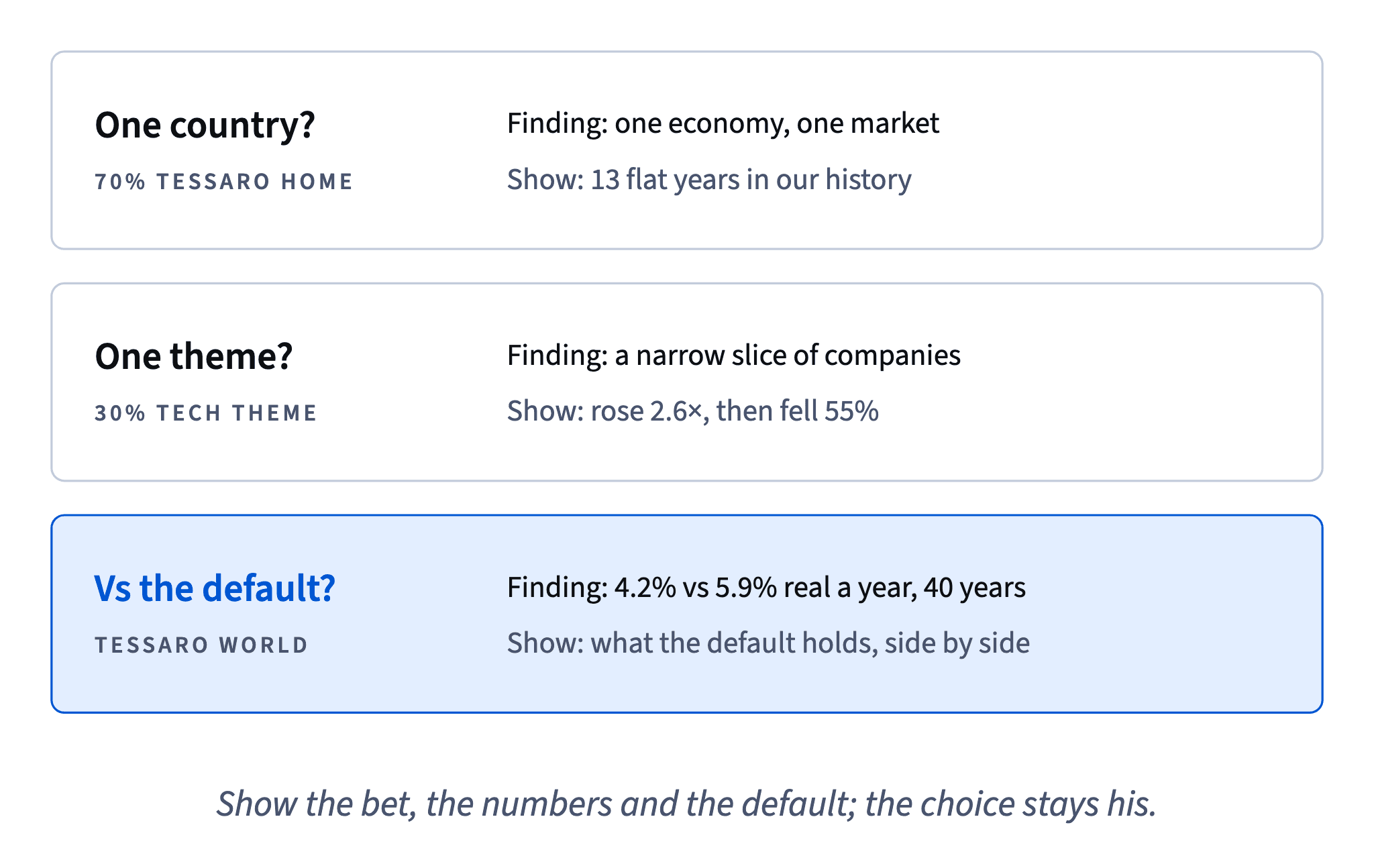
- Do"Two focused bets. Here's how it behaved in our data. Here's the default. Your choice."
- Don't"You should switch to World."
That's advice, not information.
Outcome is not risk
A common mistake is to judge a portfolio's risk by how it ended. A risky bet can end well, and a sensible one can end badly over a given window.
Risk is about what could happen and what did happen on the way: the range of results, the size of the falls, how long they lasted. Victor's mix, started at year 30, was well ahead by year 34 (1,990 against 1,794) and slightly behind by year 40 (3,365 against 3,439). In years 35–37 it lost almost a quarter of its value while the world lost a sixth, and over the full 40 synthetic years it trailed: 4.2% vs 5.9% real a year.
For a product this matters in reports and notifications. "You're ahead" can be true and still hide a much wider range of outcomes. Show the path, not only the end point.
Chart: 1,000 dol. from the start of year 30, Victor's mix vs Tessaro World · shown above
- Do"Ahead today; on the way it fell harder than the world."
- Don't"You're ahead, so your mix is fine."
Replying to a proud user
A user who has just beaten the market is not looking for a correction. A reply that starts with "you were lucky" ends the conversation. One that starts with respect keeps it going.
A workable shape:
- Concede what's true: he did lead, and he may keep leading.
- Add the missing part of the picture: what happened to the same mix next (in the synthetic history, −23.7% vs −16.6%) and why (the theme fell 55.3%).
- Give the long view: 4.2% vs 5.9% real a year over 40 years.
- Return the choice: it's a focused bet shown next to the default, his to keep or change.
Chart: 1,000 dol. from the start of year 30, Victor's mix vs Tessaro World · shown above
No "should", no forecasts, no judgement of the person. The numbers do the work.
- Do"You may stay ahead. Here's what the same mix did next in our data, and here's the default."
- Don't"That was luck. Switch before it's too late."
Designing a concentration message
A good in-app message about concentration answers five product questions:
- When does it appear? At the decision, when the mix moves away from the default, not after a fall.
- What does it say? It names the bet ("one country and one theme") and gives one or two comparable numbers, labelled as synthetic or past data.
- What can the user do? Keep, compare or change, with keeping as easy as changing.
- How is the default described? Neutrally: broad, global, market-weighted, including the home country; fewer avoidable risks, not a promise.
- How do we know it works? One metric, such as how many open the comparison, or whether concentrated users panic-sell less later.
The message informs; it never says "you should". Its job is that a user who keeps a bet keeps it knowingly.
Picture: Show the bet, the numbers and the default; the choice stays his. · shown above
- Do"Two focused bets. Fell 23.7% when the world fell 16.6% in our data. Keep, compare or change."
- Don'tA red banner after a crash: "We warned you."
Ready to practise?
Answer the lesson's exercises and earn 250 points the first time you finish it.
Start the exercises