

Theory
Capstone: the launch memo and your own one-page plan
Write the launch memo for the app and your own one-page investment plan, including how to draw money down later.
~8 min read · 8 exercises · 250 points
Before you start
Launch week
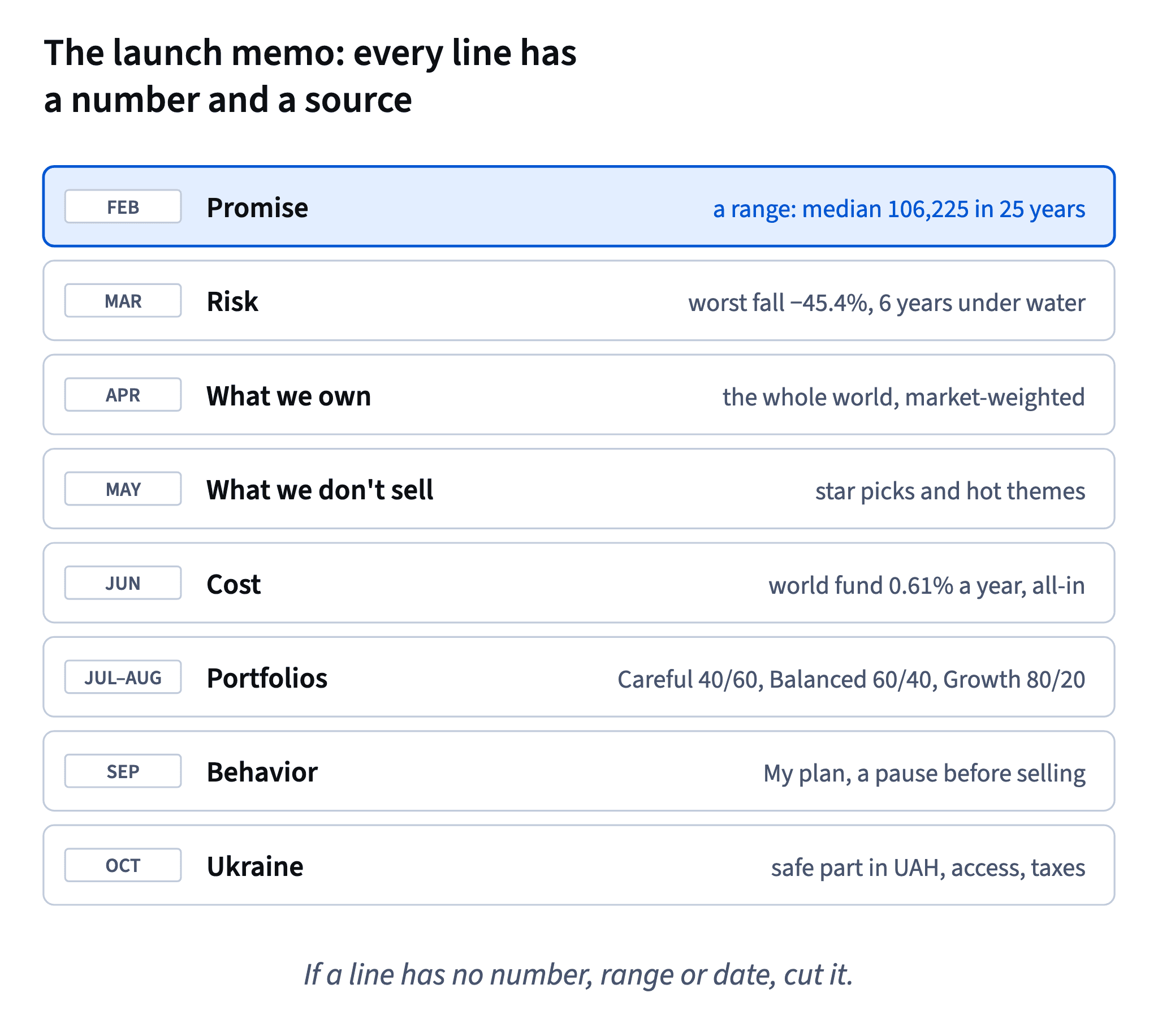
November 2027: launch week at Zapas. Nine months ago you joined as the PM, and Ethan's first draft said "Grow your money 12% a year". Now the board wants a one-page launch memo by Friday: what Zapas promises, what it sells, what it costs, how it keeps people invested and what's special for Ukraine.
Every line needs a number, a range or a date from your own work since February. You'll write that memo, and then a one-page plan for your own money.
A launch memo built from evidence
A launch memo for an investing product is a set of claims the company will be held to. Each claim needs evidence you've already produced. Zapas's year gives eight lines:
- Promise (February): 150 dol. a month for 25 years, in today's money: median about 106,225, 1 in 10 paths below 57,544, 1 in 10 above 189,828; paid in 45,000. Synthetic, not a forecast.
- Risk (March): world stocks once fell 45.4% and took 6 years to regain the old peak (11 in real terms).
- What we own (April): the whole world, market-weighted.
- What we don't sell (May): star-manager picks and hot themes.
- Cost (June): Zapas World Stock 0.61% a year all-in.
- Portfolios (July–August): Careful 40/60, Balanced 60/40, Growth 80/20, each with its worst year and fall.
- Behavior (September): "My plan" and a pause screen still being tested.
- Ukraine (October): safe part in the spending currency, access and tax notes, dated.
- Do"Median 106,225 after 25 years; 1 in 10 below 57,544. Synthetic, not a forecast."
- Don't"Grow your money 12% a year."
The risk line, in dollars and years
A portfolio card in the memo leads with what a user can lose, not what they can win. From the 40-year synthetic history, in real terms:
- Careful 40/60: compound 3.6% a year; worst year −17.6%; worst fall −27.6%; 6 years under water.
- Balanced 60/40: 4.4%; −20.0%; −30.0%; 6 years.
- Growth 80/20: 5.2%; −24.3%; −38.0%; 8 years.
Dataset · 6 rows
Stock and bond mixes over 40 synthetic years, real terms
For each mix from 0/100 to 100/0: average and compound real return, worst real year, maximum real drawdown, years to recover and under water, real value of 1,000 dol.
First 5 of 6 rows
Turn the percentages into money and time: 10,000 dol. in Growth would have shrunk to 6,200 at the worst point and stayed below its old real peak for 8 years.
Two more lines belong on the card: money needed within about two years stays outside all three portfolios; and these are synthetic past numbers, not a forecast, with a range rather than a promise.
A user who reads "−38% and 8 years" before signing up is far less likely to panic when it happens.
Chart data
| Share of stocks, % | Compound real return a year, % | Worst real year, % | Maximum real drawdown, % |
|---|---|---|---|
| 0 | 1.7 | -12.7 | -22.8 |
| 20 | 2.7 | -15.1 | -25.2 |
| 40, Careful | 3.6 | -17.6 | -27.6 |
| 60, Balanced | 4.4 | -20 | -30 |
| 80, Growth | 5.2 | -24.3 | -38 |
Show 1 more row
| 100 | 5.9 | -31.8 | -48.2 |
- Do"Growth: in our history, 10,000 fell to 6,200 and took 8 years to recover."
- Don't"Growth: up to 5.2% a year!"
The cost line
The memo states cost the way a user will feel it: all-in, in percent and in money.
All-in = fund level (ongoing charge or tracking difference) + platform fee + tax drag + one-off costs (bid-ask spread, FX in and out, entry fees) spread over the holding period.
From the June work, over a 10-year holding:
- Zapas World Stock: 0.61% a year, 61 dol. on 10,000, 122 on 20,000;
- Zapas Short Bond: 0.54%;
- the look-alike with the lowest headline fee (0.05%): 1.20% all-in, once 30% dividend withholding, its platform fee and two conversions were counted.
A cheap headline fee and a cheap product are different things. For Ukrainian users, FX is often the largest single layer: about 0.65% each way at banks on 9 October 2027. The memo shows the all-in number next to the headline fee and says what's inside it.
- Do"0.61% a year all-in: 122 dol. on 20,000."
- Don't"Fees from just 0.05%!"
What stays out of the memo
The fastest way to check a memo is to cross out every line that fails Grace's test: no number, no range, no date, no source.
Lines that usually fail:
- superlatives: "best", "smartest", "number one";
- borrowed numbers: the fund's 8.7% presented as the users' result (they averaged 6.0%);
- promises: "grow 12% a year", "safe", "guaranteed", "fully protected";
- unfinished results as wins: "a third less panic selling" from a test with p = 0.16;
- undated rules: tax or currency rules without "as of October 2027" and "check the current rules".
What remains is shorter and stronger: a range with a horizon, the bad years in money and time, the all-in cost, the honest status of the behavior features and the dated Ukrainian notes. The memo will be quoted in a year; write it so that it's still true then.
- Do"Pause screen: 35.0% vs 23.3% sold, inconclusive, test continues."
- Don't"Zapas: the safest way to invest in Ukraine."
Sequence risk and the safe bucket
While you add money, a crash is a sale: deposits buy cheap. Once you take money out, a crash early on works the other way: you sell at low prices to pay the bills, and those units never come back. This is sequence risk: the same returns in a different order leave very different results.
Two levers reduce it, each with a cost:
- A lower withdrawal rate: take a smaller share of the portfolio each year. Less income, more room for bad years.
- A safe bucket: a few years of withdrawals kept in short bonds or cash, spent during a crash so stocks don't have to be sold. It earns less in normal years.
How big? In Zapas's synthetic history the world index took 6 years to regain its peak after the year-21 crash (11 in real terms). Covering 6 years of 6,000 dol. means 36,000, 18% of a 200,000 portfolio. No size is "right"; it's a choice between calm and growth.
- Do6,000 × 6 = 36,000 dol. bucket: calmer first years, slower growth
- Don't"Keep everything in stocks and sell what you need each year, whatever the market does."
Withdrawal rates as trade-offs
A withdrawal rate is the share of a portfolio taken out each year to live on. Popular articles quote "safe" rates. There is no such thing: any rate is a bet on the order of future returns.
See what a fall does. 200,000 dol. drops 38% (Growth's worst fall in our history) to 124,000 right after retirement:
- withdrawing 6,000 a year (3% of the start) is now 4.8% of what's left;
- withdrawing 10,000 (5% of the start) is now 8.1%.
The higher rate eats into a shrunken portfolio much faster, and the units sold at the bottom won't recover.
So a drawdown plan has three adjustable parts: a starting rate low enough to leave room, a rule for cutting it after bad years, and a safe bucket for the first years. Each makes failure less likely and costs income or growth. Write the trade-off down; don't hide it behind one "safe" number.
- Do10,000 ÷ 124,000 = 8.1%; 6,000 ÷ 124,000 = 4.8%
- Don't"5% is the safe withdrawal rate."
Writing your drawdown paragraph
The drawdown paragraph of a plan is written years before it's used, so it should state choices and their costs, not a formula.
A good paragraph covers five things:
- A starting rate, as a modest range or an example, never called "safe".
- A cutting rule: what changes after a bad year (skip the inflation increase, lower the withdrawal).
- A safe bucket, sized in years of withdrawals, in short bonds or cash and in the currency you'll spend.
- The costs: less income, slower growth on the bucket.
- A yearly review, and a reminder to check the tax rules at the time.
Anchor it in something real. In our synthetic history the year-21 crash took 6 years to recover nominally and 11 in real terms; your bucket and your cutting rule are your answer to "what if that happens in my first year?".
- Do"A modest starting rate, say 2.5–3.5%, cut after a bad year; 6 years in a safe bucket, as long as the nominal recovery after the year-21 crash took."
- Don't"A fixed rate I'll never cut, whatever the market does."
Two one-page documents, one set of rules
The capstone asks for two pages that follow the same rules.
The launch memo speaks for the company. Every line has a number, a range or a date, and a source: the 25-year range (synthetic, real terms), the three portfolios with their worst year and worst fall, the all-in cost, the behavior gap and the honest status of the pause test, and the Ukrainian notes dated October 2027 with "check the current rules". It names no bank or broker and promises nothing.
Your own plan speaks for you. Seven lines in order (goal, horizon, mix, monthly amount and currency, rebalancing rule, fall rule, play bucket) plus one line on drawing money down: a modest starting rate you can cut and a safe bucket, with their costs.
The test for both is the same: would you still sign it on the day the market is down 30%?
- Do"Growth 80/20: worst fall −38.0%; I accept it because my horizon is 25+ years."
- Don't"Mix: whatever performs best."
Ready to practise?
Answer the lesson's exercises and earn 250 points the first time you finish it.
Start the exercises