

Theory
Scary questions you avoid
When your calls are honest but trivial: how to ask the scary questions that could kill the idea, welcome a lukewarm “meh”, start broad, and tell a painkiller from a vitamin and product risk from market risk.
~11 min read · 12 exercises · 250 points
Before you start
Honest, but trivial
Back at CatChow, Sofia's second round of calls about the food subscription is done. No compliments, no vague answers, only past specifics, and somehow the notes you read together hold almost nothing that could change a decision.
This module is about asking the right things. In this first lesson you'll find the questions that get avoided because the answer might hurt the idea, and learn to tell a problem people urgently need solved from one that's merely nice to fix.
What makes a question important
Once your questions are free of compliments and hypotheticals, a new trap opens: they can be honest and still useless. “How old is your cat?”, “Which brand did you buy last?” and “How many bowls does he have?” are all clean, and not one of them could change a single decision at CatChow.
An important question is one where a surprising answer would change your plan, or end it. Run every question through a quick test before the call: if the answer shocked me, would I do anything differently? If not, it's trivia, however polite and unbiased it is. Cut it and spend the time on something that matters.
For CatChow's food subscription, a cat's age or favourite bowl changes nothing. What happens when the food runs out, and what that costs the owner, goes straight to the reason the subscription exists. Facts you already hold, such as how long someone has been a customer, don't need a question at all: look them up before you dial.
- Don't“How many bowls does Whiskers have?”
Honest and unbiased, but no answer would change the plan.
- Do“The last time you ran out of food, what did you do, and what did it cost you?”
A surprising answer here could change or kill the subscription.
- Don't“How long have you been a CatChow customer?”
The CRM already knows; don't spend call time on it.
Scary questions
A scary question is an important question you're tempted to skip because the answer might hurt your idea. Sofia knew hers: would people actually leave the pet shop by their building, and would they pay for a month of food upfront? If either answer is no, the subscription falls apart, and that is exactly why she kept not asking.
Typical scary questions check whether people really switch from what they use now, whether they've ever paid ahead for something similar, and who actually decides and pays. They are the questions most worth asking, because their answers are the ones that can save you months.
Aim for at least one question in every conversation that makes you slightly nervous. If you freeze, imagine a friend's startup had your plan: you'd tell them to ask bluntly, without softening it. Give yourself the same advice. Write the scary question down before the call, so it survives the awkward moment when you'd rather talk about something pleasant.
- Do“Have you ever changed where you buy cat food? What made you change?”
Tests whether people switch at all; a “never” could sink the plan.
- Do“When did you last pay for something for your cat a month or more in advance?”
Faces the upfront-payment risk head-on.
- Don't“How did you first hear about CatChow?”
Safe and comfortable, and it risks nothing.
Love bad news
When Sofia finally asked Olivia, a long-time CatChow customer, whether she'd pay for a month ahead, the answer was lukewarm: “I don't know… I walk past the pet shop anyway. It's fine as it is.” Sofia then spent ten minutes convincing her and came away with “OK, maybe I'd try it.” She traded honest data for a polite maybe.
A “meh” feels like failure, but it's often the most honest moment of a call. A “wow” is cheap to say; a “meh” is rarely said just to please you. And compare the costs: hearing “meh” from ten people now costs two weeks of calls, while hearing it after launch costs months of development and the marketing budget.
So don't argue, push harder or offer a discount. Get curious instead. Is the problem smaller than you thought? Is this the wrong customer? Is one detail, like paying ahead, putting them off? Then thank them: they helped you more than anyone who “loved it”.
- Don't“But think how convenient it would be! And we'd give you 10% off.”
Arguing and bribing turn an honest “meh” into a useless maybe.
- Do“Fair enough. What makes it fine as it is?”
Treats the lukewarm answer as data and digs for the reason.
- Do“Thanks, that's really useful to hear.”
Rewards honesty, so the next answer is honest too.
Start broad, not with your problem
Sofia opened every call with “What's your biggest problem with buying cat food?” That's zooming in too early: diving into one narrow problem before checking that the person cares about that area at all. Ask for a problem and people will name one, simply because you asked. Often it's one they've never really thought about, and your notes fill up with pains that don't exist.
Start broad instead: “What's been taking your time and money with your cat lately?” or “Tell me about a normal week with him.” Then listen. A broad opening doesn't tell the person what you hope to hear, so whatever comes up first is theirs, not yours.
If getting food home is a real pain, they'll raise it on their own. If they talk about vet bills or a cat that scratches the sofa, that's true information too: buying food isn't near the top of their list, and no subscription pitch will change that.
- Don't“What's your biggest problem with buying cat food?”
Plants the problem; people invent one to be helpful.
- Do“What's been taking your time and money with your cat lately?”
Lets the real problem come up on its own.
Earn the zoom
Starting broad isn't the same as staying vague forever. The broad opening has one job: to open the door wide enough for the real problem to walk in. Once it does, you zoom in.
The signal to zoom is strong and specific: the person raises the problem themselves and spends real time on it. When Mark, asked about his week with his cat, talks for five minutes about hunting for his cat's brand because the shop near his office keeps running out, he has earned the zoom.
Now go for specifics from the past: the last time the shop ran out, what he did, how long it took and what it cost. Don't pitch the subscription yet; that swaps his story for opinions about your idea. And don't ask for his “biggest problem” to confirm it: he has just shown you with a real story, and a general question only invites a general answer.
If nobody raises the problem after several broad openings, that's a finding too.
- Do“When did the shop last run out of his brand? What did you do then?”
Zooms into a problem Mark raised himself.
- Don't“Then you'll love our subscription, it solves exactly this!”
Pitching now swaps his story for opinions.
Painkiller or vitamin
Olivia ran out of food twice this year. A signal, but of what size? Both times she walked to the shop by her building, ten minutes there and back. For her, a subscription is a vitamin: nice to have, easy to put off. A painkiller fixes something that hurts right now, and painkillers get paid for first.
You can't tell them apart by how much someone complains; people grumble about vitamins too. Checking whether a problem is worth solving comes down to one habit: look for cost.
- Are they already spending money or time on it?
- Have they searched for a fix or built a workaround?
- Is it among their top three worries?
An owner who runs out twice a year and pops to the shop has a vitamin problem. An owner whose cat is on a prescription diet that's often out of stock locally, who drives across town and keeps backup bags ordered online, may have a painkiller one.
- Don't“She ran out of food twice this year, so she needs us.”
Counts a cheap ten-minute fix as real pain.
- Do“What did you do the last time you ran out, and what did it cost you?”
Measures the pain by its cost, not by complaints.
The obvious problem: who pays?
Sometimes the pain is so obvious and so big that you forget to check the boring part. Sofia called Sarah, the volunteer coordinator at an animal shelter: forty cats, and the food runs out every single week. A huge, urgent problem. But the food comes mostly from donations and bags people bring in, and Sofia never asked about money, because it felt awkward with a charity.
That's the elephant in the room. A real, urgent problem with no budget behind it is a dead end for a paid product. So is an eager contact who can't approve anything, which is why you find the decision maker: the person who actually says yes to spending.
Ask about money even when it feels rude, especially then. Keep it polite and about the past: how was the food paid for last month, and who signed off on it? One awkward answer now saves months of selling to someone who can't buy.
- Don'tSkipping the money question because “they're a charity, it would be rude”.
The pain is confirmed; the budget is the open risk.
- Do“How was the food paid for last month, and who approved it?”
Polite, about the past, and aimed at money and decision power.
Product risk vs market risk
Megan, CatChow's head of sales, came back with good news: three customers said they'd switch today if CatChow delivered the same day and cost less than their shop. It sounds like validation, but it only says “give me more for less and I'll take it”. Who'd refuse?
Every new product carries two kinds of risk. Product risk: can we build it and make it work at scale, at a cost that makes sense? Whether CatChow can deliver same-day and cheaper than a shop is product risk. Market risk: do people want it, will they pay, and are there enough of them?
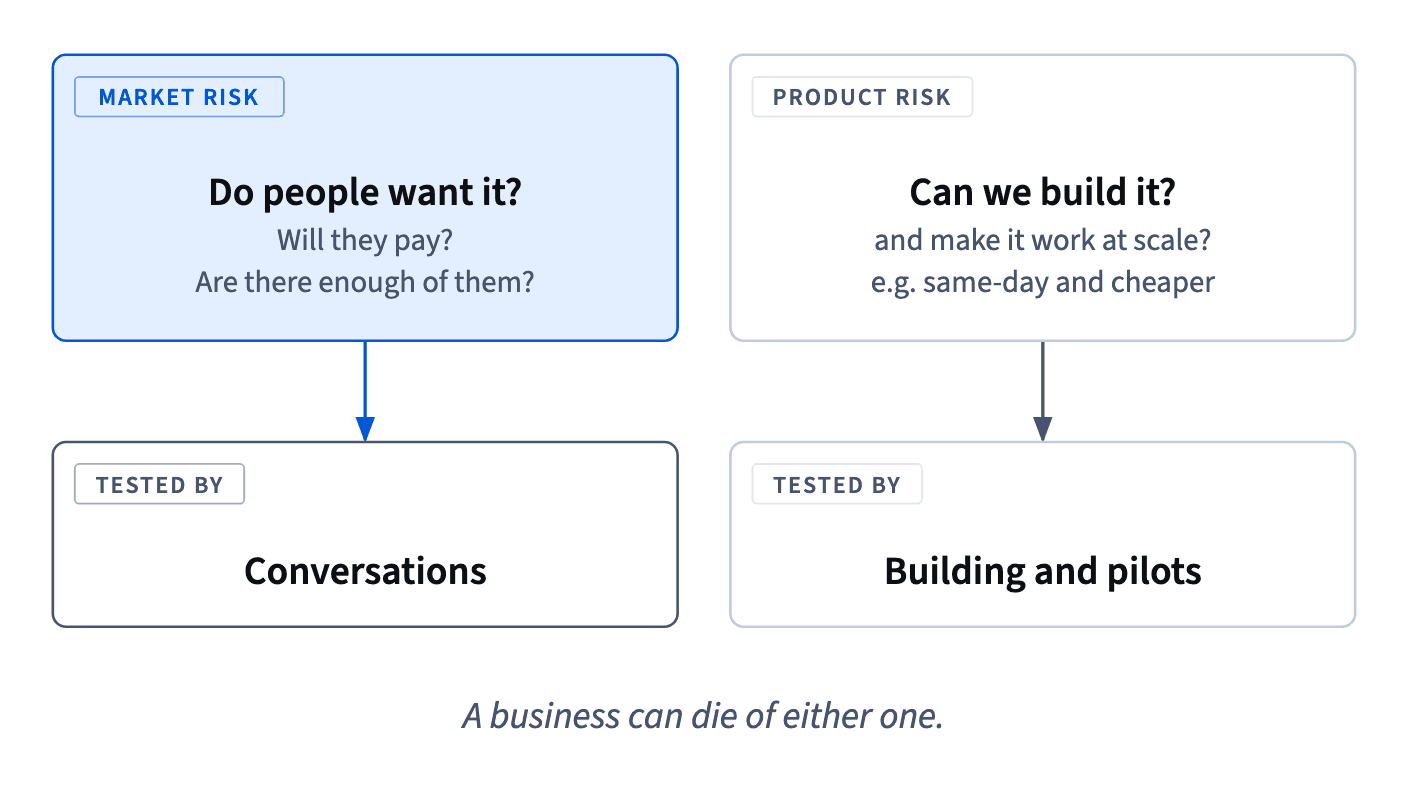
Conversations are good at testing market risk, but they can't remove product risk; only building, testing and pilots can. So Megan's customers told CatChow about its logistics, not about demand. Keep both lists side by side, because a business can die of either one. When a customer's answer starts with “if you can…”, check which list it really belongs to.
- Don't“Three customers would switch if we deliver same-day and cheaper. Demand confirmed!”
A product question disguised as demand.
- Do“Will owners pay for a month of food in advance?”
A market risk a conversation can test.
- Do“Can couriers reach small towns within 24 hours at a profit? Let's run a pilot.”
Product risk goes to a pilot, not to an interview.
What a line really tells you
After a week of calls, your notes fill up with lines that sound friendly. Friendly is rarely a yes. Sort each line by what it actually tells you. The traps of this lesson show up in every segment, whether you're talking to a cat owner or to Lucy, who runs a small cat hotel:
- A vitamin: “that'd be nice someday” means a problem that's easy to postpone.
- The obvious problem: “the owner signs every purchase and the budget's gone” points to missing money or decision power.
- Product risk in disguise: “if you're faster and cheaper than my shop, I'm in” is about what you can build, not about demand.
- An honest “meh”: “not sure I'd use it” is a reason to thank them and ask why.
For every line, ask two things: what does it really say, and what would I do next? Different segments simply hide the same traps in different places.
- Don'tLogging “that'd be nice someday” as a warm lead.
A vitamin dressed up as interest.
- DoNext to each line, write what it really says and one next action.
Turns friendly noise into decisions.
Ready to practise?
Answer the lesson's exercises and earn 250 points the first time you finish it.
Start the exercises