

Theory
Side project or full time?
Keeping the job while you start versus quitting, how co-founders with different finances agree on it, and how to protect time and energy either way.
~9 min read · 9 exercises · 250 points
Before you start
Who quits, and when?
You're still advising GarageDesk's founders with Alex, and the investor got his polite no. The next question is closer to home: who works on GarageDesk, and how much? Nina wants to quit her job and build it properly. Oscar has a mortgage and a small daughter, and can't.
In this lesson you'll help two co-founders with very different finances agree on a plan, and see how to protect time and energy whether you keep the job or leave it.
Different finances, one company
Co-founders almost never have the same savings, bills and safety net. One has a cushion and no dependants; another has a mortgage and a small child. That difference is normal and says nothing about commitment.
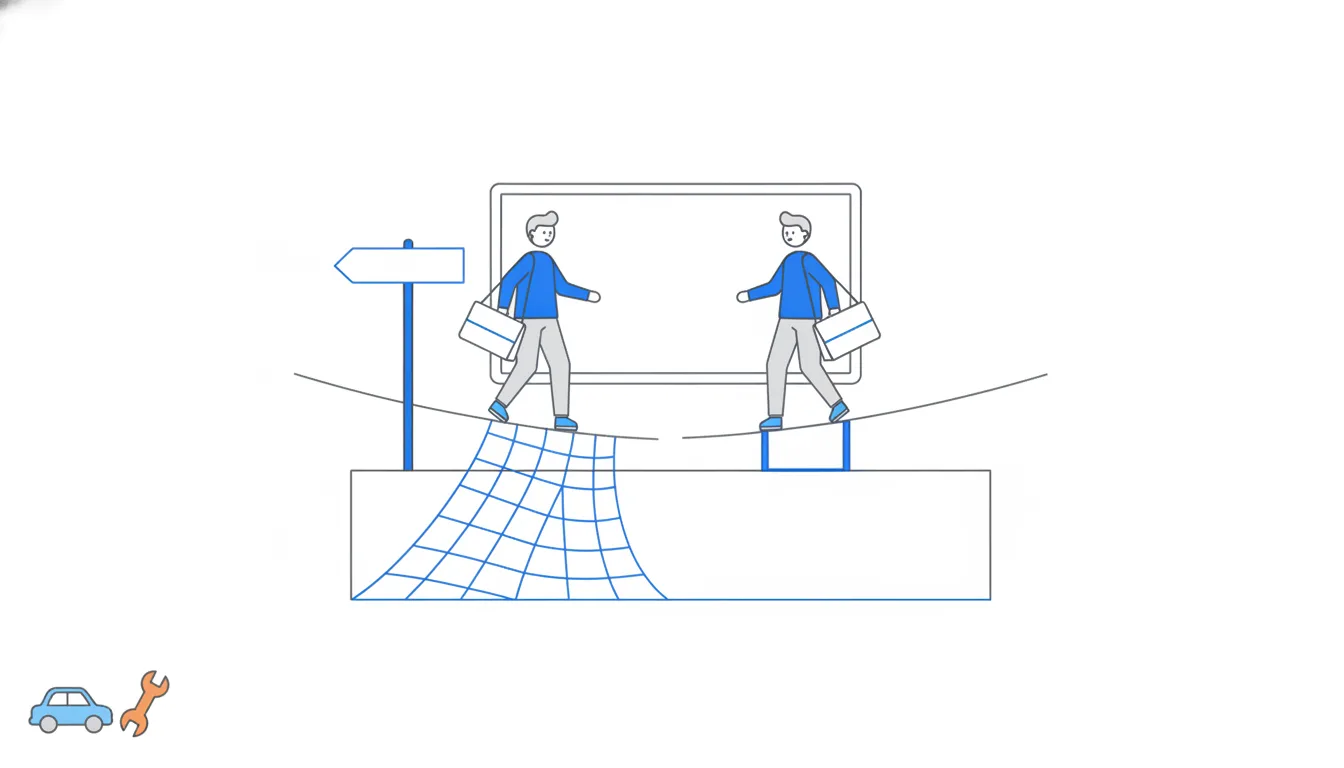
What it changes is how soon each founder needs the business to pay them. A founder with a cushion can afford to polish the product for months. A founder with fixed family costs needs income sooner, so they'll push to charge customers early.
Left unspoken, the two clocks pull the company in opposite directions: one founder wants to sell, the other to keep building, and every small decision turns into a quiet argument.
The fix is a plain conversation early on:
- how many months can each of us go without income from the company?
- what monthly amount does each of us eventually need?
- what do we do if those needs collide?
Personal finances stay private in detail, but the numbers that shape the company's pace must be on the table.
- Do“I can go nine months without pay; you need income in four. Let's plan around four.”
- Don't“Money is personal, let's not bring it into the company.”
What a side project and full time each cost
Neither path is the "serious" one; each buys something and pays for it.
A side project keeps the salary coming:
- savings stay untouched while the product earns nothing;
- there's no panic to charge customers before the product is ready;
- a job close to the audience is free research and a list of first people to call.
The price is time: progress is slower, and evening hours come after a full working day.
Full time buys speed and focus: long stretches of deep work, faster releases, quicker learning. The price is money and pressure: every month without revenue eats savings, and the clock starts the day the salary stops.
So the question isn't "how committed are you?" but "which cost can this founder carry right now?" A founder with a short cushion who quits trades a slow but safe start for a fast one with a deadline. A founder whose job puts them in front of customers every day may be more useful keeping it for a while.
- Do“Keeping the job is slower, but it saves my cushion and keeps me in three shops a day.”
- Don't“A side project will be built just as fast as a full-time one.”
Time goes in the calendar
A side project lives on the hours left after a job and a family, and those hours don't appear on their own. "I'll work on it whenever I have free time" quietly turns into "never": there's always something more urgent on a weeknight.
What works is a fixed weekly time budget: specific slots in the calendar, treated like meetings. For Oscar that's Tuesday and Thursday evenings plus Saturday morning, about 12 hours a week. The family knows the slots, and so does Nina.
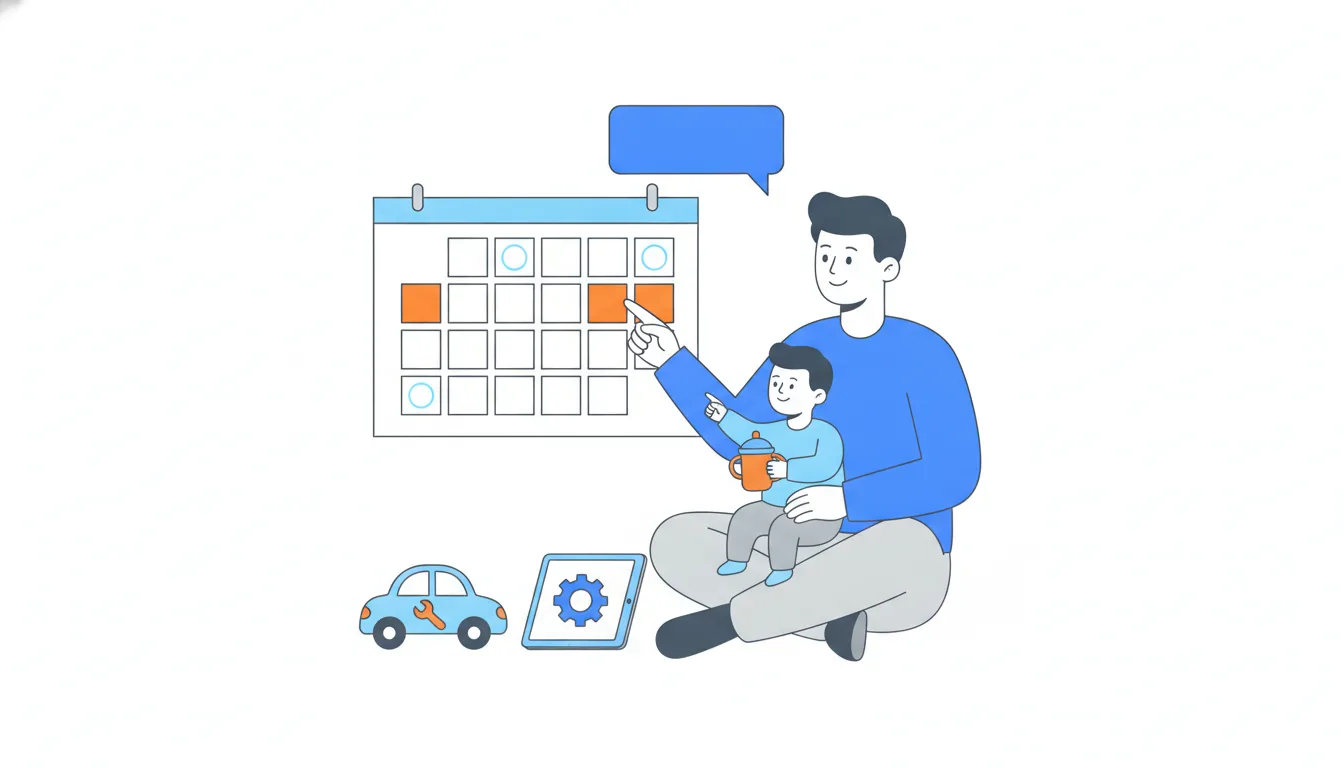
A few rules keep the budget sustainable:
- protect the slots, but keep the rest of the week free, so the project doesn't eat every evening;
- plan before the slot starts, so the first half hour isn't spent deciding what to do;
- no heroics: if both founders are exhausted by spring, the company dies with them.
Working hard isn't the same as working long hours. A rested founder with 12 planned hours makes better decisions than a tired one with 30 scattered ones.
- Do“Tuesday and Thursday 19:00–22:00, Saturday 9:00–13:00: GarageDesk.”
- Don't“I'll do GarageDesk whenever I get a free evening.”
Match the work to the time
Once the hours are in the calendar, the next step is to give each founder the kind of work that fits their hours.
Short slots suit tasks that can be finished in one sitting and don't lose much if interrupted:
- calls with shop owners;
- answering early users;
- writing a short offer or checking a list of contacts.
Long, uninterrupted stretches suit deep work that needs hours of focus to get anywhere: designing and building the booking calendar, fixing a tricky bug, setting up payments.
At GarageDesk the split follows naturally. Oscar has three evening and weekend slots and already talks to repair shops every day, so he takes the calls and the replies to users. Nina works full time, so she takes the long building tasks.
The opposite split wastes both: a complex module built in three-hour evening pieces stalls every time it's picked up again, and a full-time developer spending her best hours on phone calls slows the product down.
- DoOscar: calls and user replies in evening slots. Nina: the booking calendar in full days.
- Don'tOscar builds the payments module in three-hour evening pieces.
Deep work cut into short slots stalls every time it restarts.
Write the founders' deal down
The step most co-founders skip is putting their deal on paper while they're still friends. It's much easier to agree on what happens if someone leaves before anyone wants to leave.
A useful co-founder agreement covers the founders, not the product:
- shares: how ownership is split, for example 50/50;
- decisions: who has the final say in which area, such as Nina on the product and Oscar on sales and support;
- commitments: how much time and money each puts in now and when that changes, for example when Oscar goes full time;
- leaving: what happens to the shares if one founder leaves early.
An unequal effort today doesn't make an equal split unfair, as long as the path to equal effort is written down too: when the part-time founder goes full time, and what the founders do if that never happens.
What doesn't belong there: the feature list, the roadmap or prices. Those change every week and live in the product plan.
- Do“50/50; Nina decides on product, Oscar on sales; Oscar goes full time at 30 paying shops.”
- Don't“We trust each other, so we don't need anything on paper.”
Vesting: shares that are earned over time
Vesting means a founder's shares become fully theirs gradually, over an agreed period, rather than all on day one. Nina and Oscar each own 50%, but under a three-year schedule each of them earns that 50% step by step while they keep working on the company.
It protects against one specific problem: a founder who leaves early walking away with a large share of a company they no longer build. Without vesting, if Oscar left after four months, he'd still own half of GarageDesk, and Nina would spend years building value that's half his.
With vesting, the shares that haven't been earned yet when someone leaves go back to the company or the remaining founder, as the agreement specifies. The details (the period, whether there's an initial waiting time, how the leftover shares are handled) are set in the written agreement, ideally with a lawyer.
Vesting isn't a sign of distrust. It's insurance that both founders sign up to, because neither knows today who might need to leave.
- Do“Our shares vest over three years, so whoever leaves early keeps only what they've earned.”
- Don't“We split 50/50 on day one, fully ours whatever happens.”
A trigger: a number and a date
"I'll go full time when it takes off" sounds like a plan but can't be checked. A useful trigger for switching from side project to full time has two parts.
A number tied to what the founder needs. Oscar's share of the family budget is 18,000 UAH a month. At 600 UAH per shop per month, 30 paying shops cover it: 30 × 600 = 18,000. When that number is reached, he hands in his notice. The revenue, not a mood, makes the switch safe.
A deadline to review. If 30 shops haven't come within 18 months, the founders sit down and rethink the plan and the split instead of drifting. The talk happens on a calendar date, not in the middle of a fight.
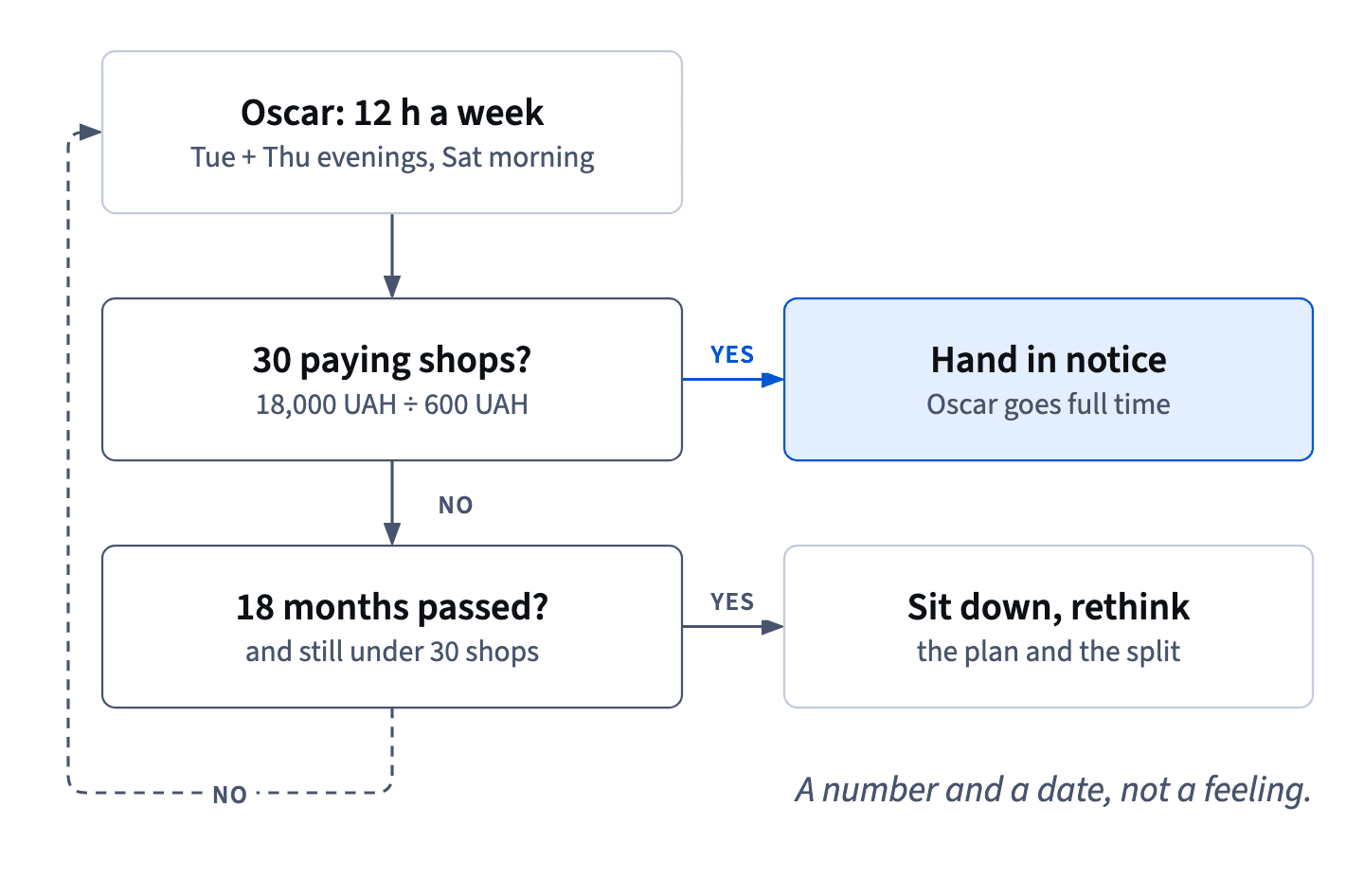
Weak triggers share a pattern: they depend on feelings ("when it feels real"), on a single event ("when the first shop signs up") or on someone else ("when Nina asks"). None of them pays a mortgage.
Write the trigger into the founders' agreement, next to the split it affects.
- Do“At 30 shops × 600 UAH = 18,000 UAH a month, I quit; if not by month 18, we review.”
- Don't“I'll quit when GarageDesk really takes off.”
Working out the trigger number
The trigger number comes from one division:
paying customers needed = monthly income the founder needs ÷ revenue per customer per month
Three steps keep it honest:
- Start from the founder's real need, the amount their household budget requires from them each month, not a round figure that sounds nice.
- Use the actual monthly price per customer. For GarageDesk that's 600 UAH per shop per month.
- Round up. If the division gives 34.2 shops, you need 35: 34 shops would leave the founder short.
For a need of 18,000 UAH: 18,000 ÷ 600 = 30 shops. If the need were 21,000 UAH, it would be 21,000 ÷ 600 = 35 shops.
This is a simplified first version: it treats all revenue as money the founder can take home. Later lessons add costs and taxes, which push the number up. Even the simple version beats a feeling, because anyone can check it.
- Do21,000 ÷ 600 = 35 shops.
- Don't21,000 − 18,000 = 3,000, so 30 + 3 = 33 shops.
Mixes hryvnias and shops: the extra 3,000 UAH needs 5 more shops, not 3.
Ready to practise?
Answer the lesson's exercises and earn 250 points the first time you finish it.
Start the exercises