

Theory
How much money do you need to quit your job?
How much money you need to quit your job: your personal runway in months without income from the product, why you keep a reserve, and how many customers stop the countdown.
~9 min read · 9 exercises · 250 points
Before you start
Before Nina sends the letter
Back at GarageDesk, Nina's resignation letter is written. Before she sends it, she has to answer the question every founder asks: how much money do I need to quit my job? Her savings and monthly bills are on the table, and Alex wants numbers from bank statements, not from the budget Nina wishes she had.
In this lesson you'll work out her personal runway, decide how big a reserve to keep, and count how many paying shops would stop the countdown.
Personal runway: how long the money lasts
Before a founder quits a job, one number matters more than any business plan: the personal runway, the number of months they can keep going before their money runs out.
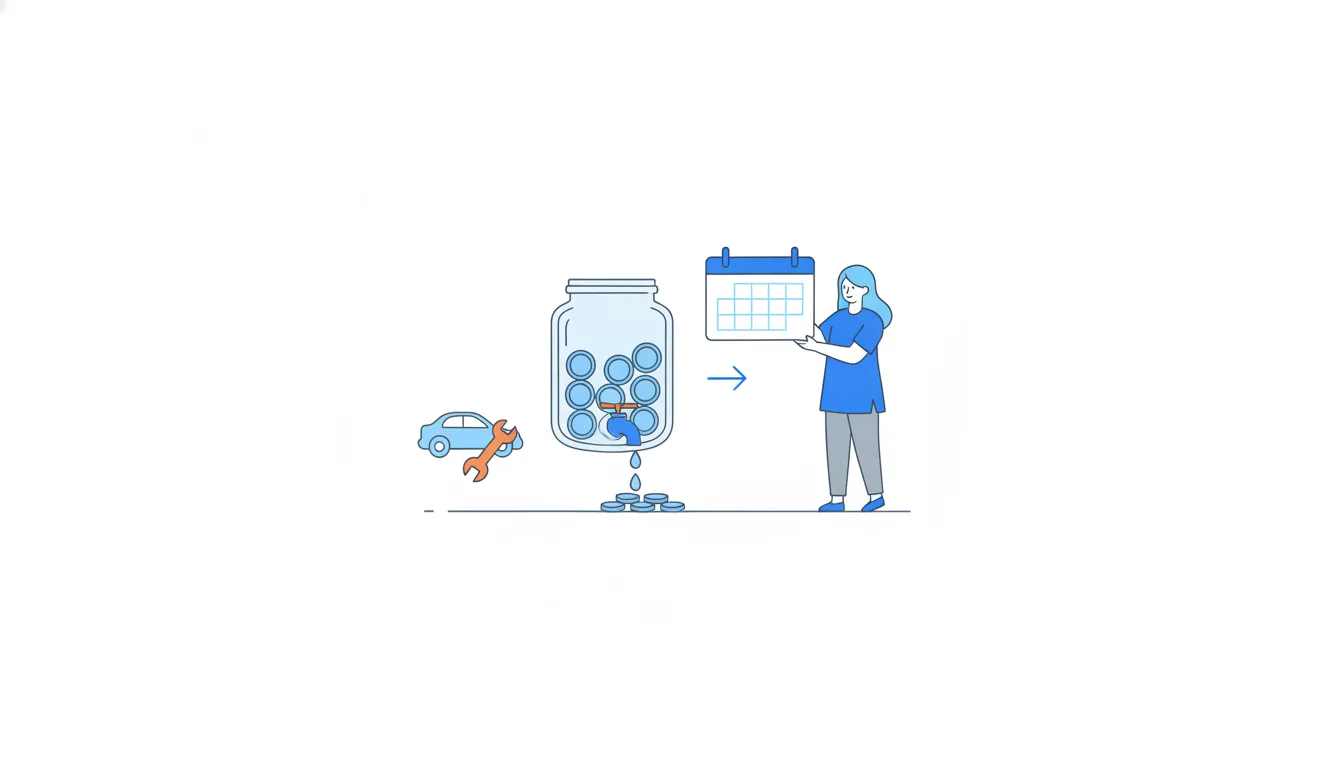
With no income at all, it's a single division:
runway = savings ÷ monthly spending
Monthly spending is the founder's burn rate: everything that leaves the account in a typical month, from rent to the phone bill.
For Nina: rent 12,000 + food and bills 11,000 + transport, phone and everything else 7,000 = 30,000 UAH a month. With 360,000 UAH saved: 360,000 ÷ 30,000 = 12 months.
Two habits keep the number honest:
- add up every line before dividing; dividing by one line (just rent) makes the runway look three times longer;
- use months as the unit and keep the answer as a decimal if needed (13.5 months is a real answer).
This is the starting point. The next steps adjust it for side income and a safety reserve.
- Do12,000 + 11,000 + 7,000 = 30,000; 360,000 ÷ 30,000 = 12 months.
- Don't360,000 ÷ 12,000 rent = 30 months.
Divides by one line of spending instead of the whole month.
Spending from statements, not wishes
A runway is only as good as the spending figure under it, and that figure is the one people get wrong most often.
The tempting source is a planned budget: what you intend to spend once you're careful. It's usually too low. Small purchases, subscriptions, gifts, repairs and "everything else" never fit into a plan written in one evening.
The reliable source is what actually left the account. Take the last three bank statements, add up each month and use the average. Three months smooth out one unusual month (a holiday, a big repair) without hiding regular costs.
Then compare the result with the plan. If the statements show 30,000 UAH a month and the plan says 24,000, the plan is a goal to work toward, not a number to bet your savings on. Cutting spending is a real lever, but count it only after it has shown up in a statement.
An overly hopeful spending figure doesn't just shift the answer a little: every month of underestimated spending shortens the real runway.
- Do“My last three statements average 30,000 UAH a month. I'll use that.”
- Don't“From now on I'll spend 24,000 a month, so my runway is 15 months.”
Net burn and the reserve
Two adjustments turn the simple runway into a realistic one.
Side income lowers the burn. If a founder keeps earning something, only the gap has to come from savings: net burn = monthly spending − monthly income. Nina's five-hour-a-week contract pays 10,000 UAH, so her net burn is 30,000 − 10,000 = 20,000 UAH. Income that doesn't eat the week is worth keeping.
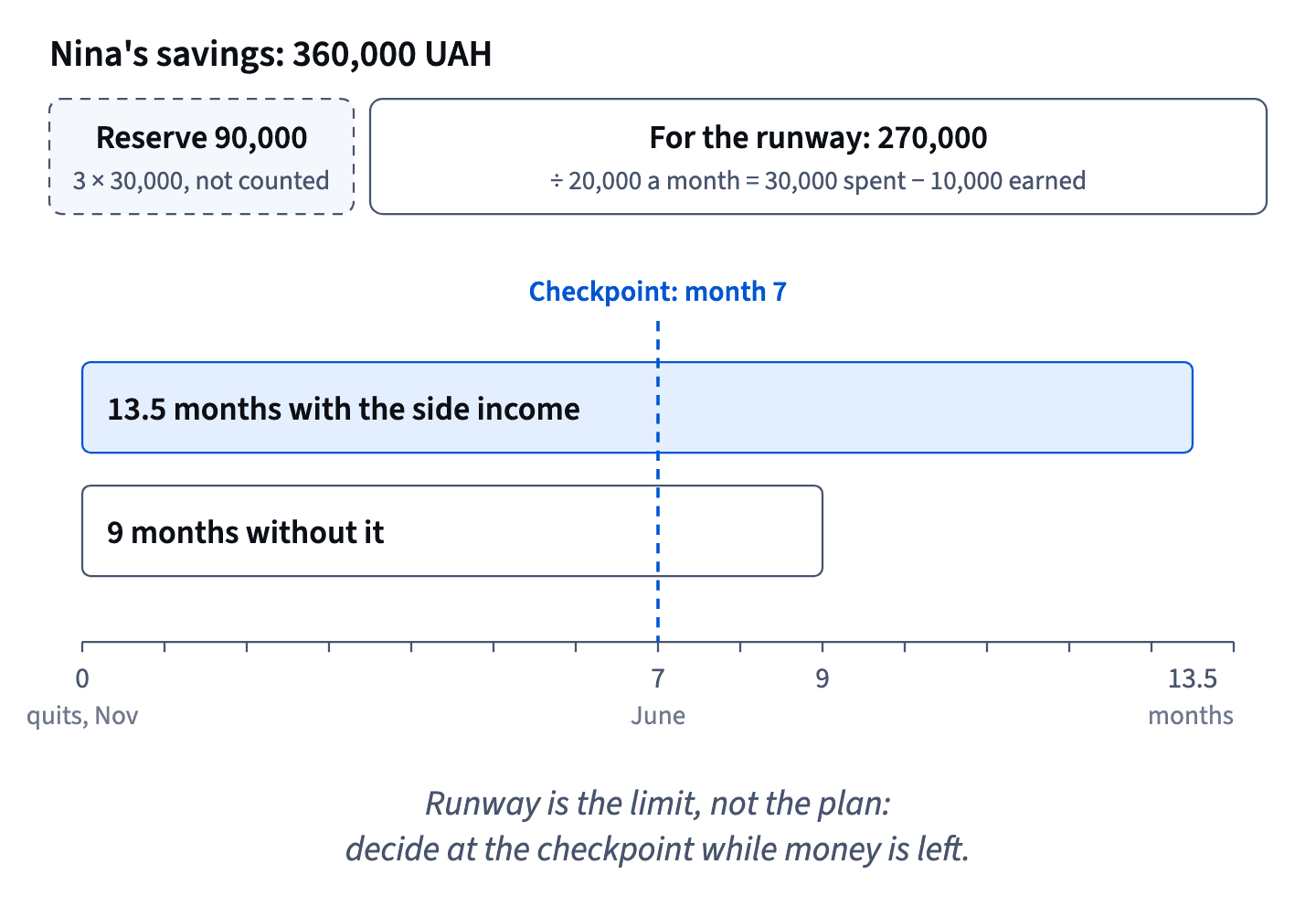
A reserve comes out first. Set aside three months of full spending for illness, a broken laptop or a contract that ends, and leave it out of the runway. Full spending, not net burn, because the reserve exists for the day the side income stops: 3 × 30,000 = 90,000 UAH.

Put together:
runway = (savings − reserve) ÷ (spending − income)
For Nina: (360,000 − 90,000) ÷ (30,000 − 10,000) = 270,000 ÷ 20,000 = 13.5 months.
The reserve isn't wasted money. It's what lets the founder hit a bad month without abandoning the plan.
- Do(360,000 − 90,000) ÷ (30,000 − 10,000) = 13.5 months.
- Don'tReserve = 3 × 20,000 = 60,000, so 300,000 ÷ 20,000 = 15 months.
Builds the reserve from net burn; it must cover full spending if the income stops.
Recount when a number changes
A runway is a calculation, not a fact about the future. It's only true while its inputs stay the same, so recount it with the same formula whenever any number changes: savings, spending, income or the reserve.
Formula: Runway R in months: savings S minus reserve Z, divided by spending E minus income I. · shown above
The input that changes most easily is side income. Suppose Nina's 10,000 UAH contract ends the day she quits. The reserve of 90,000 UAH stays set aside, so the savings for the runway are still 270,000 UAH, but the net burn jumps back to the full 30,000:
270,000 ÷ 30,000 = 9 months, down from 13.5.
Losing a third of her monthly need in income cut her runway by a third. That's why the reserve is sized on full spending: it was built for exactly this day.
A simple habit helps: keep the formula in a spreadsheet with one cell per input. When a client leaves, rent goes up or a freelance job comes in, change one cell and read the new runway the same day, instead of discovering the change months later in the bank balance.
- DoContract ends: 270,000 ÷ 30,000 = 9 months. Update the plan today.
- Don't“The contract ended, so I'll spend the reserve and keep 13.5 months.”
Runway is the limit, not the schedule
13.5 months always sounds like plenty at the start. It isn't a plan for using all 13.5 months, though; it's the limit after which the money is gone. Building, first sales and getting paid all take longer than expected, so a plan that only works if everything goes on time will run out of money.
The fix is a checkpoint around halfway, decided in advance. For Nina, who quits at the end of November, month 7 is June. At the checkpoint she looks at one measurable number, such as paying shops, and acts on it:
- on track: carry on and recount the runway with fresh numbers;
- off track: take more freelance work, cut spending or go back to a job, while there are still months of money left.
A checkpoint near the end is useless: with one month of savings left, there's no time to find a job calmly or test anything new. A decision taken halfway is a choice; one taken at the end is an emergency.
- Do“Month 7, June: if paying shops aren't growing, I take more freelance work.”
- Don't“I have 13.5 months, so I'll decide in month 13.”
Ramen profitability: where the countdown stops
Runway tells you how long the money lasts. The other end of the plan is the finish line: ramen profitability, the point where the business covers the founders' basic living costs. Nobody gets rich, but the countdown stops.

To turn it into a customer count:
- Add up everything the business must pay each month: each founder's living costs plus the company's own running costs. For GarageDesk: Nina 30,000 + Oscar 18,000 + hosting and tools 2,000 = 50,000 UAH.
- Divide by revenue per customer per month: 50,000 ÷ 600 = 83.33.
- Round up, because you can't have a third of a shop and 83 aren't enough: 83 × 600 = 49,800, which is 200 UAH short; 84 × 600 = 50,400 covers it.
So GarageDesk needs 84 paying shops for both founders, and 30,000 ÷ 600 = 50 for Nina alone.
Two common slips: forgetting the company's own costs (that gives 80) and rounding down to the nearest whole number. Both leave the founders a little short every single month.
- Do50,000 ÷ 600 = 83.33 → 84 shops (84 × 600 = 50,400).
- Don't(30,000 + 18,000) ÷ 600 = 80 shops.
Forgets the 2,000 UAH for hosting and tools.
The runway plan, step by step
The whole method fits in four steps, and their order matters because each one needs the result of the step before:
- Add up monthly spending from the last three bank statements. Everything else is built on this number.
- Set aside the reserve: three months of full spending. You can't size it before you know the spending.
- Divide the remaining savings by the net burn (spending minus side income). This needs both the reserve and the spending.
- Put a checkpoint in the calendar around halfway through the runway. You can't place "halfway" until you know the runway.
Alongside the plan sit three levers that stretch it:
- spend less, counted only once it shows in a statement;
- earn a little on the side, ideally work that doesn't eat the week;
- charge customers as early as possible.
Only the third lever does two jobs at once: it extends the runway and proves that the business works. That's why Nina starts selling in month one instead of waiting until the product feels "finished".
- DoSpending → reserve → runway → checkpoint.
- Don't“First I'll set the checkpoint at month 7, then count my spending.”
Stretching the runway with lower spending
Cutting spending stretches the runway twice: the net burn falls, and the reserve, sized on full spending, shrinks too and frees savings for the runway.
Formula: Runway R in months: savings S minus reserve Z, divided by spending E minus income I. · shown above
Recount with the same formula, changing every input the cut touches:
- New full spending: say Nina moves to a cheaper flat and trims other costs, from 30,000 to 25,000 UAH a month.
- New reserve: 3 × 25,000 = 75,000 UAH.
- Savings for the runway: 360,000 − 75,000 = 285,000 UAH.
- New net burn: 25,000 − 10,000 = 15,000 UAH.
- Runway: 285,000 ÷ 15,000 = 19 months, up from 13.5.
A 5,000 UAH cut added 5.5 months, because the gap the savings must fill shrank from 20,000 to 15,000.
The typical slip is changing only one input: keeping the old 90,000 reserve gives 270,000 ÷ 15,000 = 18, and forgetting the side income gives 285,000 ÷ 25,000 = 11.4. And count a cut only once it shows up in a bank statement.
- Do(360,000 − 75,000) ÷ (25,000 − 10,000) = 19 months.
- Don't(360,000 − 90,000) ÷ (25,000 − 10,000) = 18 months.
Keeps the old reserve; it shrinks with the new spending.
Ready to practise?
Answer the lesson's exercises and earn 250 points the first time you finish it.
Start the exercises