

Theory
Ideal customer profile: narrow or widen the niche
Build an ideal customer profile from the customers who actually get the result, say who is out, and find where the niche's members already talk to each other.
~10 min read · 9 exercises · 250 points
Before you start
Twenty-two shops
End of May, and a new module at GarageDesk. There are 22 paying shops now, all in Vinnytsia. Most are small shops that see the same cars every few months, but there are also two body shops and one large service center, and they don't seem to get much out of the product.
In this lesson you'll describe the customers who actually get the result, say plainly who is out, and find where those customers already talk to each other.
Start from who gets the result
More kinds of customers can look like more sales. But a niche isn't defined by who signed up; it's defined by who actually gets the result the product promises.
By the end of May GarageDesk had 22 paying shops in Vinnytsia. Most were like Dennis's and Greg's: 2 to 8 bays, oil changes, brakes, suspension, the same cars every six months. For them reminders work, because the same cars come back on a schedule.
The others tell a different story:
- body shops see a car once, after an accident, so there's almost nothing to remind anyone about;
- a 12-bay center wants roles for eight administrators, reports per mechanic and an accounting link: every call is about something GarageDesk doesn't do;
- dealership service centers run their own software.
So look at your customer list through one question: for whom does the product do what it promises, without extra work from us? That group is the core of your niche. Everyone else is either a different market or a polite mismatch.
- Do"Reminders work where the same cars return on a schedule: our 2–8-bay service shops."
- Don't"We have body shops and a 12-bay center too, so our niche is any shop that works on cars."
Counts sign-ups, not results.
The ideal customer profile: one sentence, two edges
A niche is a group you can describe in one sentence: the same job, the same problems, the same words. Written down, that sentence is your ideal customer profile.
A usable sentence has concrete conditions, not adjectives. "Small businesses that work with cars" includes body shops, tire shops, car washes and dealerships, and nobody can tell from it whom to call tomorrow. "Independent car repair shops with 2 to 8 bays that do repeat service work" names a type, a size and a way of working.
Then write the other edge: who's out. For GarageDesk: body shops, dealership service centers, big centers with a dozen bays, and tire shops for now. Saying who's out is what makes the sentence useful day to day. When the 12-bay center asks for user roles, the sentence already answers: that's a different customer, not a request for the "later" list.
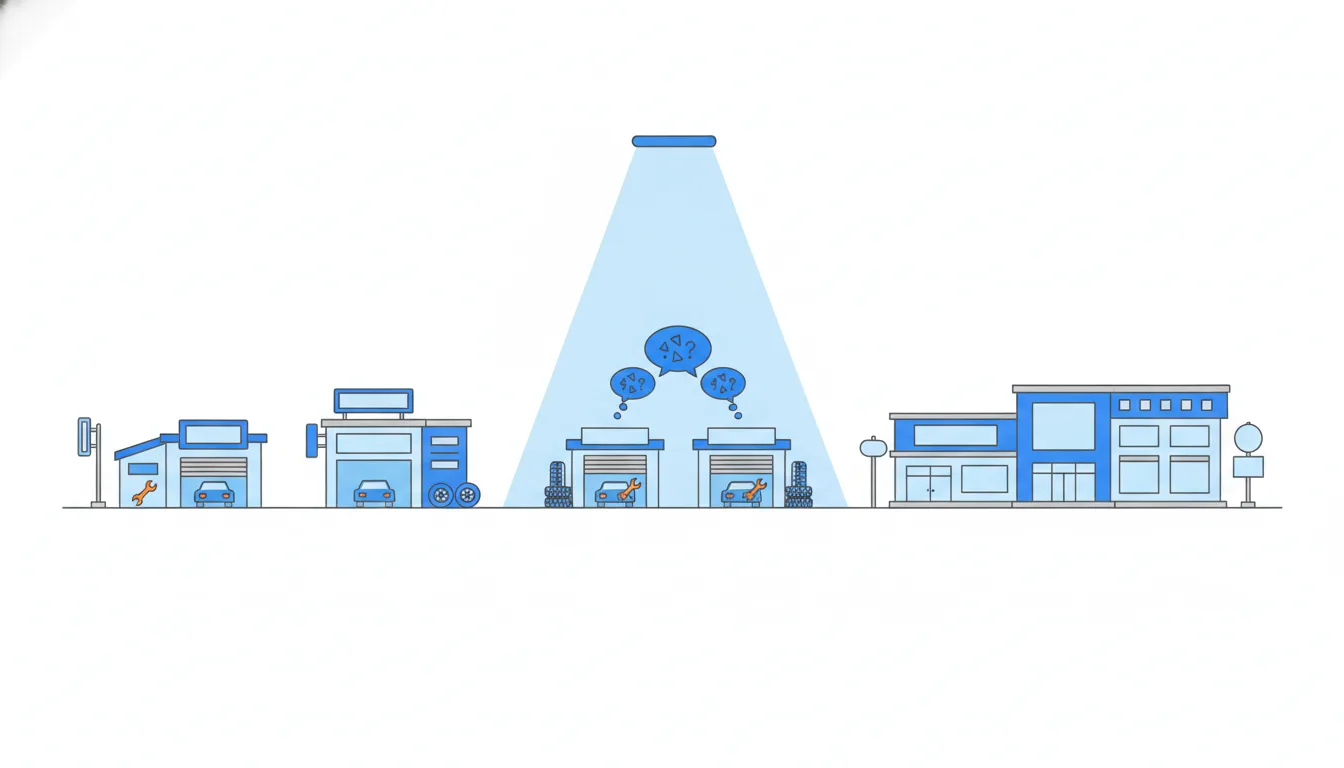
A quick test: can you name ten real businesses that fit? If not, the sentence is too vague or too narrow to act on.
- Do"In: independent repair shops, 2–8 bays, repeat service work. Out: body shops, dealerships, 12+ bay centers, tire shops for now."
- Don't"Small businesses that work with cars."
No conditions to check and no one ruled out.
Testing a shop against the niche sentence
A good niche sentence works like a checklist. GarageDesk's is: independent car repair shops with 2 to 8 bays that do repeat service work. Each part is a condition a shop either meets or doesn't:
- independent: not part of a dealership or a chain with its own systems;
- 2 to 8 bays: big enough to have regulars, small enough to work without roles and per-mechanic reports;
- repeat service work: the same cars come back for oil, brakes and suspension, so there's something to remind about.
A shop is in the niche only if it meets all the conditions. Dennis (4 bays), Greg (6 bays) and Paul (2 bays, where the owner is also the mechanic) all pass. A body shop fails the third condition: it repairs accident damage, not regular service. A dealership service center fails the first.
Notice what the sentence doesn't test: whether the shop pays yet, how friendly the owner is, or how big the deal would be. It describes who shares the problem; buying is a separate question.
- DoPaul's garage: independent ✓, 2 bays ✓, repeat service ✓, so it's in the niche.
- Don't"The body shop pays us, so it's in the niche."
Paying isn't one of the conditions; repeat service work is.
A request from outside the niche
Customers who don't quite fit the niche ask for things that fit them. The 12-bay center wants roles for eight administrators, reports per mechanic and a link to its accounting system. Each request is reasonable for that business. Together they pull GarageDesk toward a different product.
The usual instinct is to treat such requests like any other: put them on the "later" list, maybe raise their priority because the customer is big. That's the mistake. A request belongs on the "later" list when it comes from inside the niche and may repeat there. A request that only makes sense for a business outside the niche is a signal about the niche, not a feature idea.
So the answer is a polite, clear no, and the niche sentence stays as it is. The 12-bay center can keep using what GarageDesk does well, if it wants to. Building roles and accounting links for one customer would slow down the product for the twenty shops it actually fits.
One request isn't proof that the niche should widen. Widening needs evidence and a count, not one large customer.
- Do"Roles for eight administrators are for a different kind of shop. We'll say no and keep building for 2–8 bays."
- Don't"They're our biggest customer, so their roles go to the top of the list."
One outside customer starts steering the whole product.
When to narrow, when to widen
A niche isn't fixed forever. Evidence from customers tells you which way to move.
Narrow when:
- some customers in the group get no result (body shops with nothing to remind about): take that kind of customer out;
- requests pull the product toward a different business (roles and accounting links for a 12-bay center): say no and keep the sentence.
Widen when:
- you've run out of people to talk to: almost every business that fits has heard from you, so add a nearby group;
- the count can't reach your goal: "2–8-bay shops on one street" is easy to serve but too small to live on, so widen until the numbers work.
Two things are not signals: how exciting a new group looks, and how loudly one customer asks. A niche that drifts with every interesting request ends up describing nobody. Narrowing is about results and focus; widening is about room. Both are decided by evidence and by a count.
- Do"Body shops get no result, so we take them out of the sentence."
- Don't"Tire shops look like a fun new market, so let's widen now."
Excitement isn't a signal; running out of people or a short count is.
Go where the niche already talks
A real niche has a gift: its members already gather and talk to each other. For Vinnytsia's shop owners that means:
- parts-supplier counters every morning, while they wait for orders;
- a Telegram group of local mechanics, about 1,200 members;
- the regional auto-service fair, once a year.
These are the cheapest marketing channels a small team will ever have: a notice at the counter, a useful post in the group, a stand at the fair. Nobody outside the niche has to see them, so nothing is wasted on people who will never buy.
The tone matters. The Telegram group's admins ban ads, and members ignore pitches anyway. What gets read is useful and specific: how one shop brought its regulars back, with real numbers.
Compare that with a billboard on the main road or ads aimed at every small business in the region. Both pay to reach thousands of people who aren't in the niche. And a channel aimed at dealerships is aimed at a group the niche sentence already excludes.
- DoA post in the mechanics' group: "How Greg's shop brought back 30 regulars in May", with the numbers.
- Don't"GarageDesk: the best CRM for your shop! 20% off this week!" posted in the same group.
An ad where ads are banned, with nothing useful in it.
Who buys first
Inside the niche, not everyone is equally ready. The fastest buyers are the ones who already pay to solve the problem, in money or in someone's time:
- a shop paying a niece 4,000 UAH a month to call regulars from a notebook;
- an administrator typing Viber messages by hand every evening;
- an owner who has tried stickers and given up.
For them, GarageDesk doesn't create a new expense; it replaces an existing one, and the comparison is easy to make. They already believe the problem is worth money.
Shops that spend nothing, like Paul's for now, have to be convinced the problem matters before they'll compare anything. They may buy later, often after hearing from the first group.
So when choosing whom to approach first, look for signs of existing spending: a person on the phone, a paid tool, a notebook someone maintains. And be honest with customers who pay but don't fit, such as the two body shops: keep them while they want to stay, tell them reminders may bring them little, and stop pitching to body shops.
- DoFirst calls: shops where someone already spends hours or money calling regulars.
- Don'tFirst calls: the shops that seem friendliest, whatever they spend today.
Friendly isn't the same as ready to buy.
In the niche is not the same as buying now
Two questions often get mixed up:
- Is this business in the niche? That's about the problem: does it share the same job, problems and words? The niche sentence answers it.
- Will this business buy now? That's about urgency and money: does it already spend something on the problem?
Paul's 2-bay garage is a clear yes to the first question: independent, 2 bays, repeat service work. But Paul spends nothing on bringing regulars back today, so he's a late buyer, if he buys at all. That doesn't push him out of the niche. It just puts him later in the line.
Who comes first? Shops that already pay to solve the problem, in money or in time: a niece calling regulars from a notebook for 4,000 UAH a month, an administrator typing Viber messages by hand. For them GarageDesk replaces an existing cost, which is the easiest sale there is.
Mixing the two questions leads to both errors: dropping good-fit customers because they're slow, and chasing quick payers who will never get the result.
- Do"Paul is in the niche; he just isn't spending on the problem yet, so he's later in line."
- Don't"Paul hasn't paid, so he's not our niche."
Confuses who shares the problem with who buys first.
Ready to practise?
Answer the lesson's exercises and earn 250 points the first time you finish it.
Start the exercises