

Theory
Customer discovery in a week
A week of customer discovery: a short, planned round of visits and calls, with the rule for dropping a problem written down before the first one, confirms or kills a problem before any code.
~9 min read · 9 exercises · 250 points
Before you start
One week to check the problem
Another session with GarageDesk's founders. Oscar's notebook is filling up with notes from chance conversations, each with different questions, and Nina and Oscar now have three candidate problems. That isn't enough to choose one yet.
In this lesson you'll plan one week of visits and calls to check those problems before any code: whom to talk to, what to ask, and the rule for dropping a problem, written down before the first conversation.
Plan the discovery week before it starts
A handful of chance conversations, each with different questions, can't tell you which problem to build for. Customer discovery works when it's planned as one short round of visits and calls that you can add up at the end.
For GarageDesk's week, 8 to 14 December, the plan has five parts:
- a fixed sample and dates: 14 shops, nine visits on Oscar's route and five calls by Nina;
- a mix of shops: not only friendly regulars, but shops that have never met Oscar;
- the same questions, in the same words, for every shop and every candidate problem;
- no demo, so people describe their day instead of reacting to your idea;
- a written rule for dropping a problem, set before the first visit.
Each part protects the result from a different bias. Fixed questions make answers comparable; a mix of shops keeps friendship out of the numbers; the rule stops the founders from keeping whichever problem they liked.
What breaks a week: changing questions midweek "because the answers look weak". Then the answers can no longer be added up.
- Do“14 shops, 8–14 December, same five questions, rule written on Monday.”
- Don't“Let's start each visit with the demo to get people talking.”
Friendly shops make friendly numbers
The easiest people to talk to are the ones who already know you. For Oscar, that's the regulars on his sales route. They like him, they want to help, and that's exactly the problem: friendly people give kind answers.
Kindness shows up in the numbers in quiet ways:
- they remember problems more readily because they know what Oscar is working on;
- they round their hours up and their "nothing" into "a bit";
- they agree to things they'll never do, to avoid disappointing a friend.
None of this is lying. It's ordinary politeness, and it inflates every count you take from them.
The fix isn't to drop friendly shops; they're fast to reach and honest about facts. It's to mix in shops that have never met you, so you can see whether the picture holds without the friendship. If 5 of 9 friendly shops spend on a problem but only 1 of 5 unknown shops does, that gap is a warning, not a detail.
Write the mix into the plan before the week, the same way you write the rule: deciding afterwards which shops "count" is another way of bending the result.
- Do“Nine shops from my route and five I've never visited.”
- Don't“My regulars know the trade best, so let's only ask them.”
Write the rule that kills a problem first
By Friday of a discovery week, every founder can find a reason to keep the problem they already liked. The protection is to write down, before the first visit, the rule that drops a problem, with the date.

A good rule is about spending, not mentions, because mentions are cheap: "a problem stays only if at least a quarter of the shops already spend money or regular hours on it."
Turning "at least a share" into a number of shops takes two steps:
- multiply: shops in the sample × the share. For 14 shops and a quarter: 14 ÷ 4 = 3.5;
- round up, because "at least" means the result must reach the share. 3 shops would be 3 ÷ 14 = 21%, below a quarter, so the rule needs 4.
For a sample of 10 shops: 10 ÷ 4 = 2.5, so 3 (2 shops would be only 20%).
Rounding to the nearest number feels natural but quietly lowers the bar. With "at least", any fraction means one more shop.
- Do10 ÷ 4 = 2.5 → at least 3 spending shops (30%).
- Don't10 ÷ 4 = 2.5 → 2 shops is close enough.
2 of 10 is 20%, below the quarter the rule asks for.
Same questions, no demo
During a discovery week, every shop gets the same questions, in the same words, about every candidate problem. Otherwise "mentioned" in one shop and "mentioned" in another mean different things, and the tally on Sunday adds up apples and oranges.
A simple structure:
- Start open: "What took the most time last week?" Whatever they name first, unprompted, is a strong signal.
- Then, for each candidate problem, ask about the last time: what happened, who dealt with it, how long it took, what it cost.
- Record two columns per problem: mentioned, and already spends (money or regular hours).
Two things to leave out:
- No demo. The moment you show a screen, people start reacting to your idea ("nice colors", "could it also…") instead of describing their day.
- No questions about your product. "Would an app for bookings be useful?" invites a polite yes and tells you nothing about spending.
Re-ask the shops you talked to before, like Dennis and Paul, with the same questions, so their answers count the same as everyone's.
- Do“What took the most time last week?”
- Don't“Would an app that handles your bookings be useful to you?”
The discovery week, step by step
The order of the week is what keeps it honest. Each step fixes something before the results can push on it:
- List the candidate problems. For GarageDesk: A, phone chaos with bookings; B, regulars who forget their next service; C, repair history on paper.
- Write the rule for dropping a problem, with the date, before any conversation. It can't be bent by results that don't exist yet.
- Fix the list of shops and the questions. Same sample, same words for everyone.
- Visit and call the shops, filling in the sheet as you go: one row per shop, two columns per problem.
- Count "mentioned" and "already spends" for each problem, after all the visits, not after the first few exciting ones.
- Apply the rule. The rule decides, not the mood on Sunday night.
The two places where weeks usually go wrong are swapping steps 2 and 5 (inventing the rule after seeing the counts) and stopping early because the first three shops were enthusiastic.
- DoProblems → rule → shops and questions → visits → count → apply the rule.
- Don't“Let's count first and then decide what threshold makes sense.”
Mentions are cheap; look at the share that spends
On Sunday night the biggest number in the sheet is usually "mentioned", and it's tempting to pick that problem. But mentions only tell you how many people talked about something. The useful number is the share of mentioners who already spend on it:

share that spends = shops that already spend ÷ shops that mentioned it × 100%
GarageDesk's week:
- A, phone chaos: mentioned by 11 of 14, spending in 4. 4 ÷ 11 = 36.4%.
- B, lost regulars: mentioned by 9, spending in 6. 6 ÷ 9 = 66.7%.
- C, paper history: mentioned by 7, spending in 1. 1 ÷ 7 = 14.3%.
A is the loudest, but only about one in three shops that have it do anything about it. B is mentioned less often, but two out of three shops that have it already pay in money or hours, nearly twice A's share.
Divide by the shops that mentioned the problem, not by all 14: you're asking "of those who have it, how many pay?" Dividing by 14 answers a different question.
- DoA: 4 ÷ 11 = 36.4%; B: 6 ÷ 9 = 66.7%.
- Don'tA: 4 ÷ 14 = 28.6%.
Divides by all shops, not by the shops that mentioned A.
The same ratio for every problem
A fair comparison uses one calculation for every candidate problem. Doing it carefully for the problem you like and roughly for the others is how a favorite sneaks through.
For each problem:
- take the "already spends" count;
- divide by the "mentioned" count for that problem;
- multiply by 100 and round to one decimal place.
For C, paper repair history: 7 shops mentioned it and 1 already spends on it. 1 ÷ 7 = 0.1429, so 14.3%.
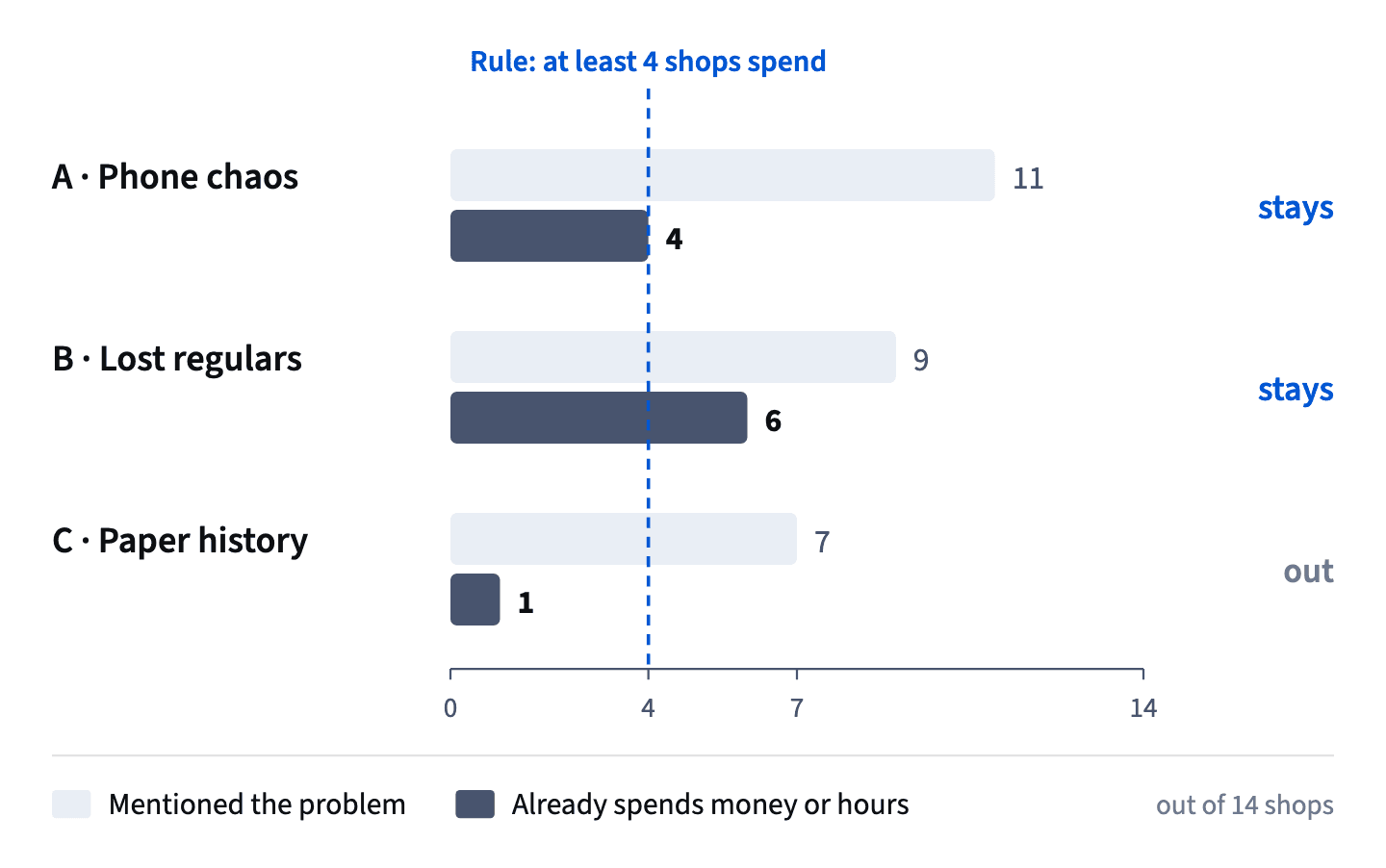
Put the three results side by side: A 36.4%, B 66.7%, C 14.3%. Now the picture is clear at a glance: C is mentioned by half the shops but almost nobody does anything about it. It's a real annoyance, not a budget.
Two slips to avoid: dividing by the whole sample of 14 (that gives 7.1% and answers a different question) and flipping the fraction (7 ÷ 1 = 700% is a sign something went wrong). A share of mentioners can never be more than 100%.
- DoC: 1 ÷ 7 = 14.3%.
- Don'tC: 1 ÷ 14 = 7.1%.
Divides by the whole sample instead of the 7 shops that mentioned C.
Apply the rule as written
The rule written on Monday does its job only if it's applied on Sunday exactly as written, even when the result is disappointing.
GarageDesk's rule: a problem stays if at least a quarter of the 14 shops already spend on it, so at least 4. The counts: A 4, B 6, C 1. A and B stay; C drops out.
Picture: The “already spends” column decides. · shown above
The same counts give a different result under a different rule, which is why the rule must be fixed first. With "at least a third": 14 ÷ 3 = 4.67, rounded up to 5 spending shops. Then only B (6) passes; A (4) is one shop short and drops out with C.
Watch for the ways a rule gets bent after the fact:
- lowering the bar for a favorite ("4 is basically 5");
- switching the measure to mentions ("but 11 shops talked about A!");
- adding exceptions ("Dennis didn't count because he's a friend").
If the rule turns out to be badly chosen, change it for next week's check, in writing, before the visits. Never for the week you've just counted.
- Do“At least a third: 14 ÷ 3 = 4.67 → 5. Only B passes.”
- Don't“A has 4, that's basically 5, so let's keep it.”
Ready to practise?
Answer the lesson's exercises and earn 250 points the first time you finish it.
Start the exercises