

Theory
Market expansion: another city or another kind of shop?
A module case on market expansion: compare a new city with the same product and a new kind of customer at home on the same numbers, place both in the Ansoff matrix, and choose one.
~9 min read · 10 exercises · 250 points
Before you start
Another city or another kind of shop?
Vinnytsia alone has only a few dozen shops that fit GarageDesk, and the founders want to know where to grow next. Oscar suggests a nearby city with the same kind of shops; Nina suggests tire shops right at home, where there are more of them and no travel.
This case closes the module. You'll compare both options on the same numbers, place them on a simple growth map, and choose one.
Ceilings on the same numbers
When you compare two directions for growth, put both through the same calculation. The first step is the ceiling: count × monthly price.
GarageDesk's two options:
- Khmelnytskyi: about 150 fitting shops, the same 600 UAH a month: 150 × 600 = 90,000 UAH a month.
- Tire shops in Vinnytsia: about 230 shops, but they see customers only twice a year (spring and autumn), so they'd pay about 300 UAH a month: 230 × 300 = 69,000 UAH a month.
The option with more businesses has the lower ceiling, because each one pays half. That's why the count alone is never the answer.
The price isn't a detail you can fix later, either. It follows from the value: a shop that sends two reminders a year gets less from GarageDesk than one whose regulars come back every six months, and it will pay accordingly. Use the price customers in that segment actually told you, not the price you'd like them to pay.
- Do230 × 300 = 69,000 UAH a month for tire shops vs 150 × 600 = 90,000 for Khmelnytskyi.
- Don't230 × 600 = 138,000 UAH a month for tire shops.
Uses the repair shops' price for customers who said they'd pay half.
A realistic share for one new city
Before adding a new city to the total, look at it on its own. It tells you how much a new market adds and how long it might take to matter.
Khmelnytskyi has about 150 fitting shops at 600 UAH a month:
- ceiling: 150 × 600 = 90,000 UAH a month;
- at one in four: 150 × 0.25 = 37.5, about 37 shops;
- revenue at that share: 90,000 × 0.25 = 22,500 UAH a month.
On its own that's well short of the 50,000 goal; Vinnytsia at the same share gives about 28,500. The two together reach the goal; neither does alone.
Two slips are common here. One is to treat the ceiling (90,000) as what the city will bring, as if every shop signed. The other is to compare the new city's share with the whole goal and conclude it's useless. A new city isn't meant to carry the goal alone; it's meant to add enough room so that Vinnytsia plus the new city can.
- Do90,000 × 0.25 = 22,500 UAH a month from Khmelnytskyi at one in four.
- Don't"Khmelnytskyi brings 90,000 a month."
That's the ceiling, every shop paying; not a realistic share.
Does the option reach the goal?
A ceiling says what's possible; the goal needs a realistic share. Apply the same share to every option, and add what you already have.
GarageDesk's working goal is 84 paying shops (about 50,000 UAH a month). Oscar calls one in four fitting shops realistic.
Vinnytsia + Khmelnytskyi, same product, same price: (190 + 150) × 0.25 = 340 × 0.25 = 85 shops ≥ 84. The goal fits, just.
Vinnytsia + tire shops, two different prices, so add money, not shops:
- Vinnytsia: 190 × 0.25 = 47.5 shops × 600 = 28,500 UAH;
- tire shops: 230 × 0.25 = 57.5 shops × 300 = 17,250 UAH;
- total 45,750 UAH a month, below 50,000.
The second option has more shops in total (about 105) and still misses the goal, because half of them pay half. When prices differ, compare in money. Counting shops would hide exactly the difference that decides the question.
- Do(190 + 150) × 0.25 = 85 ≥ 84: the goal fits.
- Don't(190 + 230) × 0.25 = 105 shops ≥ 84, so tire shops work too.
Adds shops that pay 300 to shops that pay 600 as if they were equal.
A new kind of customer means a new product
Serving a new kind of customer is rarely "the same product, more customers". List what would have to change, and the list is usually long. For tire shops:
- product logic: seasonal reminders twice a year instead of date and mileage; in peak weeks they work with a live queue, so "come back for your service" means something else;
- price: a second, cheaper plan at about 300 UAH a month;
- channels: tire shops buy from tire wholesalers and never come to the parts counters where GarageDesk is known;
- language: a new niche sentence and new words in every message.
Each item is time taken from the 22 shops that pay now. And at the end, the new segment still wouldn't close the gap to the goal.
The alternative, Khmelnytskyi, changes none of these. Its cost is different in kind: Oscar's Saturdays and some fuel, travel rather than a second product. When comparing options, put this list next to the numbers: effort counts as much as the ceiling.
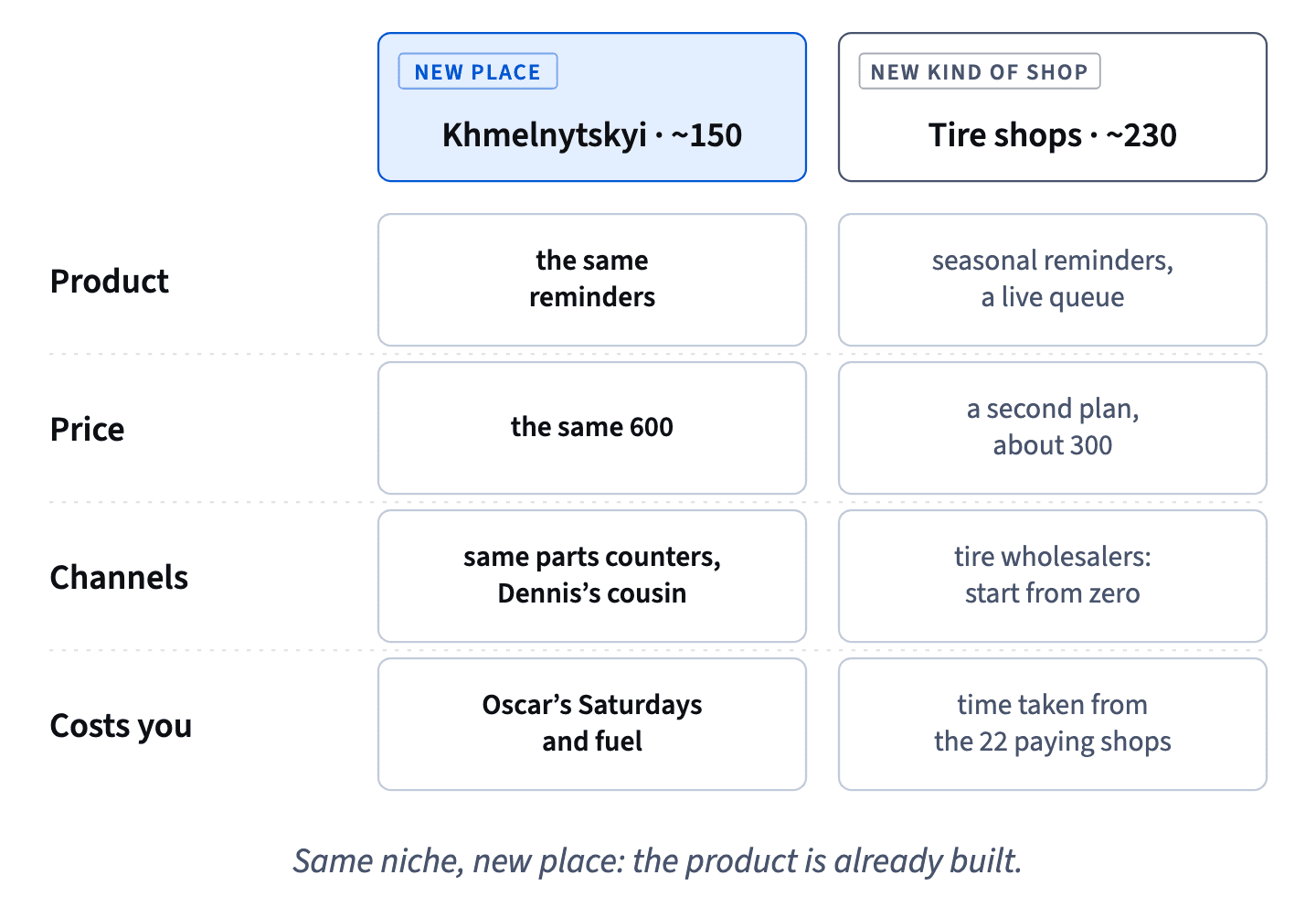
- DoTire shops: seasonal logic, a 300 UAH plan, wholesaler channels, new words. Khmelnytskyi: travel.
- Don't"Tire shops are just more shops; we'll use the same reminders."
Mileage reminders mean nothing to a business that sees customers twice a year.
The Ansoff matrix: four ways to grow
Both of GarageDesk's ideas are market expansion: growing past the customers you have. The Ansoff matrix sorts ways to grow by two questions: is the product existing or new, and is the market existing or new?
- Market penetration (existing product, existing market): more repair shops in Vinnytsia.
- Market development (existing product, new market): Khmelnytskyi. Same reminders, same 600 UAH, a new place. This is a geographic expansion.
- Product development (new product, existing market): a new feature for the same repair shops, such as booking.
- Diversification (new product, new market): the riskiest corner, because nothing is proven on either side.
Tire shops look like "just a new market", but they need seasonal logic, a second plan and new channels, so the idea drifts toward diversification.
The matrix doesn't decide for you. It names what the counting already showed: the less you change at once, the less can go wrong, and the more of what already works you get to reuse.
- DoKhmelnytskyi = same product, new market = market development.
- Don't"Khmelnytskyi is diversification: everything there is new to us."
The city is new; the product isn't.
Entering a new city through the niche
A new city with the same niche has one big advantage over a new kind of customer: the niche already talks to itself across cities. Repair shops in Khmelnytskyi buy from the same parts distributors, gather at the same kind of counters and have their own mechanics' group. Some even have family in Vinnytsia: Dennis's cousin runs a shop there.

So enter where they already gather, and let existing customers open doors:
- introductions: Dennis tells his cousin how reminders work in his shop;
- the distributors' counters: a notice or a short demo where owners wait every morning;
- the local group: no ads (the admins ban them), but a useful post with real Vinnytsia numbers and an offer to show it to anyone who asks.
One local shop that visibly brings cars back is worth more than any ad, because the next owner can call it and ask. Paid ads aimed at all Khmelnytskyi businesses do the opposite: they cost money, reach mostly people outside the niche and carry no trust.
- DoDennis introduces his cousin; Oscar shows GarageDesk at the distributors' counters on Saturday mornings.
- Don'tPaid ads aimed at every small business in Khmelnytskyi.
Pays to reach strangers outside the niche, with no trust attached.
Count alone misleads
"230 is more than 150" is the most natural first reaction, and the most common mistake in choosing where to grow. The count is only the first factor of several:
- count of businesses that could use the product;
- price each would pay: 300 for tire shops, 600 for repair shops;
- ceiling = count × price: 69,000 vs 90,000 UAH a month;
- realistic share and whether the goal fits: tire shops with Vinnytsia reach about 45,750 UAH a month, Khmelnytskyi with Vinnytsia reaches 85 shops;
- effort: what the product, the channels and the team would have to become.
On every line after the first, tire shops lose: lower price, lower ceiling, a goal that doesn't fit, and a second product to build. Khmelnytskyi reuses the product, the price and the distributors who already deliver there.
The habit to build is to never decide from a single number. Write every option through the same five lines, side by side, and only then choose.
- DoCount, price, ceiling, realistic share vs goal, effort: both options, side by side.
- Don't"230 tire shops beat 150 shops in Khmelnytskyi. Decided."
One number, four factors ignored.
Decide with a checkpoint, name the signal to revisit
A growth decision isn't final just because the numbers favour it today. The numbers are estimates: 150 fitting shops in Khmelnytskyi, one in four realistic, Oscar's 12 hours a week. Any of them can turn out wrong.
So make the decision the way the founders made their earlier ones: with a checkpoint written in advance. Nina's June checkpoint did exactly that. The rule was set before the result was known (if paying shops aren't growing by month 7, Nina takes more freelance work while money is left), and when June came it simply said "continue".
For Khmelnytskyi, write down:
- what you expect and by when, for example a first few paying shops there by autumn;
- the signal that makes you revisit, for example no paying shop after three months of Saturdays, or Oscar's hours crowding out the 22 Vinnytsia shops;
- the limit on effort: about 12 hours a week of Oscar's time until GarageDesk reaches 30 paying shops.
A rule written before the result is hard to argue with afterwards. A rule invented after a disappointing month usually says whatever you hoped.
- Do"Khmelnytskyi from July. If no shop there pays by October, we revisit."
- Don't"The numbers say Khmelnytskyi, so we're committed, whatever happens."
Estimates treated as facts, with no way to notice they were wrong.
Ready to practise?
Answer the lesson's exercises and earn 250 points the first time you finish it.
Start the exercises