

Theory
A yearly plan from day one
Monthly and yearly plans side by side: the discount, the cash up front, how a yearly customer counts in monthly revenue, and what it does to the runway.
~9 min read · 9 exercises · 250 points
Before you start
Why offer a year?
Still on pricing with GarageDesk's founders. Today's idea is a yearly plan, offered from day one, before the product even exists. Monthly would be simpler, so why bother?
In this lesson you'll put monthly and yearly plans side by side: what discount makes sense, what the cash up front does to the runway, and how a yearly customer counts in monthly revenue.
Why offer a yearly plan from day one
Monthly payment stays the default for a small subscription product. An annual plan next to it earns its place for three reasons:
- Cash now. A year paid up front lands in the bank on day one and extends the founders' runway.
- A stronger signal. A shop that pays a year ahead is betting that GarageDesk will still be around and useful in twelve months. That's a louder yes than paying for one month.
- Fewer moments to leave. A monthly shop decides twelve times a year whether to stay. A yearly shop decides once.
Two things a yearly plan does not do:
- it doesn't make the month it arrives a record month. The payment covers twelve months of service, so in the monthly numbers it's spread across the year;
- it doesn't lower the bar for the product. A shop that paid for a year expects reminders that work every month of it, and will remember at renewal time if they didn't.
The yearly plan is an option to make visible, not a demand. Owners who dislike paying a year for anything need a smaller way in.
- Do“Yearly gives us cash now, a stronger yes and one renewal decision instead of twelve.”
- Don't“Two yearly payments in January will make it our best month ever.”
The math of a yearly discount
To see what a yearly plan really offers, compare it with paying monthly for twelve months:
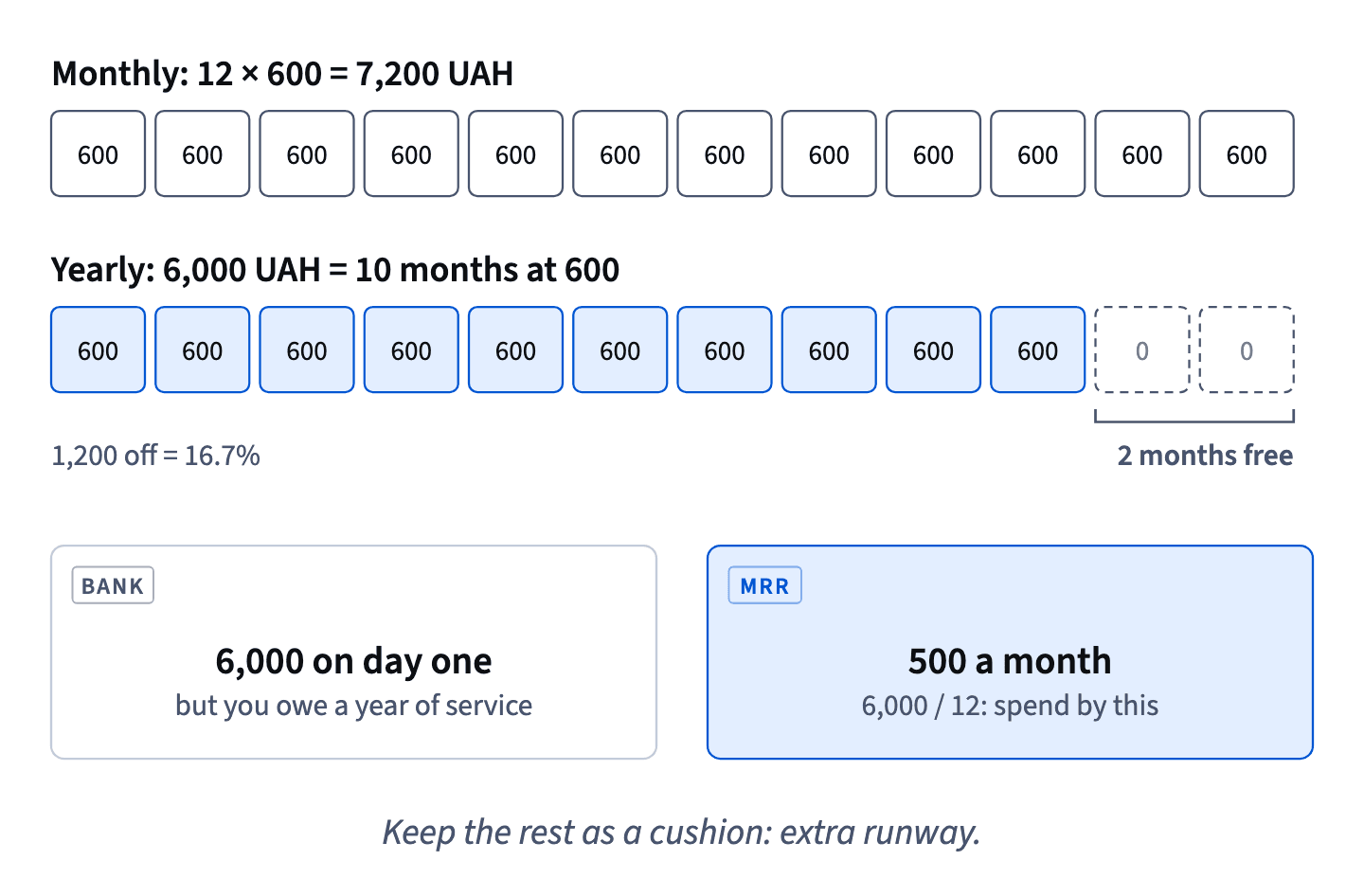
- Full year at the monthly price: 12 × 600 = 7,200 UAH.
- Saving: 7,200 − 6,000 = 1,200 UAH.
- Discount: saving ÷ full year = 1,200 ÷ 7,200 = 0.167, so 16.7%.
The same saving can be said in months: 6,000 ÷ 600 = 10, so the year costs ten monthly payments, two months free. "Two months free" is much easier to say at a counter than "16.7%", and it's exactly the same deal.
If the year were priced at 6,600 instead: saving 7,200 − 6,600 = 600, discount 600 ÷ 7,200 = 8.3%, or one month free.
The typical slip is dividing by the wrong number. The discount is the saving divided by the full price (7,200), not by the discounted price (6,000): 1,200 ÷ 6,000 = 20% overstates it. Always check by working back: 7,200 × (1 − 0.167) ≈ 6,000.
- Do(7,200 − 6,600) ÷ 7,200 = 8.3%, one month free.
- Don't(7,200 − 6,600) ÷ 6,600 = 9.1%.
Divides by the discounted price instead of the full year at 7,200.
How big should the yearly discount be?
A bigger discount would attract more yearly shops, so why not offer one? Because every hryvnia of discount is revenue you never see, for a whole year per shop.
The size of the discount is a trade-off:
- too small, such as 2% or 3%, and nobody bothers: the saving doesn't outweigh paying a year in advance for something new;
- too big, such as 40% off, and you've cut your price for twelve months for every shop that takes it, often including shops that would happily have paid monthly at full price;
- in between, around one or two months free, the saving is easy to understand and still worth the shop's commitment.
What the discount buys is concrete: cash up front, a year of certainty and one renewal decision instead of twelve. A discount bigger than those are worth to GarageDesk is a gift, not a trade.
Two months free is a common middle, not a law. The right size is the one where the shop feels a real saving and the founders still earn a fair price for the year.
- Do“Two months free: a clear saving for the shop, a fair price for us.”
- Don't“Let's offer 50% off the year so every shop takes it.”
Cash in the bank is not this month's income
When two shops pay 6,000 UAH each for a year, the bank account shows 12,000 UAH on day one. It's tempting to treat that as a 12,000 month. It isn't: GarageDesk owes those shops a year of service.
Two numbers are true at the same time:
- cash: 12,000 UAH arrived now;
- monthly revenue: each yearly shop counts as 6,000 ÷ 12 = 500 UAH a month, so the two together are 1,000 UAH a month.
The rule that keeps founders out of trouble: spend by the monthly number, and keep the rest as a cushion. The cushion is extra runway, and it's also what lets GarageDesk keep serving those shops if new revenue comes slower than hoped.
Spending by the bank balance looks fine for a month or two. Then the yearly money is gone, the shops still need eleven months of reminders, and the next month's income is only the 1,000 UAH the plan really brings.
The same logic shows up later in the course as monthly recurring revenue: a yearly payment is spread across its twelve months.
- Do“The bank says 12,000, the monthly numbers say 1,000. We spend by 1,000.”
- Don't“We had a 12,000 month, so let's hire a part-time support person.”
Yearly cash as a cushion, in months
Cash from yearly plans is easiest to understand when you turn it into months of a cost it can cover:
months covered = cash received ÷ monthly cost
For GarageDesk, hosting and tools cost 2,000 UAH a month.
- Two yearly shops: 2 × 6,000 = 12,000 UAH, so 12,000 ÷ 2,000 = 6 months of tools.
- Three yearly shops: 3 × 6,000 = 18,000 UAH, so 18,000 ÷ 2,000 = 9 months. Check: 9 × 2,000 = 18,000.
That's a real cushion: the product's own running costs are paid for most of a year before anything else happens. It's extra runway for the founders, too, because those 2,000 a month no longer come out of savings.
Keep in mind what the cushion is not. It isn't income for the month it arrives, and it isn't free money: the shops are owed a year of service. Treat it like the reserve in a personal runway, something that keeps the company steady, not something to spend the moment it appears.
- Do3 × 6,000 = 18,000; 18,000 ÷ 2,000 = 9 months of tools.
- Don't6,000 ÷ 2,000 = 3 months.
Counts one shop's payment instead of all three.
Monthly recurring revenue with mixed plans
When some shops pay monthly and others yearly, add them up on the same basis: what each shop brings per month.
- A monthly shop: 600 UAH a month.
- A yearly shop: 6,000 ÷ 12 = 500 UAH a month.
Then:
MRR = monthly shops × 600 + yearly shops × 500
MRR, monthly recurring revenue, is the steady income the business can count on each month. For 6 monthly shops and 2 yearly ones: 6 × 600 = 3,600, plus 2 × 500 = 1,000, so 4,600 UAH a month.
The yearly shops look a little smaller in that sum, 100 UAH a month each. That's the discount, and it's the price GarageDesk pays for a year of certainty and the cash up front.
The common mistake is adding the yearly cash straight in: 3,600 + 12,000 = 15,600 makes one month look more than three times bigger than the real 4,600. Another is counting a yearly shop at 600 as if there were no discount, which overstates MRR by 100 per yearly shop.
- Do6 × 600 + 2 × (6,000 ÷ 12) = 3,600 + 1,000 = 4,600 UAH.
- Don't6 × 600 + 2 × 6,000 = 15,600 UAH a month.
Puts a whole year of cash into one month.
A smaller way in: three months
Some owners hate paying a year for anything, especially for a product that doesn't exist yet. Pushing them toward the year turns a curious shop into a refusal. So the pre-sale page offers a smaller option next to it: three months for 1,800 UAH.
Why three months and not one?
- One month is too short to see the result. A reminder goes out, the car owner books, the car comes in: that can easily take more than a month. A shop that paid for one month may leave before the first regular returns.
- One month is too weak a commitment. At 600 UAH it's barely a test; three months is a real decision, but still a small one for an unsure owner.
The three-month option isn't there to push anyone toward the year. Its job is to let a hesitant shop say yes to something meaningful. Make the year visible, explain the saving honestly and let the owner choose.
What the shorter option does not do: bring in more cash than a year (1,800 is less than 6,000), or replace monthly billing after launch. It's a way in for the pre-sale.
- Do“Not ready for a year? Three months for 1,800 is enough to see regulars come back.”
- Don't“It's the year or nothing.”
The discount belongs to the longer commitment
Once there's a yearly discount, it's tempting to sweeten the three-month option too, say 1,600 instead of 1,800. Don't. The discount belongs only to the longer commitment.
Here's why:
- The year stops being special. If three months also come with a discount, the reason to commit for twelve shrinks, and fewer shops choose the option that brings the most cash and certainty.
- It's a discount without a trade. The yearly discount buys something real: a year paid up front and one renewal decision. Three months at full price is already a small, fair step; a discount on it buys almost nothing.
- It muddies the monthly price. 1,800 is exactly 3 × 600, so the three-month option confirms the monthly price. 1,600 would quietly make the "real" monthly price 533 UAH.
The structure stays simple: monthly at 600, three months at exactly 3 × 600 = 1,800 for the pre-sale, and the year at 6,000 with two months free. Each step up in commitment is the only thing that lowers the price.
- DoThree months = 3 × 600 = 1,800; only the year gets two months free.
- Don't“Three months for 1,600, to make it more attractive.”
Ready to practise?
Answer the lesson's exercises and earn 250 points the first time you finish it.
Start the exercises